

Your account has 47 campaigns and the account is not volatile because of the market. It is volatile because 47 campaigns are splitting the same conversion pool into 47 thin streams, and Smart Bidding is running on statistical approximation instead of real signal. The structure that made sense in 2019, when you were adjusting bids line by line, is the structure that is now capping what the algorithm can do in 2026.
The fix is not “delete all the campaigns.” It is a specific test that separates the splits that are strategic from the splits that are legacy control habits, and a data floor that tells you when a campaign is too thin to optimize. The floor is 30 conversions per month at the campaign level. Below it, the algorithm cannot evaluate the contextual signals, device, location, time, and intent, that make Smart Bidding worth using in the first place. That is the number this article is about, and the test around it is the part most PPC accounts have never actually run.
The Problem: What SKAGs Were Built For No Longer Exists
Single Keyword Ad Groups were a manual-bidding tool. The structure existed because a human was adjusting the bid on each keyword row, and the ad group was the unit of control. Split device, split match type, split geographic radius: each split was a place the human could make a specific bid decision. The structure was the interface between the human and the auction.
That interface is gone. Smart Bidding, tROAS, tCPA, and the campaign-level automation that came after them removed the human bid row. The algorithm now decides the auction price, the ad rotation, and the keyword expansion. What the algorithm needs to do that well is conversion volume, data velocity, and signal flexibility across the account. What the account that was built for manual control gives it is the opposite: dozens of thin campaigns, each with too little data to stabilize, each stuck in learning, each reporting a CAC that bounces because the denominator is small.
The symptoms are the ones you already recognize. Perpetual learning phase. Campaigns that cannot scale past a certain spend because the algorithm has not enough data to know what to do with more. CAC that is volatile week to week, not because the market moved, but because the account structure is below the data floor where optimization stops being real. The fix is consolidation, and the consolidation is a decision you can make in an afternoon with two numbers in front of you.
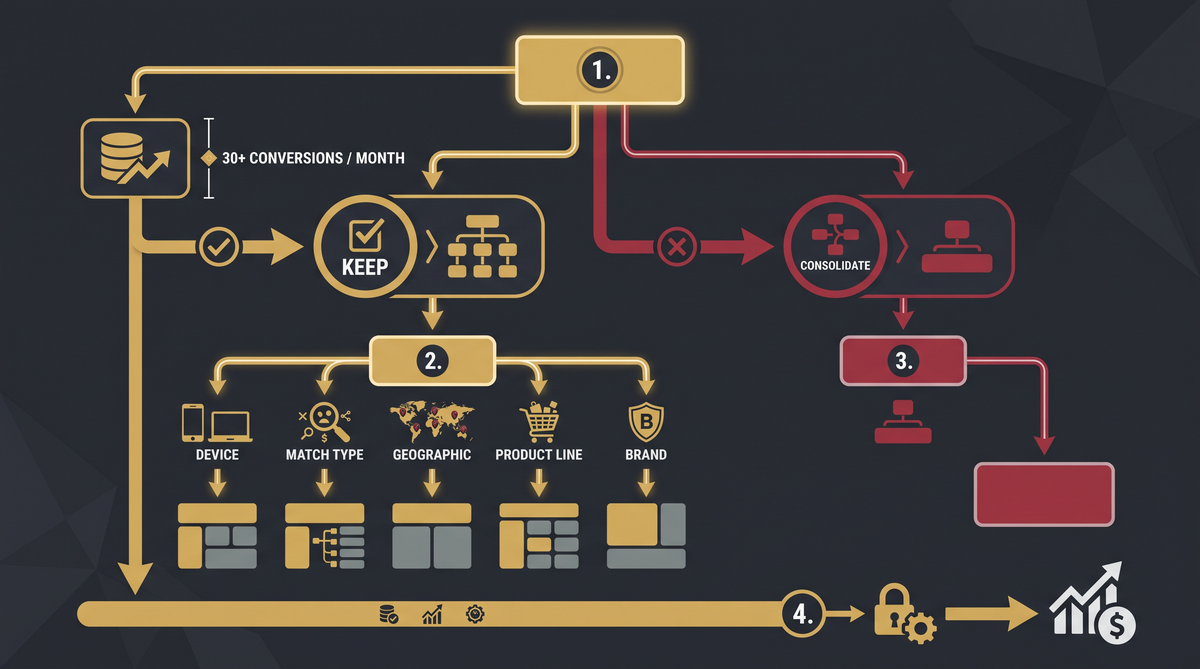
The 30-Conversion Rule
The rule is simple and it is the number that decides everything else. A campaign needs at least 30 conversions per month at the campaign level for Smart Bidding to accurately evaluate the contextual signals that make it worth using. Device. Location. Time. Intent. The algorithm needs volume in each of those dimensions to learn. Below 30 a month, it does not learn. It approximates. And an approximation running at $5,000 a month in spend is a different cost than an approximation running at $500 a month.
30/mo
The minimum conversion volume a campaign needs per month for Smart Bidding to run on real signal. Below that floor, the algorithm operates on statistical approximation and the CAC volatility you are seeing is the structure, not the market.
The practical application is to run the number across the account. List every campaign. Pull the last 90 days of conversions. Divide by 3. Any campaign under 30 a month is below the floor. In a typical mid-size PPC account, that is not two campaigns. That is often 20 or 30 of them. The account is not “a little fragmented.” It is fragmented by a factor the structure was never designed to survive, because the structure predates the automation that now consumes it.
The Keep-Or-Consolidate Test
Consolidation is not “flatten the account into one campaign.” That goes too far. Merging high-margin and low-margin products into a single target forces the algorithm toward an average that underserves the top-performing inventory. Collapsing brand and non-brand keywords into the same campaign muddies intent signals that predict vastly different conversion behaviors. The test that separates the two is one question:
If splitting the campaign changes your underlying business strategy, your budget allocation, or your creative experience, keep it separate. If it only changes how identical customer journeys are labeled in your reports, consolidate.
That is the entire decision. Run it against every split in the account. The device split: does the creative and the budget differ by device? If the answer is no, and the only reason the split exists is that the 2019 manual bidder wanted a separate bid row for mobile, consolidate. The match-type split: does exact, phrase, and broad get different landing pages, different budgets, different bids? If not, they are the same customer journey with three labels. Consolidate. The geographic split: are you running a different offer in the 5-mile radius than in the 50-mile radius? If not, the radius split is a reporting label. Consolidate.
The splits that survive the test are the ones that reflect a real business difference. A high-margin product line and a low-margin product line, with different tROAS targets and different budgets. A brand campaign and a non-brand campaign, with fundamentally different intent and different creative. A B2B campaign and a B2C campaign, with different sales cycles and different close rates. Those are the structural boundaries the account is built around. Everything else is legacy, and everything else is what the algorithm is fighting through right now.
| Split type | Keep if | Consolidate if |
|---|---|---|
| Device | Different creative or budget by device | Same journey, different report label |
| Match type | Different landing page, budget, or tROAS | Same page, same offer, three labels |
| Geographic | Different offer or budget by region | Radius split with no business difference |
| Product line | Different margins and tROAS targets | Same margin profile, arbitrary split |
| Brand vs. non-brand | Always keep. Intent is fundamentally different. | Never consolidate. Muddies the signal. |
The 30-Day Transition Protocol
Consolidating a campaign is not a delete-and-recreate. The signal history is part of the value, and the transition is done in a specific order to preserve it.
Week 1: Map the consolidation targets
Run the keep-or-consolidate test across every campaign. Mark the ones that are below the 30-conversion floor and the ones that are consolidations of the same customer journey. Build the target structure: the campaigns that survive, and which legacy campaigns feed into them. Write it down before touching the account. The target structure is the artifact that gets signed off, and the 30-day protocol runs against it.
Week 2: Pause the redundant campaigns, do not delete
Pause the legacy campaigns that are being consolidated. Do not delete them. The pause preserves the signal history in the account, and the pause means the spend moves to the surviving campaign immediately. The surviving campaign, now with the consolidated conversion volume, should start climbing toward the 30-conversion floor within the first two weeks. Watch the learning phase indicator on the surviving campaign. If it exits learning within 14 days of the consolidation, the structure is working.
Week 3: Verify the data floor and the CAC
Pull the surviving campaigns’ conversion counts. They should be at or above 30 a month by the end of week 3, and the CAC should be stabilizing, not bouncing. The stabilization is the signal that the algorithm has moved from approximation to optimization. If a surviving campaign is still below the floor, it means the consolidation did not go far enough, and the legacy campaign that was supposed to feed it was not actually the same customer journey. Re-run the test on that pair.
Week 4: Delete the paused campaigns and lock the structure
Delete the paused legacy campaigns now that their signal history has been absorbed. Lock the target structure in the account documentation. The structure is now the baseline, and the next quarterly review runs the keep-or-consolidate test against it. The 30-day protocol is not a one-time migration. It is the first iteration of a standing practice, because the account will drift back toward fragmentation as the next campaign split gets added for a reporting reason that is not a business reason.
The structure is the interface. The 2019 interface was the human bid row. The 2026 interface is the conversion volume the algorithm feeds on. Consolidation is not deleting campaigns. It is rebuilding the interface for the system that is actually running the account now.
What The Consolidated Account Looks Like After The 30 Days
The end state of the 30-day protocol is worth describing explicitly, because the client’s mental model of the account is usually still the pre-consolidation one, and the gap between the two is where the next quarter of decisions gets made.
After the transition, the account has a small number of campaigns, each one above the 30-conversion floor, each one structured around a real business difference. The brand campaign. The non-brand campaign. The high-margin product line. The low-margin product line. Each one has its own tROAS target, its own budget, and its own creative. The learning phase indicator on each campaign is stable, not cycling. The CAC on each campaign has a flat line instead of a bounce, because the denominator is now large enough for the algorithm to actually optimize.
The report that comes out of that structure is different in a specific way. The pre-consolidation report is 47 campaign rows, most of them small, most of them volatile, and the account owner has to average them to get a number. The post-consolidation report is 8 campaign rows, each one a real business unit, and the number on each row is a number the client can make a decision on. The consolidation did not just stabilize the CAC. It made the report readable, which is the thing the client has actually been complaining about for a year without naming it.
There is one more end-state detail that matters for the next review. The quarterly re-run of the keep-or-consolidate test now runs against the new structure, not the old one. The new product line that gets added in Q2 starts at zero conversions and sits below the floor for two quarters. The test catches it at the first quarterly review, and the answer is the same one that started this whole process: does the new line have a different strategy, budget, or creative? If yes, it is its own campaign and it gets the 30-day transition run on it. If no, it is folded into the existing structure and the volume is where the algorithm needs it. The structure that survived the first consolidation is the template the next one runs against, and the template is the artifact that makes the second consolidation faster than the first.
What AI Max Changes About The Whole Question
The expansion of features like AI Max accelerates the consolidation transition. Broader keyword matching, auto-generated text variations, and campaign-level automation remove the operational burden that SKAGs and match-type splits used to fill. The splits existed because the human needed the control. The automation does not need the control. It needs the volume.
The advertisers who benefit most from that automation are the ones who consolidate the signal base, align conversion tracking with revenue outcomes, and reserve campaign segmentation for true strategic boundaries. The account that is already structured around business differences, with the volume where the algorithm needs it, gets the full benefit of AI Max. The account that is still structured around 2019 manual control habits gets the automation running on the same thin data it has always been running on, which is the worst possible version of the feature. The automation amplifies the structure. The structure is the decision.
Common Mistakes When Consolidating
Deleting instead of pausing in week 2. The delete loses the signal history that the surviving campaign is supposed to absorb. Pause first. Delete in week 4, after the surviving campaign has climbed and the learning phase has exited.
Consolidating across margin lines. The keep-or-consolidate test exists to stop this. A high-margin and a low-margin product line are two different businesses. Merging them into one tROAS target forces the algorithm to optimize for the average, which underserves the top performer and overbids on the low-margin inventory. Keep the margin split. Consolidate everything else.
Merging brand and non-brand. The brand campaign and the non-brand campaign are the one split the test always says keep. The intent is different, the close rate is different, and the creative is different. Muddying that signal is the single fastest way to make both halves of the account perform worse.
Not re-running the test quarterly. The account drifts back. A new reporting need adds a split. A new product line adds a campaign that starts at zero conversions and sits below the floor for two quarters. The 30-day protocol is not a migration. It is a standing practice, and the quarterly re-run is what keeps the structure honest.
Waiting for the CAC to prove the problem. The CAC is the lagging indicator. The 30-conversion floor and the learning-phase indicator are the leading ones. If the account is stuck in learning, the structure is already wrong. Do not wait for the CAC to confirm what the learning phase has already told you.
FAQ

Should I still use SKAGs if I’m running tROAS?
No, in most cases. SKAGs are a manual-control structure, and tROAS is an algorithm that consumes conversion volume, not keyword-level bid rows. The exception is a SKAG that is part of a true strategic split: a brand SKAG with a different tROAS target, a high-margin product SKAG with its own budget. The test is whether the split changes strategy, budget, or creative. If it only changes the report label, the SKAG is legacy and the consolidation is the fix.
How many conversions per month does Smart Bidding actually need?
The practical floor is 30 conversions per month at the campaign level. Below that, the algorithm is evaluating contextual signals, device, location, time, intent, on a dataset too small to stabilize, and the CAC volatility you see is the structure, not the market. Above 30, the signal is real and the optimization is real. The number is not a Google-published spec. It is the working rule from accounts that have been through the consolidation, and it is the number that separates the campaigns that stabilize from the ones that do not.
What happens to my historical data when I consolidate campaigns?
The historical data stays in the account. You are not deleting the conversion history, you are moving the spend and the learning into the surviving campaign. The surviving campaign’s signal base is now the sum of the consolidated volume, which is exactly the point. The pause-then-delete sequence in the 30-day protocol is what preserves the history through the transition instead of losing it to a hard delete.
Is the consolidation permanent, or will I drift back?
Drift is the default. Every new reporting need, every new product line, every new geo-test adds a split that is not driven by a business difference. The 30-day protocol is the first iteration. The standing practice is the quarterly re-run of the keep-or-consolidate test, which catches the drift before it pushes the account back below the 30-conversion floor on the surviving campaigns. The structure is a living document, and the quarterly re-run is what keeps it honest.
How do I explain the consolidation to the client without it reading as “we deleted half the account?”
Frame it as the interface rebuild, not the cleanup. The account was structured for a human bidder. The account is now run by an algorithm that needs volume, not control rows. The consolidation moves the volume to where the algorithm can use it, and the target structure is the artifact the client signs off on before the transition runs. The client sees the target structure, the 30-day protocol, and the stabilization metric. The client does not see 30 campaigns deleted. The client sees 30 campaigns that were below the data floor consolidated into 8 that are above it, and a CAC that stopped bouncing.
Where Verified Leads Fit For The Consolidation Conversation
Every PPC consolidation conversation ends in the same place: the client asks what happens to the leads the account produces, and the agency that can answer that question with a verified, same-day lead is the agency that gets the next quarter of work. The consolidation stabilizes the pipeline. The verified lead closes it.
Verified leads compress the follow-through step that a consolidated account needs. You get leads whose email and phone a human has checked, so the sales team works the pipeline the account just stabilized instead of waiting on a cold-list bounce rate. Exclusive, internet-verified leads close at 6 to 12 percent against 1 to 3 percent on a cold list, which is the difference between the consolidated CAC being a real number and being a projection. Read more about how verified B2B leads work.
The math on the consolidation side is the same as on any structural fix: the cost is an afternoon of account work, and the payoff is the CAC stabilization that the client can see in the next report. The real risk is the follow-through. A consolidated account that produces a stable lead flow into a cold-list outreach system still has a cold-list close rate. See our PPC lead packages or how to build the lead pipeline that matches the consolidated account.
Want a sample before you commit?
Ask us for a free sample list of verified leads in your niche. You review the data quality before you spend anything.
LeadPot delivers qualified leads for agencies that need predictable pipeline. See how CRO teams find qualified leads or explore our automation lead packages.