
# CRO Leads: Finding Buyers Who Want to Convert More Visitors
Your client spent months driving traffic to their website. They invested in SEO, paid ads, content marketing, and social media. The traffic is coming in. The analytics dashboard looks impressive. But the conversions are not there. Visitors land, browse a few pages, and leave. The bounce rate climbs. The signup form goes untouched. The sales team is waiting for leads, and they are not getting them.
This is the conversion rate optimization problem, and it is one of the most frustrating challenges in digital marketing. The solution is not more traffic. The solution is better conversion optimization. And the people looking for that solution are your CRO leads.
CRO leads are prospects actively seeking help with conversion rate optimization. They have a website that is not performing. They know they need to fix it. They are researching tools, agencies, and methodologies to improve their conversion rates. These leads are valuable because they have a defined problem, a measurable goal, and a sense of urgency. A prospect who says “our conversion rate is 1.2% and it should be 3%” is a buyer. They just need the right partner.
This guide covers everything you need to know about identifying, qualifying, and converting CRO leads. We will cover what CRO leads are, the buyer intent signals that identify serious buyers, verification methods, how to choose between DIY and DFY models, the best channels for finding CRO leads, qualification frameworks, common mistakes, and a call to action.

What Are CRO Leads?
CRO leads are prospects who have expressed active interest in improving the percentage of website visitors who take a desired action. That desired action might be a purchase, a signup, a form submission, or any other conversion event the business tracks. These leads understand the concept of conversion rate optimization. They are not looking for more traffic. They are looking for more conversions from the traffic they already have.
There are two main categories of CRO leads. The first is tool leads. These are prospects evaluating CRO software and platforms such as Optimizely, VWO, Convert.com, or Google Optimize. They want a tool that lets them run A/B tests, analyze user behavior, and implement changes based on data. The second is agency leads. These are businesses that need a CRO agency to audit their website, design experiments, implement changes, and report on results. They want expertise, not just software. Agency CRO leads are often more valuable because they represent a larger commitment and a longer relationship.
CRO leads are also distinguished by their level of sophistication. Beginner CRO leads have just discovered the concept. They are reading introductory articles. They are downloading basic guides. They need education as much as they need a solution. Intermediate CRO leads have tried some basic optimizations. They have run a few A/B tests. They are looking for a partner who can help them scale their efforts. Advanced CRO leads are running sophisticated experiments. They have a dedicated optimization team. They are looking for specialized expertise in a particular area such as funnel optimization, checkout optimization, or lead form optimization. Understanding where a CRO lead sits on this spectrum helps you tailor your outreach and messaging.
Buyer Intent Signals for CRO Leads
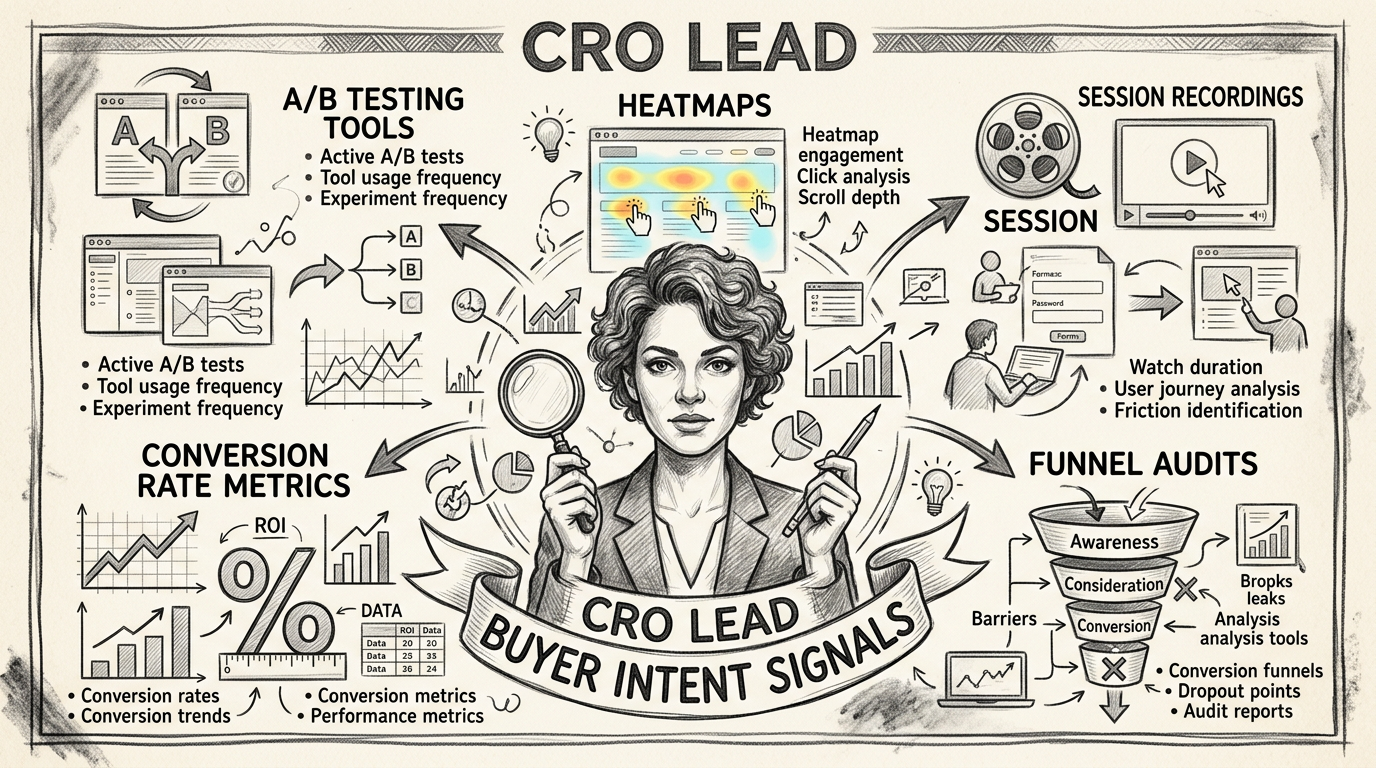
Buyer intent signals are the behaviors and data points that reveal a prospect is actively in the market for a CRO solution. Here are the most reliable signals for identifying CRO leads.
A/B Testing Tool Engagement
Prospects who are actively using or evaluating A/B testing tools are warm CRO leads. Look for behavior such as downloads of A/B testing guides, requests for Optimizely or VWO demos, and searches for A/B testing best practices. A prospect who has already signed up for a free A/B testing trial and is comparing paid plans is a buyer. They have moved past curiosity. They are making a purchasing decision. These are the CRO leads you want to prioritize.
Heatmap and Session Recording Tools
Heatmaps and session recordings reveal how users interact with a website. Prospects who are researching heatmap tools, session recording platforms, or user behavior analytics are signaling that they want to understand why their conversions are low. They suspect there is a problem, but they need data to identify it. A prospect who downloads a heatmap guide or signs up for a Hotjar trial is actively diagnosing conversion issues. This makes them an excellent CRO lead. They have identified a problem. They are looking for a solution.
Funnel Audit Requests
A prospect who requests a funnel audit is explicitly asking for help with conversion optimization. Funnel audits are a specific CRO service that analyzes each step of the conversion funnel, identifies drop-off points, and recommends changes. When a prospect asks about funnel audits, they are not window shopping. They have identified a specific problem and they want expert analysis. These CRO leads are typically decision makers who have budget allocated for optimization work.
Conversion Audit Interest
Conversion audits are similar to funnel audits but broader in scope. A conversion audit examines the entire website for conversion barriers: confusing navigation, weak calls to action, slow page load times, unclear value propositions, and more. Prospects who are researching conversion audits, downloading conversion audit checklists, or requesting conversion audit services are serious CRO leads. They have recognized that their website has conversion problems and they want a systematic approach to fixing them.
CRO Agency Research
Prospects who are researching CRO agencies are ready to buy agency services. They have looked at tools, tried some DIY optimizations, and concluded that they need expert help. Look for behavior such as reading CRO agency case studies, comparing agency pricing, and asking about CRO agency credentials. These CRO leads are the highest quality agency prospects. They have done the research. They have tried the alternatives. They are ready to engage.
Buyer Intent Data: What It Reveals About CRO Leads
Buyer intent data has transformed how agencies find CRO leads. Rather than guessing who might be interested in conversion optimization, you can now see exactly which prospects are actively researching the topic. Intent data platforms track search behavior, content consumption, and engagement patterns across thousands of B2B websites. When a prospect spikes in CRO-related research topics, you know they are in the market.
The most powerful use of intent data is timing. A prospect who is actively researching CRO is receptive to outreach right now. A prospect who researched CRO six months ago may no longer be interested. Intent data tells you when to reach out and when to stay quiet. For CRO leads specifically, intent data is especially valuable because the research behavior is so distinctive. A prospect reading about A/B testing, heatmaps, funnel audits, and conversion audits is almost certainly evaluating a CRO solution.
How to Verify CRO Leads
Verification is critical for CRO leads because the decision maker profile can vary significantly. A CRO lead from a small e-commerce store might come from the store owner. A CRO lead from a Fortune 500 company might come from a VP of Digital. Verification ensures you are reaching the right person at the right company.
Email Verification
Start with email verification. CRO leads often come from contact forms, demo requests, and content downloads. These sources produce a mix of valid corporate emails, personal emails, and invalid entries. Verify every email before adding it to your outreach list. Use tools that check deliverability, detect role-based addresses, and flag free email providers. A clean email list improves your outreach metrics and protects your sender reputation.
Company and Website Verification
Next, verify that the lead’s company has a real website that is live and accessible. A CRO lead without a website is not a real CRO lead. They cannot have a conversion problem if they do not have a website to convert visitors. Check the website’s traffic levels. A website with fewer than 1,000 monthly visitors may not have enough data for meaningful CRO work. A website with 100,000 monthly visitors is an excellent CRO lead. Use tools like SimilarWeb or Alexa to estimate traffic. Verify that the website is in a relevant industry. If you specialize in e-commerce CRO, a lead with a blog-only website may not be an ideal fit.
Role and Budget Verification
CRO leads need to come from people who can approve CRO services. Verify the lead’s role in the organization. A junior marketing coordinator may be researching CRO but not have the authority to hire an agency. A marketing director or VP of Digital is more likely to have budget authority. Ask about budget expectations early in the conversation. A lead who says they have $5,000 allocated for CRO is more likely to convert than one who has not thought about budget at all.
Intent Verification
Cross-reference the lead’s behavior with intent data. Has the lead been researching CRO topics consistently? Have they engaged with your CRO-related content? Are they active in CRO communities or forums? Strong intent signals across multiple touchpoints indicate a good CRO lead. Weak or inconsistent signals suggest the lead may be casually interested, not actively buying.
DIY vs DFY for CRO Lead Generation
Once you have verified your CRO leads, you need to decide how to serve them. The DIY and DFY models apply to your relationship with the CRO lead as much as to how you generate leads.
In the DIY model, you provide CRO leads with the tools, templates, and knowledge they need to optimize their own website. This might mean selling a CRO toolkit, offering a course, or providing a subscription to a CRO insights platform. The DIY approach works well for leads who want to do the work themselves but need guidance. It is lower touch, higher volume, and typically lower price point.
In the DFY model, you provide a full CRO service. You audit the website, design experiments, implement changes, and report results. The DFY approach works well for leads who know they need help but lack the time, expertise, or resources to do CRO themselves. It is higher touch, lower volume, and higher price point. The agency CRO leads we discussed earlier are DFY buyers.
DIY vs DFY: CRO Lead Generation Compared
| Factor | DIY CRO Model | DFY CRO Model |
|---|---|---|
| Price point | Lower – tools, templates, courses | Higher – agency retainers or project fees |
| Service scope | Self-service with guidance | Full hands-on optimization |
| Lead volume | Higher volume, lower conversion | Lower volume, higher conversion |
| Client relationship | Transactional, broad reach | Deep, long-term partnership |
| Best client profile | Teams with time but need guidance | Teams with budget but no CRO expertise |
| Scalability | Highly scalable with automation | Limited by agency capacity |
The right choice depends on your business model and target market. If you want to serve a broad audience with accessible CRO solutions, the DIY model can generate volume and recurring revenue. If you want to work with high-value clients on high-impact projects, the DFY model delivers higher margins and deeper relationships. Many successful agencies offer both. They sell DIY tools and templates to the broader market while providing DFY services to their premium clients. You can explore buy-seo-leads for access to verified CRO leads in both DIY and DFY segments.
The Best Channels for CRO Leads
CRO leads are found in specific contexts. They are researching optimization, reading case studies, comparing tools, and evaluating agencies. Here are the channels where CRO leads are most active.
LinkedIn for CRO Outreach
LinkedIn is the best channel for reaching CRO decision makers. Use Sales Navigator to find marketing directors, CMOs, heads of digital, and e-commerce managers at companies with significant website traffic. Search for profiles that mention conversion optimization, CRO, or user experience. Join CRO-focused LinkedIn groups and participate in conversations. Share content about CRO case studies and best practices. CRO leads on LinkedIn are receptive to thoughtful outreach because the platform context is professional. They are at work, thinking about growth, and open to solutions that help them hit their targets.
Email Outreach to CRO Prospects
Email outreach to CRO leads requires a specific approach. CRO leads are analytical. They respond to data, case studies, and specific recommendations. Instead of generic outreach, lead with a quick win. Analyze their website. Identify one or two specific conversion issues. Send a personalized email that mentions the issues and offers a free 15-minute consultation. This approach cuts through the noise because it shows you have done your homework. It also demonstrates the value you can deliver, which builds trust faster than any generic pitch.
Content Marketing for CRO Lead Generation
Content marketing is one of the most effective ways to generate CRO leads organically. Write in-depth articles about CRO topics. Create case study videos showing before-and-after conversion improvements. Produce webinars about CRO methodologies and tools. Optimize your content for search engines so that CRO leads find you when they are researching solutions. Topics such as “how to increase conversion rate on Shopify”, “CRO for SaaS companies”, and “A/B testing best practices” attract high-intent prospects. Learn more about building a content-driven lead engine for agencies in our lead-gen-for-marketing-agencies guide.
CRO Communities and Forums
CRO leads are active in online communities. Join Reddit communities such as r/analytics, r/PPC, and r/bigseo. Participate in CRO-focused Slack groups and Discord servers. Contribute to CRO threads on Quora and Stack Exchange. These communities are where CRO leads ask questions, share results, and seek recommendations. By participating thoughtfully, you build credibility and generate referrals. CRO leads who see you providing helpful advice in these communities are more likely to reach out when they are ready to hire.
Referrals from Existing CRO Clients
If you have delivered CRO results for clients, those clients are your best source of new CRO leads. A satisfied client who has seen their conversion rate improve is a powerful advocate. Ask for referrals after delivering a successful project. Make the referral process easy. Provide a simple message they can send to their network. Offer an incentive for successful referrals. CRO leads from referrals convert at higher rates because they arrive with pre-existing trust in your expertise.
How to Qualify CRO Leads
CRO leads vary widely in quality. A lead with a high-traffic e-commerce site and a defined budget is very different from a lead with a blog and no clear goals. Here is how to qualify CRO leads effectively.
The CRO Qualification Framework
Start with the basics. Does the lead have a live website with meaningful traffic? Does the lead understand what CRO is? Does the lead have a specific conversion problem they want to solve? Does the lead have budget for CRO services or tools? Does the lead have the authority to make a buying decision? A lead that answers yes to all five questions is a strong CRO lead. A lead that answers no to two or more questions should be nurtured, not prioritized.
Traffic Volume as a Qualification Signal
Website traffic is a main qualification signal for CRO leads. A website with 10,000 monthly visitors and a 1% conversion rate has 100 conversions per month. A 1% improvement in conversion rate adds 1 conversion per month. That may not justify a $5,000 CRO engagement. A website with 500,000 monthly visitors and a 1% conversion rate has 5,000 conversions per month. A 1% improvement adds 50 conversions per month. That easily justifies a substantial CRO investment. Use traffic volume as a qualification filter. CRO leads with high-traffic websites are more likely to see the ROI of CRO and convert to paying clients.
Conversion Rate as a Qualification Signal
A lead with a 10% conversion rate may not be as motivated to invest in CRO as a lead with a 0.5% conversion rate. The gap between current performance and potential performance is what creates urgency. Ask about current conversion rates and targets. A lead who says “we are at 0.8% and we want to get to 2%” has a clear problem and a clear goal. This is an ideal CRO lead. A lead who says “our conversion rate is fine, but we want to explore CRO” is not ready for a serious conversation.
CRO Lead Qualification Checklist
- Live website with minimum 10,000 monthly visitors
- Clear understanding of what CRO is and what it can deliver
- Specific conversion rate or goal identified by the prospect
- Budget allocated or likely available for CRO services
- Decision maker or influencer engaged in the conversation
- Previous CRO attempts identified (tools used, tests run, results)
- Timeline for CRO project defined
- Technical access to website confirmed (CMS, analytics, testing tools)
- Industry and business model match your CRO expertise
- Potential ROI from CRO improvements quantified by the prospect
Common Mistakes With CRO Leads
CRO leads come with their own set of common mistakes. Avoiding these will improve your close rate and client retention.
Mistake 1: Promising Guaranteed Results
CRO involves testing, learning, and iterating. There are no guarantees. Promising a specific conversion rate increase, even if you are confident in your methodology, sets the wrong expectation. Instead, talk about process, methodology, and past results. Share case studies that show what you achieved for similar clients. Let the prospect draw their own conclusions about what you can deliver for them. Over-promising and under-delivering is the fastest way to lose a CRO client and damage your reputation.
Mistake 2: Selling CRO Without Education
Many prospects do not fully understand what CRO involves. They think it is a quick fix. They expect you to wave a magic wand and double their conversion rate in a week. Educate CRO leads about the process. Explain that CRO requires hypothesis, testing, analysis, and iteration. Set realistic timelines. A good CRO audit takes 2-4 weeks. A solid testing program takes 3-6 months to show meaningful results. Educated CRO leads become better clients because they understand the process and are more patient with results.
Mistake 3: Ignoring Traffic Quality
A high conversion rate on low-quality traffic is not a win. CRO is most effective when the traffic is already qualified. If a prospect is driving unqualified traffic through misleading ads or poor targeting, CRO will have limited impact. Ask about traffic sources. Analyze the quality of incoming traffic before focused on a CRO project. Sometimes the best recommendation is to fix the traffic before fixing the conversion rate. CRO leads who understand this are more likely to become long-term clients.
Mistake 4: Focusing on Micro-Optimizations
CRO is not just about button colors and headline copy. While those elements matter, the biggest conversion gains usually come from fundamental changes to the funnel, the offer, and the value proposition. CRO leads who are focused only on micro-optimizations may be missing the bigger picture. Guide them toward a full CRO strategy. A full funnel audit that identifies structural issues will deliver more value than a series of A/B tests on minor elements.
Mistake 5: Not Setting Up Proper Tracking
CRO without proper tracking is CRO by guessing. Before starting any CRO project, ensure that the prospect has Google Analytics 4 set up correctly, conversion events defined, and a testing tool in place. Many CRO leads come to you because their tracking is broken. Fixing the tracking setup is often the highest-impact first step in a CRO engagement. If you skip this step, you will not be able to measure your results, and the prospect will not be able to see the value you delivered.
Getting Started With CRO Leads
If you are ready to start generating CRO leads for your agency or business, the first step is to define your CRO service offering. Are you a generalist who handles all types of CRO? Are you a specialist in e-commerce, SaaS, or B2B lead generation? A clear service offering makes your outreach more targeted and your messaging more compelling.
Next, build a verification process. CRO leads need to have real websites, real traffic, and real budget. Verify all three before investing outreach resources. Use traffic estimation tools, company research tools, and qualification calls to filter out leads that are not a fit.
From there, choose your channels. LinkedIn outreach, email sequences, and content marketing are the most effective channels for CRO leads. Use exclusive web design leads follow the same verification model with leads matched to web design project requirements./”>exclusive-seo-leads as a source of pre-verified CRO leads. These leads are sourced, verified, and ready for your outreach team. You can also explore our b
uy-seo-leads offering for direct access to CRO lead lists.
If you are an agency looking to build a sustainable CRO lead generation pipeline, check out our lead-gen-for-marketing-agencies program. We provide the frameworks and support you need to generate consistent CRO leads month after month.
Conclusion
CRO leads are among the most valuable leads in the B2B marketing space. They have a defined problem. They have budget. They are actively looking for solutions. The main winning with CRO leads is a systematic approach that combines intent identification, rigorous verification, educational outreach, and clear qualification.
Avoid the common mistakes that kill CRO deals. Do not promise guaranteed results. Educate leads about the process. Verify traffic quality. Focus on strategic improvements. Set up proper tracking before you start optimizing.
The demand for CRO services is growing as businesses become more based on data. The competition for CRO leads is also growing. The agencies that win will be the ones that generate the highest quality leads, verify them rigorously, and deliver exceptional results for every client.
Start building your CRO lead system today. Define your ideal client. Verify your leads. Choose your channels. Execute with data, not guesswork. The results will compound over time as your client success stories generate more CRO leads through referrals and case studies.
Get Verified CRO Leads
Explore Exclusive Lead Lists
Frequently Asked Questions
What is B2B lead generation?
B2B lead generation is the process of identifying and attracting potential business clients who need your agency’s services. It involves prospecting, qualifying, and nurturing decision-makers at target companies.
How do you find B2B leads for agencies?
Effective B2B lead sourcing includes LinkedIn prospecting, industry databases, cold outreach, referral programs, and content marketing. Focus on decision-makers like marketing directors and CEOs.
What makes a qualified B2B lead?
A qualified B2B lead has decision-making authority, budget availability, a genuine need for your services, and a realistic timeline. Qualification frameworks like BANT help prioritize prospects.