
Your SMM clients just gave Meta permission to crawl their websites and train its AI models on the content. Most of them do not know it. The permission is not in their ad contract. It is in the Commercial Terms Meta updated on October 15, 2026, and the terms take effect October 30. Continued use of Meta’s products for business purposes, running ads, managing a Facebook Page, using the Business Suite, counts as agreement. There is no checkbox. There is no notification. The window to act is two weeks.
For an agency, this is not a tech story. It is a client-protection story with a positioning angle. The clients who are running Meta ads have already been inside a crawling clause through the Self-Serve Ad Terms since August 2025. The new terms extend the same right to every business that uses Meta for any commercial purpose, not just advertisers. That means the segment of your book that “only uses Meta for social, not ads” just got a new AI-training grant they did not sign up for.
Meta’s own documentation names two crawlers that matter here. Meta-ExternalAgent crawls for training foundation AI models. Meta-WebIndexer improves Meta AI search results and makes your content citable in Meta AI responses. Both are controlled through robots.txt. That control is the entire agency workflow, and it is the thing your clients will ask you about in the next report if you bring it up first.
What Actually Changed In The October 2026 Terms
The current Commercial Terms, dated March 2024, had no crawling clause. The Self-Serve Ad Terms, dated August 2025, had one that applied to advertisers: placing an ad order gave Meta the right to crawl the advertiser’s domains and use the content for “research and training.” The October 2026 Commercial Terms carry that same crawling paragraph into the general commercial agreement, where it applies to any business use of Meta’s products.
The new paragraph lets Meta, or anyone acting for it, use web scrapers, bots, and other automated tools to crawl and collect content from domains and pages associated with a business’s products or services. It also covers URLs made available through the business’s use of Meta’s products or through users’ use of them. Meta may use that content to develop, improve, research, and train its products.
Two details in the clause are worth flagging to your clients. The first is test credentials. The terms let Meta “create test credentials” to reach those pages. A Cornell law professor noted that test credentials could technically let Meta sign up as a fake user to get past registration walls. Meta declined to say whether test credentials would bypass paywalls or other paid content. The second detail is the link-sharing clause. When a user shares a link to a business’s content through Meta’s platforms, the terms cover that URL too. The European Publishers Council is writing to the European Commission specifically about this, worried that Meta may claim permission to use an article when a user simply shares its link.
Meta’s response, through spokesperson Andy Stone, is that the update is “meant to make sure Meta can pull accurate information about products for sale on third-party websites when it makes ad and content recommendations on its platforms, and that it’s not about scraping news sites.” The counter-argument is that the clause does not say “products for sale.” It says “domains and pages associated with a business’s products or services.” For a marketing agency client with a blog, a service page, and a Facebook Page, all of those are now inside the crawl grant.
What This Means For Your SMM Clients Specifically
The practical exposure is not that Meta will index your client’s service pages. It is that the content, the writing, the case studies, the customer proof, the proprietary process descriptions, will be in the training corpus for the models that generate ad creative, answer questions in Meta AI, and inform recommendations across the platform. For a client whose brand voice is a competitive asset, that is a real consideration. For a client whose content is commodity, the exposure is low and the response can be proportionally low.
There is a second, quieter exposure that most agencies have not quantified. Meta’s crawl grant covers URLs “made available through users’ use” of Meta’s products. That includes content behind a login, behind a client portal, or behind a lead form, if the URL is reachable from a page that was shared through Meta. The terms do not define the boundary. The exposure is a live question, and the honest answer to a client asking it is: we do not know yet, and the prudent response is to block the training crawler while keeping the search crawler allowed.
Oct 30
Effective date of Meta’s updated Commercial Terms. Two weeks from the October 15 announcement. Continued business use of Meta’s products after that date is agreement. The robots.txt decision needs to be made and deployed before the terms take effect, not after.
The Two Crawlers Your Clients Actually Need To Decide Between
Meta’s crawler documentation lists the two that matter for this decision, and the split is clean.
Meta-ExternalAgent: the training crawler
This is the one that crawls “for uses such as training foundation AI models or improving products by indexing content directly.” If a client wants their content in Meta’s training corpus, this is the crawler to allow. If they do not, this is the crawler to block in robots.txt. The block is a single User-agent line and it takes effect on the crawler’s next visit.
Meta-WebIndexer: the search crawler
This crawler “improves Meta AI search results, and Meta says allowing it helps the company cite and link to your content in Meta AI responses.” For most SMM clients, this is the one worth keeping allowed. Being cited and linked in Meta AI responses is the equivalent of being in the AI Overviews in Google’s world. It is a visibility channel that is growing and that most clients would not want to opt out of by default. The block-and-allow split is the answer for the majority of clients: block the training crawler, allow the search crawler.
One caveat worth stating plainly: Meta’s own crawler documentation notes that Meta-ExternalFetcher may bypass robots.txt when fetching pages at a user’s request, and FacebookExternalHit may also bypass it during security or integrity checks. The block in robots.txt is a strong signal, not a hard technical wall. For clients whose content is genuinely sensitive, the practical protection is to keep it behind authentication and not share the URL through Meta’s platforms. The robots.txt block is the low-cost, high-signal first step.
The Three-Tier Response
Not every client wants the same answer. The response depends on what the client’s content is worth to them as a competitive asset, and the three tiers cover the realistic range.
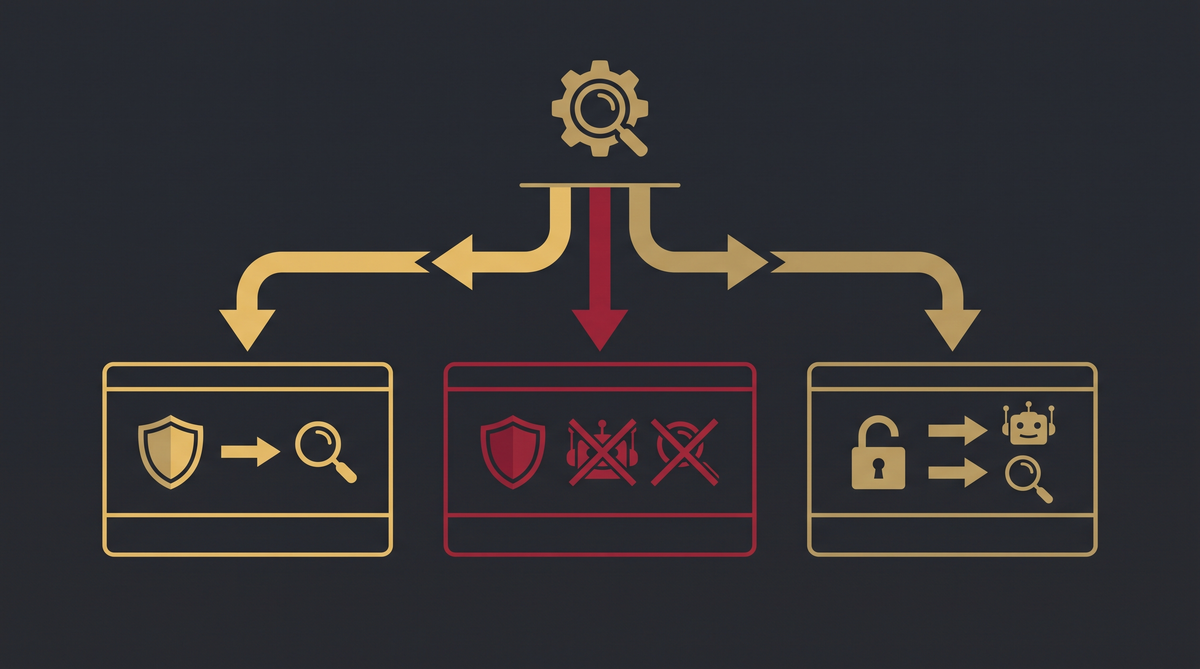
Tier 1: Block the training crawler, allow the search crawler
This is the default for most SMM clients. The robots.txt change is two lines. The Meta-ExternalAgent block stops the training use. The Meta-WebIndexer allowance keeps the client in the Meta AI search index, where their content can be cited and linked. The cost is zero. The benefit is that the client’s proprietary process descriptions and case studies are not feeding a model that will generate ad creative for their competitors, while the client still gets the AI-search visibility. This tier is the one to propose in the next SMM report unless the client has a specific reason for a different choice.
Tier 2: Block both crawlers
For clients whose content is genuinely sensitive, a law firm with unpublished case analysis, a medical practice with proprietary treatment content, a B2B vendor whose documentation is a competitive moat, blocking both crawlers is the right call. The client loses Meta AI search visibility entirely, which is a real cost, but the alternative is the content in a training corpus with no control over how it is used. The client makes that trade consciously, in writing, with the trade-off stated in the report.
Tier 3: Opt in deliberately
For clients whose content strategy explicitly includes being in Meta’s AI corpus, the full allow is the right call. The client keeps both crawlers, the content trains the models, and the client is in the position of having opted into the visibility channel knowingly. This tier matters for clients who are actively working on Meta AI search visibility as a channel in its own right, and for whom the training-crawler benefit, better recommendations, better ad creative, is part of the value proposition of the relationship with Meta.
| Tier | robots.txt change | Who it fits |
|---|---|---|
| Block training, allow search | Block Meta-ExternalAgent, allow Meta-WebIndexer | Most SMM clients. The default. |
| Block both | Block Meta-ExternalAgent and Meta-WebIndexer | Sensitive content. Proprietary moat. |
| Allow both | No change, or explicit allow | Deliberate AI-corpus strategy. |
The Two-Line Privacy Policy Disclosure
Whatever tier the client chooses, the client’s privacy policy needs a disclosure. Not a legal opinion, not a 40-paragraph terms section. Two lines, in the same section as the rest of the data-use disclosures:
“Meta Platforms may crawl and collect content from pages associated with our business, including pages made available through our use of Meta’s products, and use that content to develop, improve, research, and train Meta’s products and services. This applies to our use of Meta’s advertising and business management tools. You can review the current Meta Commercial Terms for the full scope.”
That disclosure is not a fix. It does not change the crawl behavior. It changes the client’s legal posture from “unknown, silent consent through continued use” to “disclosed, documented, consciously chosen.” For a client in a regulated industry, that difference is the entire value of the agency’s involvement. For a client who is not in a regulated industry, it is still the right posture, and it is the thing that shows up in the next audit or the next question from a customer who asks who has access to their content.
The agency that surfaces this to the client before the terms take effect is the one the client remembers as the protector. The agency that finds out in the client’s own audit six months later is the one that has to explain why it did not know.
The Positioning Move In The Next SMM Report
The practical question is how to put this in the client report without it reading as a scare pitch. The framing that works is the one the report is already built around: what changed, what it means for the client specifically, what the options are, what the recommendation is, and what the next step is. The section is six paragraphs, not a white paper. The recommendation is Tier 1 for the default client. The next step is a one-line robots.txt change deployed by the agency’s technical team, confirmed in the next report with the crawler status.
The report section should not say “Meta is training on your content.” It should say “Meta’s October 2026 terms extend the crawl-and-train clause from the ad agreement to all business uses. Your site is in scope. Here is the two-line robots.txt change that blocks the training crawler while keeping you in Meta AI search. We can deploy it this week.” The difference is the agency is offering the fix, not just the warning. The warning without the fix is what every tech blog is already doing. The fix is what the agency is for.
There is a second positioning move that is easy to miss. The client who asks “should we also do this for Google and OpenAI crawlers” has just opened the AI-visibility conversation for the whole account. The answer is that the same robots.txt discipline applies to every AI training crawler, and the agency that can speak to the whole picture, not just the Meta change, is the agency that gets the AI-visibility line in the next contract renewal. The Meta terms are the entry point to a conversation the client is going to have anyway. The agency that starts it on purpose owns it.
Common Mistakes When Responding To The New Terms
Waiting for the terms to take effect to start the conversation. The two-week window is the point. The client who decides after October 30 has already agreed. The decision the agency surfaces in the report is the one that changes the client’s posture from passive to active.
Blocking both crawlers by default. The default for most clients is Tier 1, block training and allow search. Blocking Meta-WebIndexer removes the client from Meta AI search entirely, which is a visibility cost the client may not have priced. The block is the conservative choice only for Tier 2 clients with a genuine sensitivity reason.
Treating the robots.txt block as a hard technical wall. It is a signal, not a guarantee. Meta’s documentation says certain crawlers can bypass robots.txt in specific conditions. For sensitive content, the real protection is authentication and not sharing the URL through Meta’s platforms. State both to the client.
Skipping the privacy policy disclosure. The two-line disclosure is not optional for a regulated-industry client. It is the difference between silent consent and documented, conscious choice. The cost is two lines. The benefit is the client’s legal posture in the next audit.
Framing it as a Meta problem. The framing is a client-protection problem with a Meta trigger. The client is asking “who has access to my content and what are they doing with it.” Meta is the specific instance. The agency’s answer is the crawler-discipline system, which the client will ask about for every other AI platform too.
FAQ

Does Meta actually train on business websites now?
Under the October 2026 Commercial Terms, which take effect October 30, Meta has the right to crawl and collect content from domains and pages associated with a business’s products or services, and to use that content to develop, improve, research, and train its products. The clause applies to any business use of Meta’s products, not just advertising. The specific crawler that does the training work is Meta-ExternalAgent, and it is controllable through robots.txt.
How do I block Meta’s training crawler without blocking Meta AI search?
Block Meta-ExternalAgent in robots.txt and leave Meta-WebIndexer allowed. The two crawlers do different jobs. Meta-ExternalAgent is the training crawler. Meta-WebIndexer is the search crawler that puts your content in Meta AI responses. The two-line robots.txt change is: a User-agent block on Meta-ExternalAgent, no restriction on Meta-WebIndexer. Deploy it before October 30 so the decision is made before the terms take effect.
Does Meta’s spokesperson say the terms are not about scraping?
Meta’s spokesperson Andy Stone responded that the update is “meant to make sure Meta can pull accurate information about products for sale on third-party websites when it makes ad and content recommendations on its platforms,” and that it is “not about scraping news sites.” The counter-argument is that the clause as written covers “domains and pages associated with a business’s products or services,” which is broader than “products for sale.” Three law professionals who reviewed the terms for Nieman Lab believe the language could support an argument that Meta is permitted to scrape and train on website content. The prudent response is to assume the broad reading and make the robots.txt decision on that basis.
What is the difference between the old ad terms and the new commercial terms?
The Self-Serve Ad Terms dated August 2025 gave Meta the right to crawl an advertiser’s domains when an ad was placed, for uses including “research and training.” The October 2026 Commercial Terms carry the same crawling paragraph into the general commercial agreement, where it applies to any business use of Meta’s products, including businesses that do not buy ads. The difference is the scope: advertiser-only in the 2025 terms, all business users in the 2026 terms. The businesses that “only use Meta for social” are the segment the new terms newly cover.
Should I tell my client to stop using Meta entirely if they disagree with the terms?
The terms say that if you disagree, you may cease utilizing Meta’s products for business purposes. For most clients, that is not a realistic option, and the agency’s recommendation should not be built on it. The realistic options are the three tiers: block the training crawler and allow the search crawler, block both for genuinely sensitive content, or allow both for clients who deliberately want to be in Meta’s AI corpus. The “stop using Meta” option is the legal exit, not the practical one, and the agency’s value is in making the practical choice work, not in recommending the exit.
Where Verified Leads Fit For The AI-Visibility Conversation
Every client-protection conversation about AI crawling terms ends in the same place: the client now wants to know their position in AI search, not just their position in Google. The Meta terms are the trigger. The question that follows is the one that builds the next quarter of work: “what are we actually doing about AI visibility, across all the platforms, not just the one that just changed its terms?”
Verified leads compress the outreach step for that conversation. You get clients who have already shown a need, with a contact whose email and phone a human has checked, so the AI-visibility conversation starts the same week instead of the same quarter. Exclusive, internet-verified leads close at 6 to 12 percent against 1 to 3 percent on a cold list, which matters when the AI-visibility engagement is a new line item in the next renewal. Read more about how verified B2B leads work.
The math on the protection side is not close. The two-line robots.txt change costs an hour of technical work. The two-line privacy policy disclosure costs a client-legal review. The client who gets both before the next audit is the client who does not have to explain a silent consent they never gave. See our digital marketing lead packages or our social media lead packages for the pipeline that builds the AI-visibility book of business.
Want a sample before you commit?
Ask us for a free sample list of verified leads in your niche. You review the data quality before you spend anything.
LeadPot delivers qualified leads for agencies that need predictable pipeline. See how social media agencies find qualified leads or explore our agency lead packages.