# Outbound Sales Strategies That Actually Work for Agencies
Agency owners know this feeling all too well. Your portfolio is solid. Your past results speak for themselves. Your team is talented and your processes are tight. But the pipeline is inconsistent. Some months are great. Other months are dry. You rely on referrals and inbound inquiries, but those are unpredictable. You need a systematic way to generate new business on demand.
The answer is outbound sales. Not the spray-and-pray cold calling of the past, but a strategic, multi-channel outbound engine that targets the right prospects at the right time with the right message. Outbound sales strategies for agencies have evolved dramatically. The tools are better. The data is richer. The methodologies are proven. The agencies that invest in outbound sales strategies today will have a competitive advantage for years.
This guide covers outbound sales strategies that actually work for agencies in 2026. We will cover what outbound sales strategies are, the buyer intent signals that tell you when to reach out, how to verify prospects before investing outreach resources, the DIY versus DFY decision, the best channels for agency outbound, how to qualify leads, the mistakes that kill outbound campaigns, and a clear action plan for getting started.

What Are Outbound Sales Strategies for Agencies?
Outbound sales strategies are proactive approaches to generating new business. Instead of waiting for prospects to find you through inbound marketing, you reach out to them directly. For agencies, outbound sales strategies typically involve identifying target accounts, researching decision makers, making personalized outreach messages, and following up systematically across multiple channels until a conversation happens.
The best outbound sales strategies for agencies are built around buyer intent. Rather than cold-calling random businesses, you target prospects who are already showing signs that they need your services. A prospect who posted about needing help with their website is a stronger outbound target than a prospect who has never mentioned their marketing challenges online. Intent-driven outbound sales strategies dramatically improve response rates because you reach prospects at the moment they are receptive.
Agency-specific outbound sales strategies also need to account for the agency sales cycle. Selling agency services is different from selling software. The deals are larger. The decisions involve multiple stakeholders. The risk for the buyer is higher. A business owner who has been burned by a bad agency experience will be cautious. Your outbound strategy needs to build trust, demonstrate expertise, and reduce perceived risk. This is where multi-channel outreach and social proof become important.
Outbound sales strategies for agencies fall into two broad approaches. Outbound prospecting is the process of identifying and reaching new prospects who have not expressed interest. Outbound nurturing is the process of reaching out to prospects who have shown some interest but have not yet become clients. Both are important. Prospecting fills the top of the pipeline. Nurturing moves warm prospects closer to a decision.
Buyer Intent Signals That Power Outbound Sales Strategies
The most effective outbound sales strategies are built on buyer intent signals. These signals tell you when a prospect is open to a conversation and what they are interested in. Here are the intent signals that matter for agencies building outbound sales strategies.
LinkedIn Engagement
LinkedIn is the richest source of buyer intent data for B2B outbound. When a prospect posts about a business challenge, comments on a post about agency services, or shares content about marketing and growth, they are signaling interest. These signals are public and easy to track. Set up alerts for keywords related to your agency’s services. When a decision maker posts about needing help with SEO, web design, or marketing automation, that is a direct invitation to reach out. Respond to their post with a thoughtful comment. Then follow up with a direct message that references their post. This approach is far more effective than unsolicited cold outreach because it is contextually relevant.
Social Selling Activity
Social selling is the practice of using social media platforms to find, connect with, and nurture prospects. For agencies, social selling on LinkedIn and X/Twitter is one of the most effective outbound sales strategies. Follow your target accounts. Engage with their content. Share insights that demonstrate your expertise. Build relationships before you pitch. When the time is right, the prospect will be receptive to your outreach because they already know who you are and what you stand for.
Company Growth Signals
Companies that are growing are companies that need agencies. Look for signals such as new funding rounds, new product launches, expansion into new markets, and new executive hires. A company that just raised a Series B and hired a VP of Marketing is likely looking for an agency to support their growth. A company that just launched a new product needs help with launch marketing. These growth signals are public and can be tracked through press releases, job postings, and LinkedIn updates.
Website and Technology Changes
Changes to a prospect’s website or technology stack can signal an opportunity for agency services. A company that recently migrated to a new CMS may need help with SEO migration. A company that just started using a new marketing automation platform may need help setting up campaigns. Use tools like BuiltWith and Wappalyzer to track technology changes at your target accounts. When you spot a meaningful change, you have a timely reason to reach out.
For agencies that want to skip the prospecting phase entirely, exclusive web design leads provide pre-qualified prospects who are already looking for a web design agency.
How to Verify Prospects Before Outreach
Verification is a critical step in any outbound sales strategy. Reaching out to the wrong person wastes time and damages your brand reputation. Here is how to verify prospects before investing outreach resources.
Contact Verification
Start with the basics. Verify that the email address or phone number you have is correct and active. Use email verification tools to check deliverability. For phone numbers, use SMS verification or a quick call to confirm the number is active. Invalid contact information is the number one cause of wasted outreach effort. A 10-minute verification step saves hours of follow-up time.
Company Verification
Verify that the prospect’s company is real, active, and relevant. Check the company website, LinkedIn presence, and recent news. A company with no recent activity may not be a good outbound target. A company in an industry you do not serve is not a fit. Cross-reference the company size, revenue, and growth trajectory against your ideal customer profile.
Role Verification
Outbound sales strategies fail when you reach out to the wrong person. Verify that the person you are targeting has the authority or influence to make a buying decision. A junior employee may be interested in your agency services but unable to approve a contract. A senior leader may not be involved in day-to-day agency selection. Find the person who is in the middle: the manager or director who evaluates agencies and makes a recommendation to leadership.
Timing Verification
Timing matters in outbound sales. Verify that the prospect is in a position to engage with your outreach. Has the company recently hired new marketing staff? Are they running a campaign? Are they attending industry events? Timing signals tell you when a prospect is most likely to be open to a conversation about agency services.
Outbound Sales Strategies: main Tactics
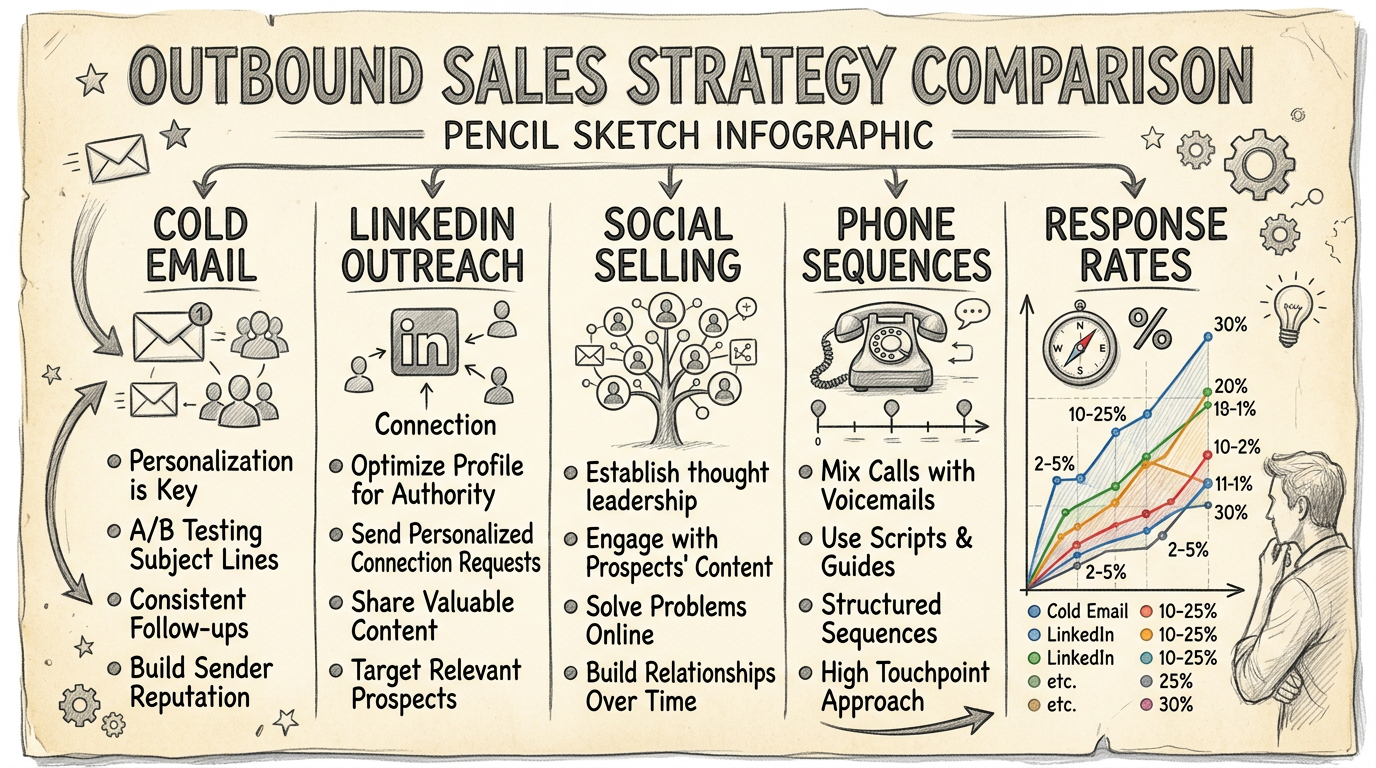
There are several outbound sales strategies that agencies use to generate new business. Each has strengths and tradeoffs. The best agencies combine multiple strategies into a cohesive system.
LinkedInphishing
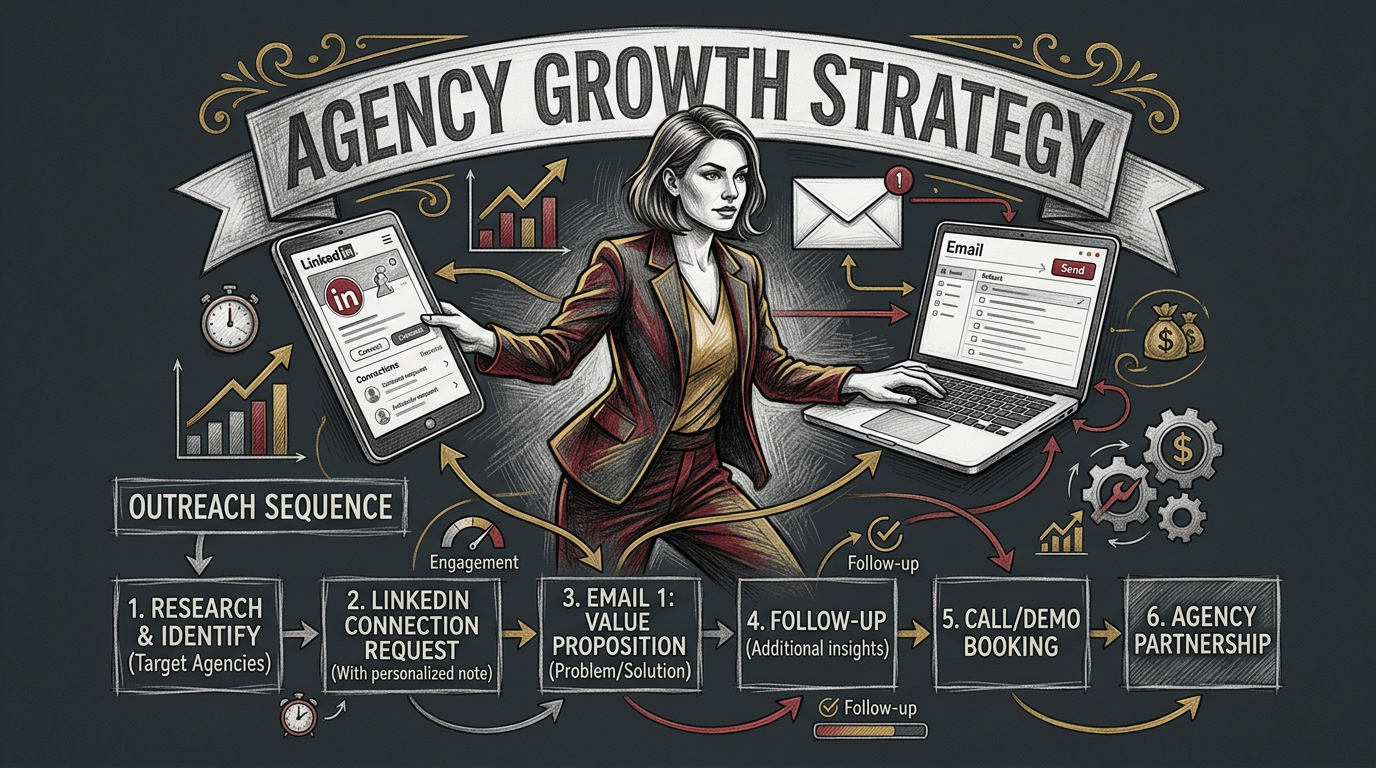
LinkedInphishing is the practice of using LinkedIn’s features to identify and engage prospects. It involves searching for decision makers at target companies, sending personalized connection requests, and engaging with their content before pitching. The main LinkedInphishing is authenticity. Do not send generic connection requests with no personalization. Reference something specific about the prospect’s profile or recent activity. After they accept your connection request, share a piece of content or ask a thoughtful question. Build the relationship before you pitch. LinkedInphishing works because it leverages the professional context of the platform. Prospects on LinkedIn are in a business mindset and open to relevant outreach.
Cold Email Sequences
Cold email is one of the most scalable outbound sales strategies. The main cold email success is personalization and sequencing. Write subject lines that reference the prospect’s specific situation. Keep the email body short, specific, and focused on one idea. Offer value first: a free audit, a relevant case study, or a quick tip that addresses a known problem. Follow up with a sequence of 3-5 emails over 2-3 weeks. Each follow-up should add value, not just nag. Cold email sequences work because they are automated but not impersonal. A well-crafted sequence feels like a series of thoughtful one-to-one messages.
Social Selling
Social selling is a long-term outbound strategy that builds relationships through consistent engagement. Follow your target prospects on LinkedIn and X/Twitter. Like, comment, and share their content. Post content that demonstrates your agency’s expertise. Attend virtual events where your target prospects are present. The goal is to become a familiar, trusted voice in your prospect’s feed. When the time comes for them to hire an agency, you will be top of mind. Social selling takes longer than cold outreach but produces stronger relationships and higher conversion rates.
Phone Outreach
Phone outreach is the most direct outbound channel, and it is also the most intimidating for many agency owners. But phone outreach can be highly effective when done well. Research the prospect before you call. Know their company, their role, and a specific challenge they might be facing. Lead with a question, not a pitch. “I was looking at your website and noticed that your checkout process might be losing some customers. I have a few ideas about that. Do you have two minutes?” This approach respects the prospect’s time and opens the door for a real conversation. Phone outreach works best when it is part of a multi-channel sequence. Follow a cold email with a phone call. The email gives context. The call creates connection.
DIY vs DFY Outbound Sales Strategies
Agencies can approach outbound sales in two ways: DIY or DFY. The right choice depends on your team’s capacity, your budget, and your growth goals.
In the DIY model, your team handles all aspects of outbound sales. You research prospects, craft outreach messages, run campaigns, track responses, and book meetings. The DIY approach gives you full control and lower upfront costs. But it requires time, expertise, and ongoing management. Your team needs to learn sales copywriting, outreach sequencing, and CRM management. The DIY model works well for agencies that have a dedicated business development person or a founder who enjoys sales.
In the DFY model, you partner with an agency that handles your outbound sales strategy and execution. They source leads, craft outreach messages, run campaigns, and deliver qualified appointments to your calendar. You focus on closing deals. The DFY approach costs more but delivers faster results and frees your team to focus on delivery. It works well for agencies that are scaling quickly and need predictable lead flow without hiring a full outbound team.
DIY vs DFY: Outbound Sales Strategies Compared
| Factor | DIY Outbound | DFY Outbound |
|---|---|---|
| Upfront investment | Lower – tools and training costs | Higher – agency retainer or campaign fee |
| Time to first results | Slower – 3-6 months to optimize | Faster – 4-8 weeks to first appointments |
| Control over messaging | Full control | Shared control with agency |
| Scalability | Limited by team bandwidth | Scales with agency infrastructure |
| Skill requirements | Requires sales and copywriting skills | Requires only deal-closing ability |
| Best for | Founders and solo operators | Agencies ready to scale |
If you are building outbound sales strategies in-house, you will need a reliable source of prospects. exclusive-seo-leads provides verified lead lists that you can use for your DIY outbound campaigns. These leads are pre-qualified and verified, which means your team can focus on outreach and closing instead of research and data cleaning. If you want a fully managed approach, our buy-seo-leads service includes done-for-you outbound campaigns that deliver qualified appointments directly to your calendar. And if you are an agency that wants to build a complete lead generation system, our how-to-get-seo-clients guide provides the frameworks for generating consistent inbound and outbound leads.
The Best Channels for Outbound Sales Strategies
A multi-channel outbound strategy outperforms single-channel approaches. Here are the channels that produce the best results for agency outbound sales strategies.
LinkedIn Outreach
LinkedIn is the top channel for B2B outbound sales strategies. Use Sales Navigator to identify your target accounts and decision makers. Send personalized connection requests with a specific reason for connecting. After they accept, engage with their content. Share relevant articles and insights. Then, when the relationship is established, propose a conversation. LinkedIn outreach works because it is personal, professional, and contextual. You are not a stranger cold-calling. You are a peer reaching out with a relevant idea.
Cold Email Sequences
Cold email is the most scalable outbound channel. Write sequences of 3-5 emails per prospect. Personalize each email for the recipient’s company, role, and situation. Use clear, concise language. Focus on one idea per email. Offer value before asking for anything. Cold email works at scale because it can be automated while still feeling personal. Use tools that support personalization tokens, A/B testing, and follow-up scheduling. Track open rates, response rates, and conversion rates to optimize your sequences over time.
Social Selling on X/Twitter
X/Twitter is an underrated channel for B2B outbound sales strategies. Many agency founders and marketing leaders are active on X/Twitter. Follow your target prospects. Engage with their posts. Share your own insights and case studies. Build a reputation as a knowledgeable, helpful voice in your niche. When you reach out to prospects on X/Twitter, they will recognize your name and be more receptive. X/Twitter is also useful for joining live conversations. When a prospect tweets about a challenge your agency solves, respond with a helpful comment or a direct message.
Instagram for Visual Agency Services
If your agency offers visual services such as web design, branding, or video production, Instagram is a powerful outbound channel. Follow design directors, marketing managers, and brand leaders at companies in your target market. Engage with their posts and stories. Share your own portfolio work. Instagram is a visual medium, so use it to show your agency’s creative capabilities. When you reach out to prospects on Instagram, reference a specific piece of their visual content that you admire. This shows you have done your research and that you appreciate their brand.
Reddit and Community Outreach
Reddit and niche communities are goldmines for outbound sales strategies. Join subreddits related to your agency’s services. Participate in discussions. Offer helpful advice without pitching. When a prospect posts about a problem your agency solves, respond with a thoughtful, non-promotional answer. Build credibility through consistent, valuable contributions. Over time, community members will start reaching out to you for help. These inbound inquiries from community engagement are among the highest quality leads because they come with built-in trust.
Phone Outreach and Voicemail
Phone outreach is the highest-touch outbound channel. It works best when used as part of a multi-channel sequence. After sending a cold email, follow up with a phone call. Reference the email in your voicemail. Keep voicemails short and specific. “Hi, I sent you an email about your website’s conversion rate. I had a couple of ideas I wanted to share. My number is [number]. Call me back when you have a minute.” Phone outreach combined with email has a higher response rate than either channel alone.
How to Qualify Outbound Leads
Outbound leads need to be qualified before you invest sales resources. Here is a practical framework for qualifying outbound sales leads.
The ANUM Framework
ANUM is a qualification framework designed for outbound sales. Authority: Does the person you are speaking with have decisions power? Need: Does the prospect have a clear problem that your agency can solve? Urgency: Is the prospect motivated to solve the problem soon? Money: Does the prospect have the budget to invest in a solution? ANUM prioritizes authority first because outbound leads often come from people who are interested but not empowered. If the person you are speaking with is not the decision maker, ask to be connected to someone who is.
The Budget Conversation
Budget qualification is one of the hardest parts of outbound sales. Agencies often avoid the budget conversation because it feels uncomfortable. But avoiding it wastes time on prospects who cannot afford your services. Bring up budget early in the conversation. Ask directly: “What budget have you allocated for this type of project?” If the prospect has not thought about budget, help them think through it. Present a rough price range based on similar projects. This filters out prospects who are not a fit and shows that you are serious about working with qualified clients.
The Timeline Conversation
Timeline tells you whether a prospect is ready to buy now, in the future, or just exploring. Ask directly: “When are you looking to get started on this?” A prospect who says “we need to start within the next 30 days” is a hot outbound lead. A prospect who says “we are just researching options for now” is a cold lead. Prioritize hot leads for immediate outreach. Nurture cold leads with educational content and check-ins.
Outbound Sales Lead Qualification Checklist
- Decision maker or influencer identified and engaged
- Specific problem or need clearly articulated by the prospect
- Budget range confirmed or discussed
- Project timeline defined (ideally within 1-3 months)
- Company size and industry match your target market
- Prospect has experience with agencies or is agency-ready
- Competition or current provider identified
- Success criteria or KPIs discussed
- Stakeholders and decisions process mapped
- Urgency or catalyst for change confirmed
Common Mistakes in Outbound Sales Strategies
Even experienced agencies make mistakes with outbound sales strategies. Here are the most common ones and how to avoid them.
Mistake 1: Spraying and Praying
The biggest mistake in outbound sales is sending generic messages to as many prospects as possible. This approach destroys response rates and damages your brand reputation. Quality always beats quantity in outbound sales. A targeted outreach to 50 well-researched prospects will outperform a generic blast to 5,000. Personalize every message. Reference something specific about the prospect. Explain why you are reaching out specifically to them. This requires more effort per message but produces dramatically better results.
Mistake 2: Leading With the Pitch
Outbound sales strategies fail when you lead with a pitch. Prospects do not know you. They do not trust you. They do not care about your services yet. Lead with a question, an insight, or a piece of relevant content. Build the relationship first. Pitch later. The rule of thumb is to give before you ask. Share a useful idea. Offer a free resource. Reference a relevant case study. Once the prospect has received value from you, they will be open to hearing about your services.
Mistake 3: Giving Up After One Follow-Up
Most outbound sales strategies fail because the follow-up is not consistent enough. The average B2B sale requires 5-12 touchpoints before a conversation happens. Most salespeople give up after 1-2 attempts. Follow up systematically across multiple channels. Send an email. Follow up with a LinkedIn message. Leave a voicemail. Share a relevant article. Keep following up with value until the prospect responds or explicitly asks you to stop. Consistency and persistence separate successful outbound sales strategies from failed ones.
Mistake 4: Not Segmenting Outreach
Sending the same message to every prospect is a waste of opportunity. Segment your outbound outreach by industry, company size, and prospect role. A message about e-commerce SEO for a Shopify store will not resonate with a SaaS VP of Marketing. Tailor your messaging to each segment. Use different case studies, different value propositions, and different subject lines for each segment. Segmented outreach consistently outperforms generic outreach by 2-3 times.
Mistake 5: Ignoring Data and Analytics
Outbound sales strategies are only as good as the data behind them. Track open rates, response rates, meeting booking rates, and close rates by channel, message, and segment. Use this data to optimize your outreach. If email open rates are low, test new subject lines. If response rates are low, test new messaging. If meeting booking rates are low, test new offers. based on data optimization is what turns a mediocre outbound strategy into a high-performing system.
Building Your Outbound Sales Strategy
Building an effective outbound sales strategy requires planning, execution, and iteration. Start by defining your ideal client profile. Know exactly who you want to reach. Know what challenges they face. Know what results they want. This clarity makes every subsequent step more effective.
Next, choose your channels. For most agencies, a combination of LinkedIn outreach, cold email, and social selling produces the best results. Use exclusive-seo-leads as a source of verified prospects for your outbound campaigns. These leads are pre-qualified and verified, which means your team can focus on outreach and relationship-building instead of research and data cleaning.
Set up your outreach sequences. Write a cold email sequence. Create a LinkedIn outreach template. Prepare a phone script. Test each element and optimize based on results. Track your metrics religiously. Know your response rate, your meeting booking rate, and your close rate by channel and segment.
If you want a shortcut to building your outbound engine, consider our buy-seo-leads service. We provide verified leads and done-for-you outreach campaigns that deliver qualified appointments to your calendar. You focus on cl
osing while we handle the prospecting.
And if you are an agency that wants to build a complete lead generation system that combines inbound and outbound strategies, our how-to-get-seo-clients guide provides the frameworks, playbooks, and tools you need to generate consistent new business month after month.
Conclusion
Outbound sales strategies are the most reliable way for agencies to generate consistent new business. Inbound marketing is important, but it is unpredictable. Referrals are powerful, but they depend on other people. Outbound sales strategies put the control in your hands. You decide who to target. You decide when to reach out. You decide what message to send. This control is what transforms agencies from feast-or-famine operations into predictable, scalable businesses.
The outbound sales strategies that work are the ones that combine buyer intent, multi-channel outreach, rigorous verification, and systematic follow-up. Avoid the common mistakes that derail outbound campaigns. Personalize your outreach. Lead with value. Follow up consistently. Segment your audience. Measure everything and optimize based on data.
The agencies that invest in outbound sales strategies today will have a significant advantage over competitors who rely solely on inbound and referrals. Start building your outbound engine now. Define your target audience. Choose your channels. Write your sequences. Track your metrics. The pipeline will follow.
Get Started With Outbound Leads
Learn More About Getting SEO Clients
Frequently Asked Questions
What is B2B lead generation?
B2B lead generation is the process of identifying and attracting potential business clients who need your agency’s services. It involves prospecting, qualifying, and nurturing decision-makers at target companies.
How do you find B2B leads for agencies?
Effective B2B lead sourcing includes LinkedIn prospecting, industry databases, cold outreach, referral programs, and content marketing. Focus on decision-makers like marketing directors and CEOs.
What makes a qualified B2B lead?
A qualified B2B lead has decision-making authority, budget availability, a genuine need for your services, and a realistic timeline. Qualification frameworks like BANT help prioritize prospects.