SEO Client Outreach That Actually Gets Responses
Your agency fires 200 cold emails on a Tuesday morning. By Friday you have one reply. It is not even from a prospect who wants SEO. It is from someone asking where to unsubscribe.
Your team assumes the problem is outreach itself. The channels are broken, the buyers have moved to LinkedIn, nobody reads emails anymore. So you cut the outreach budget and wonder why the pipeline went quiet. The truth is your process is fine. The message is not.
Most agencies treat outreach like a vending machine. Drop in the effort, shake the glass, expect a client. This piece gives you the outbound message framework instead.
It covers the 3 message sequence that opens conversations, the subject line rules that earn the open, and the personalization rules that scale without burnout.
It also covers the send timing that hits the inbox when a decision maker actually works, and the hard stop that tells you when to quit chasing a lead. If you have sent SEO client outreach campaigns before and hated the results, this is the rewrite.
Why 95 Percent Of Your SEO Outreach Lands In Spam
Cold email is a numbers game, but not the way most agencies run it. A typical agency owner buys a list of 1,000 business names, writes one template, and fires it out at 200 addresses a day from a brand new domain.
The first batch gets flagged, the sender reputation drops, and by batch three almost nothing reaches the inbox at all. You end up with a 0.5% response rate and a hard bounces list full of dead names.
Three things drive the spam folder, and all of them live in your process.
Sender reputation starts at zero. A domain that has never sent mail gets no trust. Gmail and Outlook filter it to Promotions or Spam before a human ever sees the words. You need a warmup period, real volume growth over two to three weeks, and a sending domain separate from the one your clients use to read their reports.
List quality sets the floor. Scraped lists carry 20 to 40 percent dead or mistyped addresses. Every bounce trains the providers against your domain. A list broker that sold you 1,000 names may only hold 700 real inboxes, and the broker sells those same 700 to six other agencies, so your message is the fourth one they see this week.
The message itself reads like spam. All caps words, stacked exclamation marks, five links, and the words you will not want in a cold email (free, guaranteed, $1,000 off) all trip classifier rules. The provider scores your email the same way it scores an invoice attachment nobody asked for.
The fix is not a better list. It is a message built for one person, sent from a warmed domain, to a name that actually exists. Before you copy the sequence below, run your target list through the lead qualification framework so the three touches land on buyers who can actually hire you.
The 3-Message Sequence That Opens Conversations
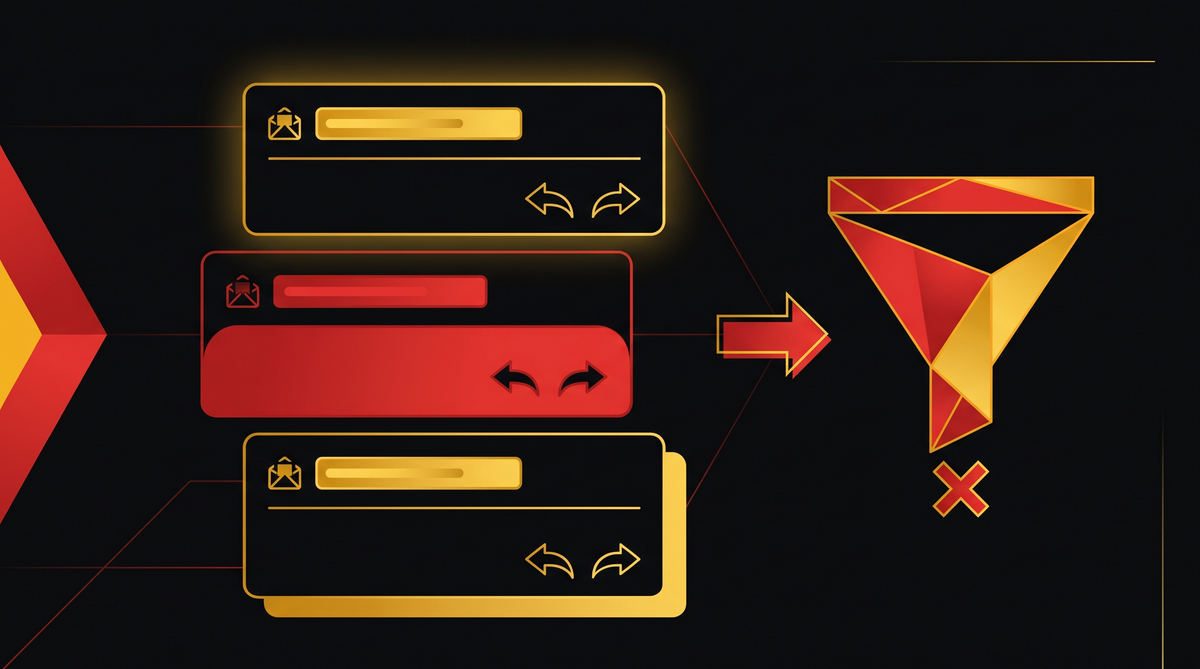
One email rarely works. Three, spaced out and built on each other, is the sequence that produces the reply. Each message has a job. Message one earns attention. Message two adds one piece of proof. Message three closes the door politely so the lead can say yes without guilt.
Here is the shape, with a worked example for a SEO agency pitching a local service business.
Message 1 (Day 0): The observation email
“Saw your site ranking #4 for ‘plumber in Austin’ while the top result is a 2019 forum thread. That is a winnable gap. Happy to walk you through what would close it, no deck, 15 minutes.”
Message 2 (Day 4): The proof email
“Quick follow up. A dental office we worked with lost three top 3 rankings after their template migration and got them back in six weeks. If your site has had any recent platform changes, that is the first thing I would audit.”
Message 3 (Day 10): The breakup email
“Closing the loop on my last two notes. If search is not a priority right now, no worries at all. If it becomes one, this thread is here. Either way, good luck with Q4.”
Notice what the sequence does not do. It does not ask for a call in message one. It does not attach a proposal. It gives one specific, checkable observation and leaves the next move to the reader.
The spacing matters as much as the words. Day zero, day four, day ten. Too fast reads as a bot. Too slow loses the thread while their inbox buries yours.
The sequence also works on LinkedIn, with the same shape. A short note that references one thing you actually read on their site, a second note with one case number, a third that says the door is open.
If you want to layer this on top of verified lead flow instead of scraping names yourself, see how a sourced list actually gets built before you apply the sequence.
Subject Lines That Get The Reply
The subject line does one job: earn the open. It should never promise the email body, because the body has to deliver something the subject did not.
Most agency subject lines fail the same two ways. They are too generic (“Question about your website”) or too salesy (“Grow your traffic 200%”). Both read as a category the brain files and ignores.
Four rules hold up on email and LinkedIn alike.
Under 40 characters. Mobile previews cut off after that. Put the specific noun in front: a rank, a competitor, a page on their site. “Your page 2 ranking” beats “SEO question” because it names something they can picture in one glance.
One concrete reference. Name the thing you noticed: a lost keyword, a slow page, a competitor’s new landing page. One reference reads as attention. Three reads as a generated email.
No all caps, no exclamation marks. Capitalized words and stacked punctuation are the two fastest classifier triggers. If a sentence would look odd shouted at you, it should not be in a subject line.
Match the follow up thread. On message two and three, keep the thread. A changed subject reads as a new stranger and resets the trust you built on day zero.
Three subject lines that work, by job
Day 0 (observation): “Your #4 rank on ‘roofing + city’ keyword”
Day 4 (proof): “One ranking win we can show you”
Day 10 (breakup): “Closing the loop on this one”
A practical test: read the subject line to a colleague outside your agency. If they cannot say what the email is about in one word, rewrite it. That word is the noun the rest of the message hangs on.
Personalization Rules That Scale Without Burnout
Personalization that scales means two or three concrete details per message, not a twenty line love letter. The details cost minutes to find and tell the reader something they have not seen repeated from ten vendors.
The budget: one observed fact about their site, one proof point from your case work, one next step. That is the ceiling. More than that and the message stops reading like a person.
Where to find the observed fact is the whole game. You do not need to write a report. You need one screen worth of evidence.
The five minute personalization checklist
- Search their main service keyword and note what rank they hold (three clicks in a SERP).
- Open their site and check one technical signal: page speed, mobile layout, or a broken link on a money page.
- Look at their last blog post or service page update date. A stale site is a clean, factual opener.
- Match the proof point to their industry. If you have a case study in their niche, use that number; if not, use your closest one and say it is the closest.
- Keep the total under 60 words of personalization. The message, not the research, is what they will read.
Two rules protect the sender from themselves. First, every personalization line must survive the “did they actually do the work” test. If you would catch a junior analyst writing it without looking, rewrite it.
Second, batch the research, not the writing. Pull the one screen of evidence for 30 names in one morning, then write the messages that same day. Spreading research and writing across weeks is where quality drops and burnout starts.
If the list you are running this against is a scraped list, the five minute budget will not hold. Bounce rates and dead addresses eat the morning. The honest fix is a pre verified list instead of building one from scratch.
You can see the difference between a scraped name and a checked inbox on our SEO leads page, where this research step is done before the name reaches you.
$800
What a wasted outbound month looks like: 300 scraped contacts, one close, and a client who churns by month three. Finding the two or three warm names early changes the math.
When To Stop Chasing A Lead
Every outbound list carries leads that will never be ready, and keeping them open has a real cost. Each open thread steals time from the ones that might close.
The clean rule: three messages, two weeks, then stop. The breakup email already did the closing work.
Three exceptions to that rule, and only those.
They replied with a hold, not a no. “Not this quarter” and “send me something later” are both a request to stay warm. Put them in a monthly nurture cadence, not the active outbound queue. One short note per month, zero pitch, is enough to keep the thread open without burning the relationship.
Something public changed their situation. A new funding round, a new site launch, a visible SEO hire. A public signal means the buyer just changed their constraints, and one short note that references the change is not chasing. It is a new conversation that happens to reuse an old thread.
They hit a churn signal you can name. A marketing hire leaving, a platform migration announced, an ad budget cut that shows in their numbers. One targeted note that names a specific, dated trigger earns the open.
A fourth generic follow up asking “did you get a chance to review my last note” closes more deals than it opens.
The operational part is tagging, not memory. When a thread ends, record the outcome in your CRM: no response, hold, churn risk, or nurture.
A lead you chased five times last year should not top this year’s batch.
Our churn signal keywords page is a working start on the signals to watch for.
Comparison: Sending More Vs Sending Better
The most common fix for a weak pipeline is to send more. Double the batch, add a channel, run the sequence twice. For most small agencies, that is the wrong lever. Volume without message quality raises the cost per close, not the close rate. The honest comparison looks like this.
| Lever | Cost per close | Best for |
|---|---|---|
| Send more of the same (2x batch, same message) | Stays high, often rises | Testing subject lines on warmed domains |
| Send better (rewrite sequence, same batch size) | Drops from month one | Most agencies with a sub 2% response rate |
| Buy verified leads, keep the same sequence | Lowest of the three | Agencies that already have a tested message |
Read the table the way your P&L does. Volume scales cost linearly: double the sends, double the time, double the domain wear, same reply rate.
Message quality is the lever that moves the reply rate itself, and it costs a weekend to test three versions of the day zero email against each other.
Verified leads are the lever that removes the list problem entirely, which matters most once your message is already strong and you just need more of the right names.
Run the second lever first, then the third. A verified list fed into a weak message just puts the weak message in front of better people, and you pay the list premium for it.
A 1% response rate on 500 sends is five replies. A 4% rate on 125 sends is also five replies, with one quarter of the work and one quarter of the domain wear. The winning move is almost always the message, not the volume.
If you decide the third lever is your next step, the call is between building your own list and buying exclusive verified ones. The DIY vs DFY breakdown is a fair read of both paths, including where each one quietly costs more than the sticker suggests.
Common Outreach Mistakes That Kill Response Rates
The mistakes below are the ones that show up in agency outreach programs over and over, and the fix for each is short enough to do the same week you read this.
Sending from a fresh domain. Fire 200 emails from a domain that registered last month and the provider treats every one as a guess. Fix: warm the sending domain over two to three weeks before it carries a real campaign.
Writing the pitch before the research. The message leads with your services and the personalization is one inserted first name. Fix: reverse the order. Do the one screen of research first, write the message around what you found.
Asking for a call on day zero. The first email asks for 30 minutes before you have earned the meeting. Fix: ask for a 15 minute review of one specific thing, or better, offer to just send the findings.
No breakup message. The sequence stops at message two and the thread dies with the lead still undecided. Fix: the day ten note is not optional. It is what converts a quiet no into a usable one.
No outcome tagging. Every lead closes as a mystery, so the next campaign starts from the same list with the same dead ends at the top. Fix: five tags, CRM, done in a batch of two minutes per thread.
FAQ
How many cold emails can you send per day before you get flagged?
There is no universal number, but a safe ramp for a warmed sending domain is under 50 real sends per day for the first two weeks, growing by 10 to 15 percent a week. What trips the filters is a low open rate on a domain with no sending history. Keep the open rate above 40 percent and the ceiling stays high.
What trips the filters is a low open rate on a domain with no sending history. Keep the open rate above 40 percent and the ceiling stays high.
Is it worth doing SEO client outreach on LinkedIn if email is not working?
Yes, but with a different message budget. LinkedIn gives you a public profile to work from, so the personalization floor is higher, not lower. Run the same three message shape, swap the observation for a post or a company page detail, and expect the reply rate to land between your cold email rate and your warm referral rate.
How long does it take for a new outreach campaign to show real results?
Plan on two full cycles of the sequence before you judge it. One cycle is 10 to 14 days, so expect the first meaningful batch of replies and booked calls around day 25 to 30. Anything you measure before the second cycle runs out is noise, because the day ten breakup emails have not all landed yet.
Should I use a tool like Apollo or Instantly, or just do it by hand?
For under 50 names a batch, by hand beats any tool. The research step is the differentiator and no tool does it for you. For 300 or more names a month, the tool pays for itself in typing time, but you still write the three messages yourself. Pre written templates make the generic message problem worse. The tool is a delivery layer, not a writing one.
For 300 or more names a month, the tool pays for itself in typing time, but you still write the three messages yourself. Pre written templates make the generic message problem worse. The tool is a delivery layer, not a writing one.
What response rate should I expect from a well run cold email campaign?
A realistic target on a warmed domain with a personal day zero email is 2 to 4 percent of contacts replying with a real answer, not a bounce or a reply all. Verified lead sources run above that, closer to 5 to 8 percent. Every name, role, and inbox was checked before the message left your outbox, so the readers are the people you meant to reach.
Verified lead sources run above that, closer to 5 to 8 percent. Every name, role, and inbox was checked before the message left your outbox, so the readers are the people you meant to reach.
Do cold email laws or spam rules limit what I can send in the US?
CAN SPAM sets the baseline for US B to B email: identify yourself, give a working address, and honor opt outs within ten business days. B to B email is exempt from the opt in rules that apply to consumer mail, so cold outbound to company inboxes stays legal in the US. Keep a one click opt out, and the rest is a drafting problem, not a legal one.
B to B email is generally exempt from the opt in rules that apply to consumer mail, so cold outbound to company inboxes stays legal in the US. Keep a one click opt out, and the rest becomes a drafting problem, not a legal one.
If you would rather not build the list side of this, the digital marketing leads page covers exclusive verified lists across the agency verticals, and the contact page is where a sample starts.
Start Your Next Outreach Batch This Week
Run the 3 message sequence on 30 real names
Pick 30 accounts this week, spend one morning on the one screen of research for each, and write the day zero, day four, and day ten notes in a single sitting.
Send the first batch on a Tuesday. You will have a full cycle measured by the end of the month. If the reply rate is under 2 percent, the message is the next thing to fix, not the list.