You run a digital agency. You have good work, good clients, and a team that delivers. The problem is that growth is not consistent. Some months are strong. Some months are thin. You land a big client, then spend three months on that project while the pipeline empties. You wake up one morning realizing that your revenue depends entirely on whether a few key clients renew their contracts.
That pattern is common. It is also solvable. The agencies that scale predictably are not the ones that work harder or spend more on advertising. They are the ones that build systems that produce a steady flow of qualified leads regardless of how busy they are on client work. This article covers the growth strategies that produce consistent agency scaling: lead generation systems, pricing models that support growth, team structures that scale with revenue, and client retention systems that keep revenue growing even when new leads are slow.
Why Agency Growth Stalls
Most agencies hit a growth ceiling between 50,000 and 200,000 dollars per month in revenue. Below that range, the founders are usually doing most of the delivery work, and the lead generation depends on their personal network. Above that range, the agency needs systems that do not depend on any one person. The transition from founder-led growth to system-led growth is the hardest shift an agency makes.
The agencies that stall are the ones that keep doing what worked in the early days. Founder-led outreach, ad-hoc proposals, and client relationships that depend on personal chemistry all work when the agency is small. They break when the agency needs to produce consistent revenue from a pool of prospects who have never met the founder.
The Lead Generation System
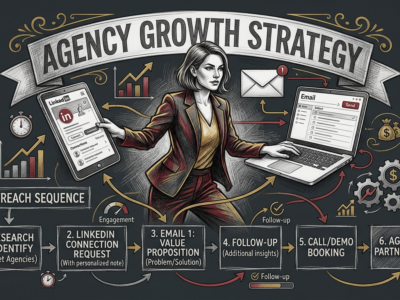
Predictable agency growth starts with a predictable lead flow. The agencies that grow consistently have three lead sources running simultaneously: inbound leads from content and SEO, referral leads from existing clients and partners, and outbound leads from targeted outreach. When one source slows, the others cover the gap.
Inbound leads through content and SEO
Content that ranks for your target keywords produces inbound leads who are actively searching for your services. A page that ranks for “web design leads” or “SEO leads” attracts prospects who have already identified their need and are comparing providers. The leads that arrive through organic search are higher quality than leads that arrive through paid advertising because the intent is more specific.
Build content clusters around the problems your ideal clients search for. A cluster for “B2B lead generation” might include pages on how to find B2B leads, how to qualify B2B leads, and what makes a quality B2B lead. Each page answers one question and links to the others, creating a network of content that signals topical authority to search engines and attracts leads at every stage of the buying process.
Content also establishes your agency’s expertise before the first conversation. A prospect who reads your article on B2B lead qualification enters the sales conversation already believing you know your field. That belief reduces the persuasion work you need to do in the pitch and increases the likelihood that they will choose your agency.
Referral leads from existing clients
Your best clients are your best lead source. A client who is happy with your work will refer you to other businesses in their network if you ask at the right time. The right time is not immediately after project delivery, when the client is focused on reviewing the work. The right time is two to four weeks later, when they have seen the results and can speak to the outcome.
Ask for referrals with a specific question: “Do you know anyone else who might benefit from this?” The specificity makes it easier for the client to think of someone. A vague “feel free to refer us” gets ignored. A specific ask that references the client’s own positive experience gets responses.
Referral leads convert faster and at higher rates than any other lead source. A lead who arrives through a referral has already received a recommendation from someone they trust. They are pre-qualified by the referring client, which means they match your ideal client profile more closely than a lead who finds you through a search engine.
Outbound leads through targeted outreach
Outbound outreach supplements inbound and referral leads with a consistent flow of new prospects. The agencies that do outbound well target decision makers at companies that match their ideal client profile. The outreach message references a specific observation about the prospect’s business and offers a relevant insight, not a generic pitch.
Outbound works when it is consistent and targeted. Sending ten personalized messages per day to qualified prospects produces more leads than sending 100 generic messages per day. Quality over volume applies to outreach more than almost anything else in agency growth.
Build an outreach list from companies that match your ideal client profile. Use LinkedIn, industry directories, and business databases to identify the right contacts. Segment the list by industry, company size, and the specific problem your agency solves. Write outreach messages that reference the prospect’s specific situation, not a generic description of your services.
Pricing Models That Support Growth
The pricing model you choose affects your agency’s growth trajectory. Hourly billing caps your revenue because you can only bill so many hours. Project-based pricing creates unpredictable revenue because projects end and new ones take time to close. Retainer-based pricing produces predictable revenue because clients commit to a monthly engagement.
The agencies that scale best combine project work with retainers. A new client starts with a project that lets them evaluate your work risk-free. Once the project is complete and the client is satisfied, you propose a retainer for ongoing support. The retainer provides predictable revenue while the project pipeline fills with new opportunities.
Retainer pricing also improves client retention. A client who pays a monthly retainer is more invested in the relationship than a client who pays per project. The ongoing engagement creates continuity, which leads to better results, which leads to more referrals, which leads to more inbound leads.
Team Structure That Scales
Agency growth stalls when the team structure does not keep up with revenue. The founders who are also the primary deliverers reach capacity quickly. The agencies that scale beyond that point build teams where delivery is handled by specialists, and the founders focus on sales, strategy, and client relationships.
Hire specialists before you need them. Waiting until you are overwhelmed to hire means you are hiring under pressure, which leads to bad decisions. Build a bench of contractors or part-time specialists who can absorb delivery work as it grows. The overhead is lower than full-time employees, and the flexibility lets you adjust capacity as the pipeline fluctuates.
As your team grows, invest in processes that let new team members deliver consistent quality without your direct oversight. Document your methodologies, build templates for common deliverables, and create review processes that catch issues before they reach the client. The agencies that scale well are the ones that build systems that work without the founder’s involvement.
Client Retention Systems
Retaining existing clients is cheaper than acquiring new ones. A client who stays with your agency for two years is worth more than three new clients acquired in that same period, once you factor in acquisition cost and onboarding time. The agencies that retain clients well do three things: they deliver consistent results, they communicate proactively, and they expand the scope of work over time.
Proactive communication means checking in with clients between deliverables, not just when you need something from them. A monthly update that summarizes results, highlights wins, and identifies opportunities keeps the relationship strong and surfaces expansion opportunities that would otherwise go unnoticed.
Scope expansion happens naturally when you deliver results and communicate proactively. A client who sees improved lead quality from your SEO work will ask about adding PPC management. A client who sees increased traffic from your content work will ask about email marketing. The agencies that grow through scope expansion are the ones who make it easy for clients to say yes to additional services.
Tracking the Metrics That Drive Growth
You cannot improve what you do not measure. The agencies that scale consistently track three metrics: lead flow, conversion rate, and client retention rate. Lead flow tells you whether your lead generation system is working. Conversion rate tells you whether your qualification and sales process is working. Client retention rate tells you whether your delivery and communication is working.
Set targets for each metric and review them monthly. If lead flow is declining, your content or outreach needs attention. If conversion rate is declining, your qualification criteria or pitch needs refinement. If client retention is declining, your delivery quality or communication needs improvement. The metric tells you where to focus your improvement effort.
FAQ
What is the fastest way to grow a digital agency?
The fastest way to grow a digital agency is to build a consistent lead flow from multiple sources while improving client retention. A 10 percent improvement in retention is worth more than a 10 percent improvement in acquisition because retained clients generate more revenue over time without additional acquisition cost.
How do I scale agency revenue without working more hours?
Scale revenue by building delivery teams that can handle client work without your direct involvement. Focus your time on sales, strategy, and client relationships. Delegate delivery to specialists. As the team grows, your capacity to take on new clients grows without increasing your hours.
What is a good agency growth rate?
A healthy agency grows 20 to 40 percent year over year. Faster growth is possible but risky because it often requires hiring and infrastructure investment that outpaces revenue. Slower growth is sustainable but leaves you vulnerable to market changes. The right growth rate depends on your market, your team’s capacity, and your tolerance for risk.
How do I know when my agency needs to hire?
Hire when your delivery capacity is consistently constraining new business. If you are turning down projects because your team cannot handle the workload, you are ready to hire. If you are turning down projects because your lead flow is inconsistent, fix the lead generation before you hire.
LeadPot delivers qualified leads for agencies seeking consistent growth. Read more agency growth strategies or explore our lead generation packages.
How Agency Growth Leads Compare to Other Agency Leads
Agency growth leads are different from SEO leads, web design leads, or PPC leads. They are not looking for a tactical service like search engine optimization or paid advertising. They are looking for a strategic partner who can help them grow their client base, improve their operations, and scale their revenue. The buyers are more sophisticated, the evaluation process is more involved, and the deals are larger.
An agency looking for growth support typically has a specific gap they are trying to close. They might be struggling with lead generation, struggling to convert proposals, or struggling to retain clients. Understanding their specific gap lets you position your services as the solution to a problem they have already identified rather than a service they did not know they needed.
The sales cycle for agency growth leads is longer than for tactical service leads. An agency owner who is evaluating growth services will want case studies, references, and evidence that your approach works for agencies similar to theirs. Prepare for longer sales cycles by building a strong body of case study content and nurturing leads with educational content during the evaluation period.
Building a Portfolio That Attracts Agency Growth Leads
Your portfolio should show that you understand the agency business model and have delivered measurable growth results for agencies similar to the ones you want to work with. A portfolio that features agency clients with before-and-after metrics on lead generation, revenue growth, or client acquisition converts better than a portfolio that shows work for non-agency clients.
Include specific metrics in every case study: lead volume before and after your engagement, revenue growth attributable to your services, and client acquisition improvements. The agencies evaluating your services want to see numbers they can compare to their own performance. A case study that says “we increased lead volume by 150 percent in six months” is more convincing than a case study that says “we helped an agency grow their business.”
Networking Events for Agency Growth
Agency growth leads are most accessible at events where agency owners and decision makers gather. Industry conferences, agency meetups, and mastermind groups are productive lead sources because the attendees are actively looking for ways to grow their agencies. An agency owner at a conference is in a problem-solving mindset and receptive to conversations about growth strategies.
The leads from networking events are warm because the context is established and the prospect is already engaged in the agency community. Follow up within 48 hours while the conversation is fresh. A personalized follow-up message that references a specific point from your conversation will stand out from the dozens of generic follow-ups the prospect received from other event attendees.
Content Marketing for Agency Growth Leads
Publishing content that addresses agency growth challenges attracts inbound leads who are researching solutions. A guide on how to generate more leads for an agency attracts agency owners who are struggling with lead generation. A case study showing how an agency doubled its revenue in one year attracts agency owners who have similar growth goals.
Content marketing for agency growth leads works best when it addresses the specific challenges of the agency business model. Agency owners do not have the same problems as e-commerce store owners or SaaS companies. They have unique challenges around lead generation, proposal conversion, client retention, and team scaling. Write content that speaks directly to these challenges and positions your agency as the expert who understands their world.
Cold Outreach to Agency Growth Leads
Cold outreach to agency growth leads is most effective when it references a specific observation about the agency’s current situation. An outreach message that says “I noticed your agency has 50 LinkedIn followers and your competitors have 500. Here is a strategy for closing that gap” is more likely to get a response than a generic message about your growth services.
The key to cold outreach for agency growth is demonstrating that you have done research on the agency and have a specific insight to share. Agency owners receive dozens of generic growth service pitches every month. The messages that stand out are the ones that show the sender has actually looked at the agency’s website, social media, or marketing and has a concrete observation to share.
Referrals and Partnerships in the Agency Community
Agency owners trust recommendations from other agency owners more than any sales pitch. Building referral relationships with non-competing agencies in your market is one of the most effective ways to generate agency growth leads. An agency that offers SEO services can refer web design and lead generation leads to your agency. A web design agency can refer SEO and PPC leads to your agency. The referral relationship benefits both agencies and produces leads that are already qualified by the referring agency.
Attend agency community events, participate in agency mastermind groups, and contribute to agency-focused publications and podcasts. The visibility you build within the agency community positions your agency as a trusted resource and generates referrals that convert at higher rates than any other lead source.
Pricing Agency Growth Services
Agency growth services are typically priced as monthly retainers because the work is ongoing. A lead generation retainer for an agency might range from 2,000 to 10,000 dollars per month depending on the scope and the number of leads required. A full growth strategy engagement that includes lead generation, proposal optimization, and client retention programs might range from 5,000 to 20,000 dollars per month.
Price based on the revenue impact your services create. If your lead generation service produces clients worth 50,000 dollars in revenue for the agency, a 5,000 dollar monthly retainer is a fraction of the value you are delivering. Position your pricing in terms of ROI rather than cost. The agencies that understand the return on their investment are the ones who will pay your rates without negotiation.
FAQ
How do I find leads for my agency growth services?
Target agencies that are struggling with lead generation, proposal conversion, or client retention. Use LinkedIn to identify agency owners in your target market. Monitor industry publications for agencies that are growing rapidly and may need support. Build referral relationships with complementary service providers in the agency community. Content marketing that addresses agency growth challenges attracts inbound leads who are actively researching solutions.
What makes a qualified agency growth lead?
A qualified agency growth lead is an agency owner or managing director who has identified a growth challenge, has budget for growth services, and has authority to make the decision. An agency that is already growing does not need your services as urgently as an agency that is plateauing or declining. Focus on agencies that have hit a growth ceiling and need external expertise to break through.
How much should I charge for agency growth services?
Agency growth services typically range from 2,000 to 10,000 dollars per month for lead generation and from 5,000 to 20,000 dollars per month for comprehensive growth programs. Price based on the revenue impact your services create for the agency. A service that generates 100,000 dollars in new client revenue per month is worth far more than the hours it takes to deliver.
How do I prove the value of agency growth services?
Use case studies with specific metrics: lead volume, conversion rate, revenue growth, and client retention improvements. Agency owners are data-driven and want to see numbers they can compare to their own performance. A case study that shows how you doubled lead volume for an agency in six months is more convincing than a case study that describes your growth methodology in abstract terms.
LeadPot delivers qualified leads for agencies selling marketing and growth services. Explore our lead generation insights or view our lead packages.