
Every SEO agency reaches the same breaking point. You have a talented team, a portfolio of results, and a website that looks professional. The pipeline, however, is a rollercoaster – full one month, empty the next. You start evaluating lead providers and very quickly you find two completely different products on the market. One is cheap, abundant, and almost never converts. The other is more expensive, exclusive, and consistently produces clients.
This article explains why the two products are fundamentally different, why the cheaper option is actually more expensive in practice, and why exclusive SEO leads that are internet-verified are the only model that delivers consistent results for SEO agencies.

The Shared Lead Problem No One Talks About Honestly
What shared SEO leads actually are
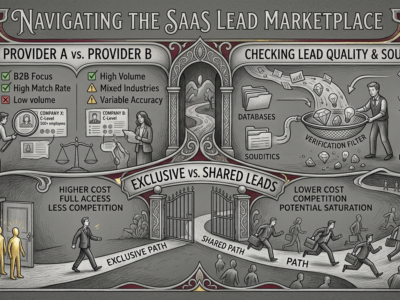
Shared SEO leads are exactly what the name describes: one account’s contact details, sold to multiple agencies simultaneously. A prospect searches “best SEO agency for my SaaS business,” fills in a form, and the lead provider distributes that contact to five, ten, or sometimes twenty agencies within a short time window.
Every agency receives the same name, the same company, the same search history, and the same pitch angle. Whoever calls first gets the conversation. The other agencies – the ones who paid for the same lead – wasted their money.
This is not a hypothetical scenario. It is the operating model of most lead marketplaces and list brokers. The more agencies the broker sells to, the more revenue they make from a single prospect. The prospect’s experience is irrelevant to their business model.
Why the lead race destroys your close rate
The damage from shared leads starts before you even dial. When a prospect receives emails or calls from five SEO agencies in one afternoon, the experience is not “I have options.” It is “I am being spammed.” The prospect’s first thought is not which agency is best. It is why every SEO agency in their city is calling them on the same day.
That psychological reaction – annoyance, defensiveness, scepticism – makes the close harder from the very first interaction. Even if your agency has the strongest technical expertise, the best case studies, and the most transparent pricing, you are starting from a position of irritation, not interest.
Research on buyer psychology shows that negative first impressions are sticky. A prospect who forms a negative impression of “SEO agencies” as a category during a shared lead outreach will carry that impression into every subsequent interaction – including the one that matters most: yours.
The real cost of shared leads
Shared leads cost less per contact but far more per close. Here is the math:
You buy 100 shared SEO leads at $40 each: $4,000 total spend.
At a 2% close rate (industry average for shared leads), you close 2 clients.
Average SEO monthly retainer: $1,500. Average client lifespan: 12 months.
First-year revenue: $36,000. Cost per close: $2,000.
Now consider the hidden costs: your team’s time spent on leads that will never convert, the opportunity cost of missing better prospects during those outreach weeks, and the morale impact of consistently low response rates. A team that sends 500 emails to get 2 responses will start questioning the entire outbound strategy – and that doubt leaks into every call they make.
The only winner in the shared lead model is the lead provider who sold the same contact ten times.

Exclusive SEO Leads: How They Actually Work
What exclusivity means in practice
Exclusive SEO leads are sold to one agency and one agency only. When a prospect shows buying intent – searching for SEO services, requesting an audit, engaging with agency comparison content – their details go to one agency and one agency only.
That agency owns the relationship from the first touchpoint. There is no race. No competition. No prospect fatigue from multiple pitches in one afternoon. You can follow up properly, build rapport, and present a considered proposal.
Internet-verified: not a list, a real signal
The keyword “exclusive” describes who receives the lead. The phrase “internet-verified” describes why the lead is worth receiving. An exclusive lead that is not verified is still just a name. An exclusive lead that has been internet-verified is an account with documented, recent evidence that it needs SEO services.
Real verification signals include: the company or decision-maker searched for SEO services, SEO agency pricing, or SEO audits in the last 30 days; they downloaded an SEO guide, pricing sheet, or comparison article; they posted on LinkedIn, X, or Reddit about organic traffic problems or ranking drops; they posted a job listing for an in-house SEO specialist, a reliable signal that the company is investing in organic traffic; they engaged with SEO tools, platforms, or industry communities.
The more signals that match, the stronger the verification. A lead verified against a search from today and a social post from last week is stronger than a lead verified against a search from six months ago. Freshness is not a detail – it is the difference between a lead that converts and a lead that has already chosen another agency.
How exclusive leads are sourced – generated, not bought from a list
The key word in exclusive lead generation is “generated.” These leads are not pulled from a business directory or purchased from a data broker. They are generated through targeted campaigns: social selling on LinkedIn, X, Instagram, and Reddit; targeted email campaigns; educational content that acts as a lead magnet.
Because the leads are generated for a specific audience with a specific need, the intent signal behind each lead is documented and verifiable. You are not guessing whether a prospect is ready to buy. You know they are, because the campaign identified them based on their own behaviour.
The verification and qualification process
Before an exclusive SEO lead reaches your inbox, it passes through a verification stack. Email addresses are checked for deliverability. Phone numbers are validated. Company names are confirmed against LinkedIn or business registries. The inquiry context – what the prospect was searching for, what content they engaged with, what social signals they emitted – is documented so you can personalise your outreach.
This transforms a raw inquiry into a qualified conversation. You are not calling a cold contact. You are calling a prospect who has already told you what they need from an SEO agency.

The ROI Math: When Exclusive Leads Cost Less Per Close
Shared lead scenario – the losing side of the equation
You buy 100 shared SEO leads at $40 each: $4,000 total spend.
Close rate: 2%. Clients closed: 2.
Average SEO monthly retainer: $1,500. Client lifespan: 12 months.
First-year revenue: $36,000. Cost per close: $2,000.
You contacted 100 accounts to get 2 clients. Your team spent hours on 98 accounts that were never going to convert. That time has a cost too. If your BD manager spends 20 hours per week on outreach and converts 2 clients from 100 leads, their effective time cost per close is significant.
Exclusive lead scenario – the winning side
You buy 100 exclusive, internet-verified SEO leads at $120 each: $12,000 total.
Close rate: 8%. Clients closed: 8.
Average SEO monthly retainer: $1,500. Client lifespan: 12 months.
First-year revenue: $144,000. Cost per close: $1,500.
Same lead volume. Four times the revenue. Lower cost per close. And because SEO clients stay for an average of 12+ months, the lifetime value gap is even wider. Year two revenue from those 8 clients is another $144,000 – pure profit margin from the same acquisition spend.
The crossover point
The crossover is at a 4% close rate. If your shared lead close rate is below 4% – which most agencies’ shared lead close rates are (1-3%) – exclusive leads cost less per close from the very first month. The math is not theoretical. It plays out for every agency that has tried both models.
Two Models for Exclusive SEO Leads: DIY and DFY
The best providers offer both models because different agencies have different capacities and priorities. Understanding which model fits your agency is one of the most important decisions you will make about your pipeline.
DIY: Verified Accounts, Your Outreach
In the DIY model, the provider delivers a list of internet-verified, exclusive SEO leads to your agency. Each lead arrives with complete account information: decision-maker name, verified email, verified phone, company context, the specific SEO pain point they were researching, and the signal that verified the lead.
From that point, your team owns the entire outreach process. You decide the messaging, the sequences, the channels, the timing, and the follow-up. The provider’s job ends at delivering verified accounts. Your job is to convert them.
Best for: agencies that have an in-house BD team, established outbound processes, and the time to run campaigns consistently. DIY gives you the best verified accounts to apply your process to.
What you are buying: your team’s time freed from list-building. Instead of two days scraping LinkedIn and cleaning a purchased list, your team opens a verified list and starts outreach the same afternoon.
DFY: Provider Runs the Campaign, You Get Booked Conversations
In the DFY model, the provider runs the full campaign on your behalf. Minimum commitment: 3 months. The provider handles everything: social selling across LinkedIn, X, Instagram, and Reddit, targeted email campaigns, and educational content creation – SEO audit checklists, organic traffic guides, keyword research frameworks – that acts as a lead magnet.
The campaign is built around your niche and target geography. If you target SaaS companies in North America, the outreach messaging and content are built around SaaS SEO challenges. You receive booked conversations directly into your calendar.
Best for: agencies that want to focus on delivery rather than prospecting, agencies entering a new niche or geography, agencies without the time or infrastructure to run consistent outbound, agencies that have the BD budget to delegate but not the in-house capacity to execute.
What to Look for in an Exclusive SEO Lead Provider
1. Can they show you the verification signal?
Ask for a sample lead before you buy. Look for the specific pain point, the internet signal that confirmed it, and the date of that signal. If the provider cannot show you the signal, the leads are not verified – they are a list with a better label.
2. Do they offer both DIY and DFY?
A provider with both models can grow with your agency. Start DIY while building your process. Move to DFY when you want to scale without adding headcount.
3. Can they target your specific niche and geography?
Generic SEO leads are not as valuable as targeted leads. “SEO leads for SaaS companies in North America” produces better conversations than “SEO leads” because every prospect starts with shared context.
4. Do they create content as part of the campaign?
In DFY, the provider should create educational content that builds trust before the first sales conversation. Ask to see examples. Good content teaches the prospect something. Bad content is a thinly disguised pitch.
5. Is the lead truly exclusive?
Exclusive means one agency only. Make sure the provider commits to this in writing, not just in a sales page headline.
How to Convert Exclusive SEO Leads Into Retainers
Personalise the first message
Reference the specific pain point and the verification signal: “I saw you were researching SaaS SEO pricing – we helped three SaaS companies increase organic traffic by 60% in six months.”
Run a qualification call, not a pitch
Ask about their current SEO performance, their goals, past agency experiences, and budget. Listen. Good-fit prospects will tell you they are a good fit in the first 10 minutes.
Lead with outcomes in your proposal
“We will increase your organic traffic by 50% and your organic MQLs by 30% within six months.” Not “we will write 4 blog posts per month.”
The Psychology of Exclusivity in SEO Agency Selection
Why first impressions anchor the entire relationship
Buyer psychology research consistently shows that the first agency a prospect engages with sets the expectation for every subsequent interaction. This is called anchoring – and it works in your favour when you are the first and only agency in the prospect’s inbox.
With shared leads, you are often the third or fourth agency calling a prospect who has already formed a negative impression of “SEO agencies” as a category. The prospect is defensive, sceptical, and time-constrained. Your outreach is competing not just with other agencies but with the mental narrative the prospect has already built about SEO agencies.
With exclusive leads, you are the first. You set the anchor. The prospect’s mental model of “an SEO agency” is built around your first interaction – your messaging, your expertise, your transparency. That first impression is worth more than most agencies budget for lead generation.
Why shared leads trigger scepticism faster
When a prospect receives multiple pitches for the same service in a short time window, their scepticism activates automatically. The brain pattern-matches: “if five agencies are all pitching me the same service with similar claims, something is off.” This is not a rational evaluation – it is a fast, emotional response that makes the prospect less likely to engage with any of the agencies.
Exclusive leads avoid this trigger entirely. The prospect receives one message from one agency. There is no comparison stack. There is no scepticism activation. There is just a message that might actually be worth reading.
The Long-Term Value Gap: Exclusive vs Shared SEO Clients
Retention rates tell the story
SEO is a relationship business. Results take time to build, and the best clients are the ones who stay through the building phase. Shared leads tend to produce lower-quality clients for a simple reason: the prospect did not choose you – they were sold the same contact as four other agencies. When the inevitable challenges of SEO arise (algorithm updates, ranking fluctuations, slow early months), shared-lead clients are more likely to shop around because they never fully committed to your agency in the first place.
Exclusive leads produce higher-retention clients because the prospect chose you from a position of exclusivity. They did not compare five agencies and pick the cheapest. They engaged with one agency that reached out with relevant context, and they decided to explore the relationship. That decision carries more commitment than a comparison-based selection.
Referral quality improves with exclusive leads
Happy exclusive-lead clients refer other clients at a higher rate than shared-lead clients. The reason is simple: the relationship started from a position of trust rather than comparison. The client feels they were treated as an individual, not as one contact in a broadcast list. That experience translates into loyalty and into referrals that are themselves higher quality – because the referring client’s network is more likely to match your ideal client profile.
Building a Lead Generation Strategy Around Exclusive SEO Leads
The short-term play: DFY for immediate pipeline
If your agency needs pipeline volume within the next 60 days, DFY is the fastest path. A 3-month DFY campaign builds momentum over time – expect the first booked conversations within 30 days, with volume increasing as the outreach sequences mature and the content library grows.
The long-term play: DIY for cost efficiency and control
Once your team has a working outbound process, DIY becomes the more cost-efficient model. You are paying for verified accounts rather than campaign management, and your team’s existing process handles the rest. The key to making DIY work is consistency – sustained outreach volume over weeks and months, not bursts of activity followed by silence.
The compound strategy: both
The agencies that build the best pipelines use both. DFY provides consistent top-of-funnel volume across your target niche. DIY handles high-priority accounts – decision-makers at your dream clients – with custom messaging that your team crafts based on the verified lead data.
This combination produces a pipeline that is both consistent and high-quality. The DFY campaign keeps the pipeline full. The DIY outreach ensures that when a dream client appears in the verified list, your team is already positioned to engage them with precision.
FAQs
What makes an SEO lead “exclusive”?
It is sold to one agency only. That agency owns the prospect relationship from the first contact.
What does internet-verified mean?
The account has shown documented online behaviour – searches, social posts, content engagement, hiring signals – that proves a real, current need for SEO services.
Do exclusive SEO leads have higher close rates?
Yes. Industry benchmarks: exclusive leads convert at 6-12% compared to shared leads at 1-3%.
Can I get exclusive SEO leads for a specific niche?
Yes. The best providers offer niche-targeted exclusive leads with verified intent signals.
How much do exclusive SEO leads cost?
Typically $80-$200 per lead for DIY, with DFY campaigns structured as monthly retainers with a 3-month minimum.
Conclusion
The choice between exclusive and shared SEO leads is not really about price. It is about what kind of agency you want to run and what kind of client experience you want to deliver. Shared leads teach you to race. Exclusive leads teach you to build advisory relationships that turn into long-term retainers. If you want to understand the full picture before deciding, read our guide to buying SEO leads for a breakdown of what verified leads actually include.
When the ROI math shows exclusive leads costing less per close – and for most SEO agencies, it does from the very first month – the choice becomes obvious.
Want to see what exclusive, internet-verified SEO leads could look like for your agency? Ask us for a sample.

Frequently Asked Questions
How do agencies get SEO clients?
Agencies acquire SEO clients through content marketing, case studies, cold outreach, SEO audits as lead magnets, referrals, and demonstrating expertise through rankings on competitive keywords.
What SEO services sell best to clients?
High-demand SEO services include technical SEO audits, local SEO, E-E-A-T optimization, content strategy, and AI search visibility. Clients pay premium for measurable organic growth.
How do you pitch SEO services to businesses?
Lead with a free SEO audit showing current gaps, demonstrate quick wins with technical fixes, present a roadmap with projected traffic and revenue impact, and show social proof through case studies.