You have two developers on the bench and three proposals out. Two of them went quiet eleven days ago. The third is a founder who likes your work but has no budget conversation on the calendar. Your bench costs about $14,000 a month whether it bills or not.
That is the real math behind mobile app lead generation. It is not a marketing metric, it is the gap between a full quarter and a quiet one. This guide covers the verticals that actually buy apps, the trigger events that create urgency, and the sourcing choices that decide whether your pipeline holds.

Why Mobile App Lead Generation Stalls
App projects are large and slow. A $60,000 build takes three to six months from first call to signed contract. Your delivery costs do not pause during that gap, and neither does your rent.
Most agencies widen the gap by marketing as generalists. “We build iOS and Android apps” puts you in a comparison with every studio on earth, including teams charging $15 an hour. A prospect who cannot tell two agencies apart compares them on price alone.
The cost of getting this wrong is measurable. Two idle developers at $85,000 each is roughly $14,000 a month of bench. One bad-fit lead burns 12 hours of scoping you never bill. On a shared list, four competitors email the same founder inside 48 hours, so your reply lands fifth.
A quiet pipeline is not a marketing problem. It is a math problem: the bench costs the same whether the calendar is full or empty.
None of that gets fixed by working harder. It gets fixed by knowing which companies buy apps, when they buy, and how to reach them before the other four studios do.
What Is Mobile App Lead Generation?
Mobile app lead generation is the process of finding companies that need an app built, reaching them before they choose a partner, and moving them into a paid discovery conversation. It is not branding, it is not app store optimization, and it is not posting about your latest launch.
A real mobile app lead has four parts. A company with a trigger, such as funding, a failing app, a web-only product, or a manual process. A decision maker you can name. A budget band, which for a first build runs $25,000 to $150,000. And a timeline tied to something external, like a launch date or a funding milestone.
Miss one of those four and you have a contact, not a lead. A founder with an idea and no budget is a contact. A company with a healthy app and no pain is a contact. Contacts are fine to collect. They are not fine to build a forecast on.
Pick One Vertical Before You Pick a Channel
Every channel works better when it points at one industry. A fintech founder who reads your teardown of a mobile banking onboarding flow does not need convincing that you understand payments. They need to know you can ship. That is a much shorter conversation than the generalist version.
Pick the vertical where you already have evidence. Two or more shipped projects, a contact who will take a call, or domain knowledge from a previous job. If you have none of those, pick the vertical you understand best and build the first case study there. Specializing feels like narrowing your market. It actually narrows your competition.
It also lets you reuse architecture. A studio that has built three booking apps for gyms can start the fourth from a working base. That protects your margin and shortens delivery, which is where most app projects lose money.
The compounding is real. Every build you deliver becomes a case study that attracts the next buyer in the same vertical. Every referral from that client reinforces the position. Twelve months of vertical focus produces a pipeline that generalist marketing cannot buy at any price.
Which Verticals Buy Mobile Apps in 2026
App demand concentrates in four verticals. Each has its own budget band, its own buyer, and its own urgency trigger. Work the one that matches your evidence.
Fintech and digital banking
Fintech pays the most. A first build starts at $100,000 and reaches $400,000 once payments, KYC checks, and audit logging are in scope. The trigger is a funding round or a license approval. Companies that have cleared regulation and raised money are buyers. Pre-seed ideas without a license are not.
Healthtech and wellness
Healthtech budgets run $80,000 to $300,000, and compliance is the gate. A company that has finished its HIPAA review is a buyer. One still arguing about data residency is not. Watch for partnerships with hospital systems, because those create a delivery deadline somebody has already promised.
Edtech and online learning
Edtech runs $40,000 to $150,000. The decision maker is often a subject expert rather than a technologist, so do not open with architecture. Open with the learning experience, offline access, and completion rates. The trigger is a web course that keeps getting requests for a mobile version.
E-commerce brands and SaaS tools
E-commerce brands buy when mobile web conversion lags. A brand doing $2M a year with a 0.9 percent mobile conversion rate has a numbers problem you can name in your first sentence. SaaS companies buy when mobile traffic climbs on a web-only product. Both buy faster than fintech because the buyer already knows what mobile is worth.
The Trigger Events That Predict an App Purchase
Timing beats messaging. A company that needs an app this month ignores a message that would have landed perfectly eight months ago. Four triggers predict a purchase inside 90 days.
Funding announcements
Seed and Series A money is roadmap money. The window is 30 to 60 days after the announcement, before a partner is selected. Track Crunchbase, TechCrunch, and the funding newsletters that cover your vertical.
Bad app store reviews
An app at 2.4 stars with reviews about crashes is a rebuild conversation. An app untouched for 18 months is a maintenance conversation. Both openers get replies because the buyer already knows the problem exists and has probably argued about it internally.
Developer job postings
A company posting for two mobile developers has budget and a timeline. It also has a three-month hiring runway. Reach the hiring manager rather than HR and offer the faster path. If the posting is still live after 60 days, they have already failed to hire and are more open than they were in week one.
Web-only products with rising mobile traffic
Check whether mobile sessions are climbing on a product with no app. SaaS tools used by remote teams are the clearest case. E-commerce brands feel the same pressure in Q3 while they plan Q4 traffic, which makes late summer the right time to reach them.
What a Qualified Mobile App Lead Looks Like
Score every lead before you spend an hour on it. A lead that fails two of these five checks does not deserve a proposal.
- Is there a trigger event inside the last 90 days?
- Can you name a decision maker, not a generic inbox?
- Is the budget band plausible for the scope you would propose?
- Is there an external deadline the app has to hit?
- Has another studio already quoted them this month?
Four or five checks passed means a discovery call this week. Two or three means a nurture sequence and a follow-up date, not a line in your revenue forecast. The point of scoring is not to feel rigorous. It is to stop your best people from writing proposals for companies that were never going to sign.
Bad-fit leads cost more than they look. A scoping call takes 45 minutes and a written proposal takes a day. A founder with a $5,000 budget for a $60,000 build consumes both and then disappears. Filtering at the top of the funnel is the cheapest work you will ever do.
Keep the scoring sheet next to your inbox. Two minutes per lead saves the day you would have spent on a proposal that was never going to close. Over a quarter, that is roughly six working days back for a two-person studio.
How to Build a Mobile App Lead List Without Buying Tools
You can assemble a workable list in one morning from free sources. The goal is not scale, it is a repeatable weekly habit that survives a busy delivery month.
Start with 40 target companies in your chosen vertical. LinkedIn search, industry directories, and the exhibitor list from the last conference in your niche will get you there. Forty is enough to fill a month of outreach for a small studio.
For each company, write one line of evidence: “raised $4M in March”, “app last updated in January”, “two mobile developer roles open”. That line becomes the first sentence of your message, and the first sentence is the only part anyone reads.
Find the decision maker. Founders at companies under 50 people, heads of product or digital above that. LinkedIn plus a guessed email pattern covers most of it. Never send to info@, because nobody owns that inbox.
Work the list in batches of ten a day. Ten messages written from evidence beat a hundred sent from a template. At that pace you touch 40 companies a week, which is a full quarter of pipeline for a studio closing two builds a month.
Once that habit holds, buying verified B2B leads replaces the research step. It never replaces the outreach step.
Why Response Speed Decides Mobile App Deals
App buyers shop. The average prospect contacts three to five studios, usually inside the same week. The first two replies set the anchor, and everyone else gets compared against them.
Reply within an hour during business hours and you are part of the conversation. Reply in three days and you are answering a scope somebody else already wrote. Whoever defines the scope sets the price anchor, which is why slow replies lose on price as well as on timing.
Set a hard rule: every inbound app inquiry gets a human reply inside 60 minutes during working hours, with two proposed call slots. Delete any form copy that promises a response “within 24 hours”. That phrasing tells the buyer you are slow before they have met you.
The same rule applies to outbound. A prospect who answers your cold email on Tuesday and hears back on Friday has usually already booked two other calls.
Track your median first-response time every week. If it climbs past four hours, you are losing deals you already paid to acquire.
How Many Mobile App Leads Do You Need Per Month?
Fifteen to twenty-five qualified leads a month sustains a small app studio. That sounds like a lot until you run the number backwards from your revenue target.
Take a studio closing two builds a month at $60,000. At a 10 percent close rate it needs about 20 qualified opportunities a month. With a three to six month cycle, that means 60 to 150 leads sitting in the pipeline at any given moment. Pipeline coverage, not monthly volume, is the number to watch.
Volume targets go wrong when the leads are unqualified. A hundred contacts at a 2 percent qualified rate produce fewer real calls than thirty verified leads at 10 percent. Count qualified opportunities, never records. Our verified lead packages for agencies are priced per qualified record for exactly that reason.
Build the target from your own numbers first. Take your average build value, divide by your close rate, and you have the monthly number you need. If your close rate is unknown, use 8 percent as a working assumption and correct it after 90 days of tracked data.
Comparing Mobile App Lead Sources: Build, Refer, or Buy
Four sourcing approaches, and each one fails in a different way. Compare them on close rate, speed to first conversation, consistency, and cost per qualified opportunity. A source that wins on one usually loses on another.
| Source | Close rate | Speed to pipeline | Cost per close | Best for |
|---|---|---|---|---|
| Design partner referrals | 25-40% | Slow and lumpy | Lowest | Pre-qualified builds |
| Inbound content and SEO | 10-20% | 6-12 months to ramp | Low once ranking | Long-term authority |
| Exclusive verified leads | 6-12% | Days | Drops from month one | Predictable monthly pipeline |
| Shared or scraped lists | 1-3% | Days | High after wasted hours | Volume testing only |
Referrals convert best and arrive least often. You cannot schedule them, and a quiet quarter for your referral partners becomes a quiet quarter for you. Treat referrals as a bonus on top of a system, never as the system.
Inbound content is the cheapest lead once it works and the slowest to start. A page targeting app development terms takes 6 to 12 months to rank. Start it this quarter, but do not expect it to cover this quarter’s bench.
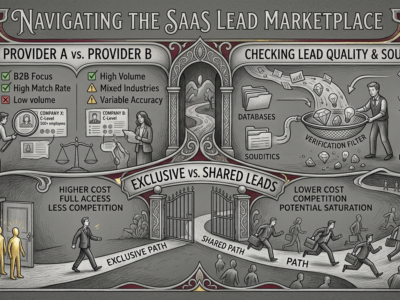
Exclusive verified leads sit in the middle. A human has confirmed the company exists, the contact works, and a signal is present. Response rates run over 3 percent against under 1 percent on scraped lists. Close rates run 6 to 12 percent against 1 to 3 percent on shared lists.
Because the record is not resold to four competitors, the cost per close drops from month one. That is the trade: more per record, less per signed build.
6-12%
Close rate on exclusive verified mobile app leads, against 1-3% on shared lists sold to four or more agencies.
Cold lists look cheap per record and expensive per close. At $0.40 a record you can buy 2,500 contacts for $1,000. Say 1 percent reply and 3 percent of those close. You have now spent $1,000 and 40 hours of outreach for one deal. Run that math before you buy volume.
Common Mistakes That Stall Mobile App Pipelines
Marketing to every industry at once. The fix is to delete three of your four target verticals and rebuild your site, case studies, and outreach around the one that remains. Generalist messaging reads as no specific expertise.
Writing proposals before discovery. A full proposal for an unscoped app is a week of unpaid work that usually loses to the cheapest quote. Sell a paid discovery phase at $5,000 to $15,000 first and credit it against the build.
Chasing pre-funding founders. An idea without money is a hobby. Wait for the round, then reach out inside 30 days while the roadmap is still being written.
Buying shared lists because the price per record looks good. Compare cost per close, not cost per record. A $0.40 record that never replies costs more than a $12 record that closes.
Leaving maintenance out of the first conversation. Apps break when iOS ships a new version. Studios that sell support from day one keep clients 12 months or longer and collect the referral at renewal. Studios that do not, lose both.
Treating referrals as a strategy. Referrals are a bonus that arrives on someone else’s schedule. If your forecast depends on them, you do not have a pipeline, you have luck.
FAQ
How do mobile app agencies get clients?
The most reliable mix is vertical referrals from design and product partners, outbound to companies showing a trigger event, and a small volume of exclusive verified leads. Content and SEO support all three but take 6 to 12 months to produce inbound. Run at least two channels so a slow month in one does not empty your calendar.
How much should I budget for mobile app lead generation?
A workable budget is $500 to $1,500 a month for verified leads plus 6 to 10 hours a week of your own outreach. Discovery revenue should fund it. One $8,000 discovery fee covers roughly six months of lead spend. Never spend more per month than one closed build returns.
How long does it take to generate mobile app leads?
Outbound and verified leads produce conversations within 7 to 14 days. Signed contracts take 3 to 6 months because app projects involve multiple stakeholders and large budgets. Expect a 90-day lag before revenue shows up, then a steady pipeline once the first cohort matures.
Are bought mobile app leads worth it?
They are worth it when the records are exclusive, checked by a human, and tied to a signal you can verify. They are not worth it when the list has been resold, the emails bounce, or nobody on your team will send the outreach. Ask for a sample list before you commit any budget.
What is a good close rate for mobile app leads?
Exclusive verified leads close at 6 to 12 percent. Shared lists close at 1 to 3 percent. Referrals close highest at 25 to 40 percent but arrive least often. Track your own close rate by source every month, because the number that matters is the one your team actually produces.
Should an app agency specialize in one vertical?
Yes. A specialist reuses architecture, shows relevant case studies, and asks better discovery questions, all of which shorten the sales cycle. Pick the vertical where you already have two or more shipped projects. If you have none, pick the one you understand best and build the first case study there.
Test the Water Before You Commit
If you have never bought app leads, start with a sample. Ask for 25 verified mobile app leads in your vertical, then check them yourself. Does the company show a trigger, does the contact work, and would you have found them on your own?
If the answer to the last question is no, the data is doing research you would never get to.
Want a sample before you commit?
Ask us for a free sample list of verified mobile app leads in your vertical. You review the data quality before you spend anything.
LeadPot delivers exclusive, internet-verified leads for agencies that need a predictable pipeline. Read more about how our B2B lead data works, or browse our agency growth guides for the rest of the system.