
You are searching for exclusive web design leads. You have probably already spoken to two or three vendors who use the word “exclusive” in their pitch. Every one of them says their leads are exclusive. None of them defines what that means.
This article explains what “exclusive” actually means in the lead vendor industry, how to verify a vendor’s claim before you spend, and how to build your own exclusive lead source so you never have to rely on a vendor’s definition again.
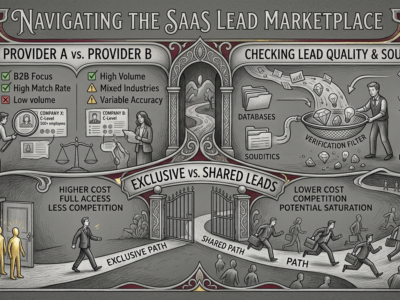
Some “exclusive” lead lists distribute the same lead to five or more agencies simultaneously. True exclusivity means one agency receives the lead. That is it.
“The word “exclusive” in lead marketing has been diluted to the point of meaninglessness. Before you buy, verify the definition, request a sample, and check the replacement policy. Your budget depends on it.”
What Exclusive Web Design Leads Are Supposed to Mean
In theory, an exclusive web design lead is a lead that only you receive. The vendor sells it to one agency, not to a list of fifty agencies competing for the same conversation. The lead knows they submitted a request, and only one agency contacts them about it.
In practice, “exclusive” means different things depending on the vendor. Some vendors define it as “we remove the lead from our list after selling it.” Others define it as “we guarantee no more than five agencies receive this lead.” A few genuinely mean exclusive to one buyer. Most mean something in between.
The gap between the promise and the reality is where lead buyers lose money. A lead that is sold to five agencies at 20 dollars each generates 100 dollars in vendor revenue and one or two actual conversations. Each buying agency spent 20 dollars for a lead that was never exclusive in any meaningful sense. Over the course of a month, an agency buying shared leads might spend hundreds or thousands of dollars on contacts that were also sold to competitors. The math does not work in the buyer’s favor.
Understanding how vendors structure their exclusive lead model helps you evaluate their claims before you commit. The terminology sounds straightforward. The implementation is rarely what the marketing implies.
How Lead Vendors Structure the “Exclusive” Claim
Shared lead pools
Some vendors build a single lead pool and distribute it across multiple agencies. When a lead submits a request, every agency in the relevant vertical receives the same contact information. The vendor may call this “exclusive within your niche” or “exclusive to your region.” In practice, the lead is receiving multiple outreach messages within hours of submitting their request. The exclusivity claim is a framing device, not a guarantee.
Shared leads work when the pool is small and the vertical is narrow. They fail when the pool is large and the outreach is aggressive. A web design lead who receives five emails from five agencies in one afternoon does not feel exclusive. They feel spammed.
Rotating exclusivity
A more honest model is rotating exclusivity: the vendor sells a lead to one agency for a set period, then resells to another after that window closes. The first agency gets a genuine exclusive window. The vendor generates more revenue per lead. The second agency gets a lead that has already been contacted once.
The risk for the second agency is that the lead has already formed an impression from the first outreach. If the first agency’s message was poor, the lead is colder by the time the second message arrives. Always ask a vendor using rotating exclusivity what the window is and whether the lead has been contacted before your outreach begins.
True exclusivity
True exclusivity means the lead is sold once. Period. The vendor does not resell, does not rotate, and does not add the lead to a follow-on list. The lead receives one outreach message, from one agency, and no other vendor messages until the deal closes or expires.
This model produces the highest response rates and the highest cost per lead. Vendors who offer true exclusivity charge between 40 and 120 dollars per lead depending on vertical and qualification depth. The ROI is higher because the close rate on an exclusive lead is three to five times the close rate on a shared lead. That math works for agencies with a healthy deal size. It does not work for agencies selling low-margin websites. Evaluate whether the lead cost makes sense against your average project value before you commit to an exclusive model.
How to Verify a Vendor’s Exclusivity Claim Before You Buy
Do not take a vendor’s word for exclusivity. Verify with these three checks before committing to a purchase.
Check 1: Ask for the exact definition
Send this message to any vendor claiming exclusive leads: “Can you define exactly what exclusive means in your model? Is the lead sold to one agency only, or does it go to a list? If it goes to a list, how many agencies receive it, and within what time frame?”
A vendor offering true exclusivity will answer clearly and specifically. A vendor running a shared pool will deflect, use vague language, or avoid the question. Their answer tells you more than their marketing page.
Check 2: Request a lead sample
Ask for three to five sample leads from the exact list you are considering buying. Not a generic lead from a different vertical or a different time period. From the exact list.
Review the sample for: completeness of contact information, relevance to your ideal client profile, and signs that the lead has been sold to other agencies already. If the lead data includes an “agency ID” field or notes about prior outreach, the lead has been distributed. True exclusivity vendors do not track which agency received a lead because there is only one.
Check 3: Check the replacement policy
No lead list is perfect. Even a genuine exclusive lead list will have a small percentage of invalid or unresponsive contacts. The vendor’s replacement policy tells you how they handle those cases. A vendor that replaces bad leads without charge is more likely to be honest about their list quality than a vendor that disputes replacements.
Before buying, ask: “What is your deliverability guarantee, and how do you handle leads that bounce or do not respond?”
The Lead Buyer’s Verification Checklist
Use this checklist before purchasing any lead list marketed as exclusive.
- [ ] The vendor defines “exclusive” in writing, not just in a sales call
- [ ] The vendor confirms the lead is sold to one agency only, not a list
- [ ] The vendor provides a sample from the exact list you are buying
- [ ] The vendor discloses how many agencies have received similar leads historically
- [ ] The replacement policy covers invalid contacts without additional charge
- [ ] The vendor provides data on lead age and source
- [ ] The lead data includes intent signals, not just name and company
- [ ] You can verify at least one lead in the sample independently
If the vendor cannot satisfy more than five of these eight items, the leads are almost certainly not exclusive in any meaningful sense. Walk away and find a vendor who can.
Even with a passing vendor, maintain healthy skepticism. Check the lead list freshness yourself at least once every quarter. If the vendor’s data quality slips, you should notice before it becomes expensive. The best agencies treat their lead source as a vendor relationship that needs regular review, not a set-and-forget purchase.
Building Your Own Exclusive Web Design Lead Source
The most reliable way to get exclusive web design leads is to generate them yourself. Here is how.
Step 1: Identify the signal that means a business needs a new website
A business that needs a new website shows observable signals. Their site has not been updated in more than three years. Their mobile load time is above five seconds. Their Google ranking for their own brand name is below position five. They recently rebranded, changed their product line, or expanded to a new market. They posted on LinkedIn about hiring a new marketing person.
These signals are public. You can find them manually in under an hour per prospect or automate the detection with a simple monitoring tool.
A portfolio that demonstrates outcome awareness is critical when reaching out to businesses with obvious website problems. If your outreach references a specific issue on their site, the prospect will almost certainly check your portfolio before responding. Make sure it is ready.
A portfolio that demonstrates outcome awareness is your most powerful asset when reaching out to businesses with obvious website problems. The outreach becomes easier when the prospect can see evidence that you solve problems like theirs.
Step 2: Build a monitoring system
Set up Google Alerts for businesses in your target industry and region combined with terms like “new website,” “redesign,” “hiring marketing,” and “rebrand.” Check the top twenty Google results for your target keywords weekly and note businesses with sites that are underperforming. Use a tool like BuiltWith to identify businesses running outdated technology stacks.
The goal is a shortlist of twenty to thirty businesses per month that show clear signals of needing web design work.
Step 3: Outreach with a specific observation
Send each prospect a message that references a specific thing you noticed about their site. Not a generic “I build websites.” A real observation: “I noticed your mobile site takes seven seconds to load, and your main competitor loads in under two seconds. Here is a quick breakdown of what is slowing it down and how we fixed the same issue for a client in your industry.”
This approach works because it demonstrates expertise, shows you have done your homework, and gives the prospect a reason to respond. Generic outreach gets ignored. Specific observation gets a conversation.
Step 4: Follow up with a case study match
After the initial observation, send a case study of a similar project. Same industry, similar problem, similar outcome. The lead does not need to imagine how you would handle their project. They can see it.
The outreach sequence for signal-based leads should be short. One observation message. One case study follow-up. One open-ended question. Most web design leads who are genuinely interested will respond within the first two messages. The ones who do not respond after three touches are not ready. Move on and add them to a nurture list for future outreach.
Exclusive Leads vs. Shared Leads: What the Numbers Say
The difference between exclusive and shared leads shows up in three metrics: response rate, close rate, and cost per close.
Response rate. Exclusive leads respond at 8 to 15 percent. Shared leads respond at 1 to 3 percent. The four to five times difference comes from the fact that an exclusive lead has not been contacted by five other agencies before yours arrives.
Close rate. Exclusive leads close at 6 to 12 percent for agencies that follow up with a structured process. Shared leads close at 1 to 3 percent. The lower close rate on shared leads comes from the fact that the lead is comparing multiple agencies simultaneously and often chooses the one who responded first or had the lowest price, not necessarily the best fit.
Cost per close. Exclusive leads cost more per lead but less per close. If an exclusive lead costs 60 dollars and closes at 8 percent, the cost per close is 750 dollars. If a shared lead costs 15 dollars and closes at 2 percent, the cost per close is 750 dollars. Same outcome. The exclusive lead reaches it with fewer outreach attempts and less competition.
The case for exclusive leads is not that they are cheaper. It is that they are more efficient. You spend less time on outreach, less time competing, and less time on leads that never close.
What “Exclusive” Should Actually Mean for Web Design Leads
If you are evaluating a lead vendor or building your own lead source, here is a practical definition of exclusive that is actually useful.
An exclusive web design lead meets all four of these criteria:
- The lead is delivered to one agency only
- The lead has not been contacted by another agency through the same vendor
- The lead data includes at least one intent signal that explains why the business needs a website now
- The lead’s contact information has been verified within the last 30 days
If a lead list meets all four criteria, it is worth paying a premium for. If it meets fewer than three, you are buying a shared list with a marketing label.
“The word ‘exclusive’ in lead marketing has been diluted to the point of meaninglessness. Before you buy, verify the definition, request a sample, and check the replacement policy. Your budget depends on it.”
Checklist: Is Your Lead Source Actually Exclusive?
Use this checklist before purchasing any lead list marketed as exclusive web design leads.
- [ ] The vendor defines “exclusive” in writing, not just verbally
- [ ] The vendor confirms the lead is sold to one agency only
- [ ] The vendor provides a sample from the exact list you are buying
- [ ] The vendor discloses how many agencies have received similar leads historically
- [ ] The replacement policy covers invalid contacts without additional charge
- [ ] The vendor provides data on lead age and source
- [ ] The lead data includes intent signals, not just name and company
- [ ] You can verify at least one lead in the sample independently
If the vendor cannot satisfy more than five of these eight items, the leads are almost certainly not exclusive in any meaningful sense. Walk away and find a vendor who can.
Stop Competing for the Same Leads
Get exclusive, internet-verified web design leads delivered to your agency. No competition, no shared lists, just qualified accounts ready to talk.
The same qualification filter applies to SaaS leads — verify before you buy, just like you would with any other lead source.
Request a sample of exclusive web design leads
Frequently Asked Questions
What is B2B lead generation?
B2B lead generation is the process of identifying and attracting potential business clients who need your agency’s services. It involves prospecting, qualifying, and nurturing decision-makers at target companies.
How do you find B2B leads for agencies?
Effective B2B lead sourcing includes LinkedIn prospecting, industry databases, cold outreach, referral programs, and content marketing. Focus on decision-makers like marketing directors and CEOs.
What makes a qualified B2B lead?
A qualified B2B lead has decision-making authority, budget availability, a genuine need for your services, and a realistic timeline. Qualification frameworks like BANT help prioritize prospects.