
Most founders searching for SaaS leads are looking for the wrong thing. They type “SaaS leads” into Google hoping to find a list of potential customers for their software product. What they get is a page of lead vendors selling contact data that was never qualified for SaaS specifically.
The result is the same every time. A few hundred dollars spent. A handful of outreach emails sent. Zero responses that matter.
This article explains what SaaS leads actually are, why most lead lists sold as “SaaS leads” are not, and how to generate leads that fit the profile of someone who will actually evaluate and buy a SaaS product.
What Makes a SaaS Lead Different From a Regular B2B Contact
A SaaS lead is not just any business contact at a technology company. It is a person at an organization with specific characteristics that make them likely to need, evaluate, and adopt a SaaS product within a defined timeframe. Those characteristics include company size within your product’s supported range, a role with budget or technical decision-making authority, an existing technology stack that overlaps with your category, and an active pain point your product solves that is currently costing them measurable time or money.
Most “SaaS lead lists” skip the qualification step entirely. They pull contacts from company registries, enrich them with basic firmographic data, and sell the list. The contact information is accurate in the sense that the email delivers and the person works at the company. It is not qualified in the sense that the person has any reason to care about your product or any budget allocated to solving the problem your product addresses.
The gap between a contact list and a qualified SaaS lead is the difference between spending 500 dollars on outreach that generates two responses and spending the same amount on outreach that generates twenty meaningful conversations.
Why SaaS Founders Burn Through Lead Lists
The typical SaaS founder lead cycle follows a predictable pattern. Search for “SaaS leads.” Find a vendor selling a list of 1,000 contacts at a low price per contact. Download the CSV. Plug it into an outreach tool. Send 200 emails over five days. Open rate lands around 15 percent. Reply rate lands around 2 percent. Two or four people respond. None of them are a fit.
The founder concludes that “cold outreach does not work for SaaS” and goes back to product work.
The problem is not outreach. It is the list. A contact who has never heard of your product, has no reason to believe your category matters, and has no budget allocated to your problem type will not respond to an outbound email regardless of how well it is written.
SaaS leads that convert share a common profile. They work at companies that have already signaled a need through public behavior. They use tools adjacent to your product category. They post about the problem you solve on professional networks. They attend events in your category. They are reachable, but not through a generic list you purchased.
4 Channels That Produce Real SaaS Leads
Channel 1: Intent data from product usage signals
The strongest SaaS leads come from prospects already showing behavior that matches your ideal customer profile. If your product is a project management tool for agencies, the best leads are agencies that posted a job description mentioning project management pain, team members who posted about switching tools on LinkedIn, or companies that just signed up for a competitor’s free trial.
You do not need expensive intent data platforms to catch these signals. Set up Google Alerts for competitor names combined with terms like “switching from” and “looking for an alternative.” Monitor LinkedIn for posts about tools in your category. Check review sites like G2 and Capterra for new reviews of competing products. The companies writing or responding to those signals are hot leads who have already admitted they have a problem.
Channel 2: Community-led prospecting
SaaS founders and decision-makers are active in specific communities: Reddit threads for their vertical, Slack workspaces, Discord servers, industry newsletters, and LinkedIn groups. The leads in these communities have self-identified as people who care about the problem you solve.
The outreach approach here is different from cold email. Do not pitch. Add value first. Answer a question, share a relevant resource, or comment on a thread with a specific observation. After two to three contributions, your outreach messages get responses because the recipient already recognizes your name.
The conversion rate from community-led outreach is significantly higher than cold list outreach because the trust foundation is already partially built.
Channel 3: Partner and integration referrals
If your SaaS product integrates with other tools, the companies that use those tools are qualified leads by default. A project management tool that integrates with Slack has a built-in lead pool in every company using Slack for team communication.
Reach out to the marketing or partnership teams at complementary tool companies. Propose a referral arrangement, a co-branded content piece, or a joint webinar. The leads that come through a trusted tool recommendation convert at three to five times the rate of cold outreach because the recommendation comes from a product they already use and trust.
Channel 4: Event and webinar leads
Running a webinar or speaking at an industry event puts you in front of an audience that has self-selected as interested in your topic. The leads who register and attend are warm. The leads who register but do not attend are still warmer than a cold list contact because they chose to invest time in your content.
Webinar leads work best when the topic is specific enough to attract your ideal customer profile but broad enough to fill seats. “How agencies manage client approvals” attracts project management tool leads better than “introducing our new feature” because it solves a problem the prospect is actively thinking about.
The SaaS Lead Funnel Nobody Talks About
Most SaaS lead generation advice focuses on the top of the funnel: how to get more leads in. Very little addresses what happens after a lead enters the funnel. The result is a leaky funnel where most leads never become customers, not because the product is bad, but because the follow-up process is missing.
A SaaS lead who downloads an ebook and never hears from you again will forget your company within a week. A lead who gets a personalized follow-up sequence tied to the content they consumed is 15 to 20 times more likely to convert.
The funnel structure that works for SaaS:
Awareness stage. The lead finds your content, signs up for a newsletter, or attends a webinar. They are interested but not ready to buy. Send them relevant content on a weekly cadence. Do not pitch. Provide value that reinforces the reason they engaged with you in the first place.
Consideration stage. The lead has engaged with multiple pieces of content over two to four weeks. They are comparing solutions. Send them case studies, comparison guides, and product-specific content. This is when demo requests happen. Your content at this stage should answer the specific questions they have about your category, not just your product.
Decision stage. The lead has asked about pricing, requested a demo, or compared you directly against a competitor. Move them to a human conversation fast. Speed of response at this stage is the biggest conversion lever. A lead who requested a demo and receives a response within one hour is significantly more likely to become a customer than a lead who waits 24 hours for a reply.
Most SaaS companies over-invest in awareness and under-invest in the follow-up sequence that moves leads from interested to ready. The leads are there. The gap is between getting their attention and closing the deal.
Building topical authority around your category works the same way for SaaS as it does for agencies — the leads who find you through content are warmer than any purchased list.
Understanding what your prospect’s situation looks like before you reach out is the same principle whether you are selling SaaS or design services.
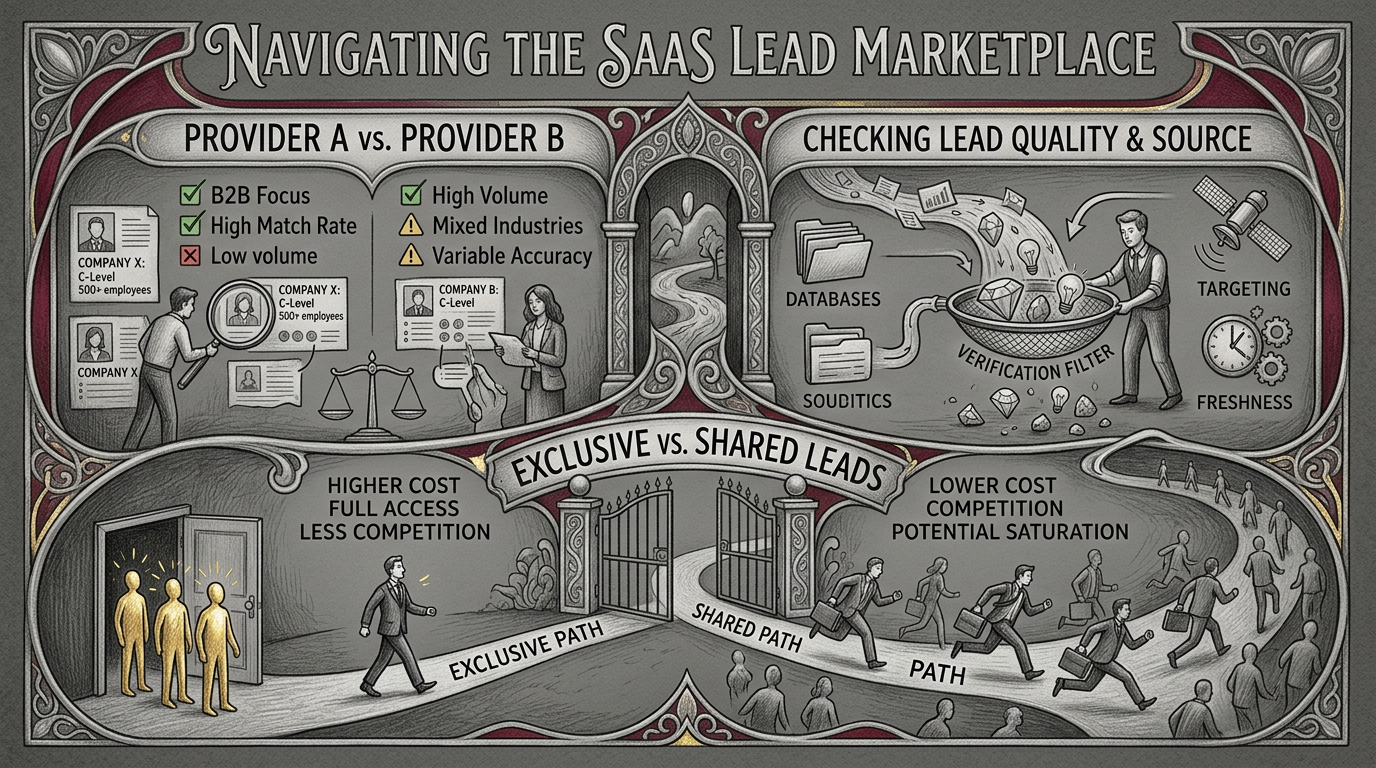
Buying SaaS Leads: What to Verify Before You Spend
If you do decide to purchase SaaS leads, verify three things before committing to a list.
Check the qualification criteria
Ask the vendor exactly how they determine that a contact is a “SaaS lead.” If the answer is “we filter by company industry,” that is not enough. You need a list built on behavior signals, role-based criteria, and technology stack overlap, not just company name matching.
The best lead providers let you filter by recent product activity, job posting signals, and role-based criteria. If the vendor cannot explain their qualification process in detail, the leads are almost certainly not qualified for SaaS specifically.
Check the data freshness
A lead list older than 90 days has a decay rate of 30 to 40 percent. People change jobs, companies pivot, and emails bounce. Ask for the list creation date and request a sample of ten contacts to verify deliverability before buying.
A lead that was valid six months ago may work at a different company today. Contact data without a freshness timestamp is a liability, not an asset. The vendor should also specify whether the lead data includes email addresses, phone numbers, or both. Email-only lead data is less valuable for high-ticket SaaS products where a phone conversation is part of the sales process. Ask about the data format before you buy.
Check the replacement policy
No lead list is perfect. Even a genuine qualified lead list will have a small percentage of invalid or unresponsive contacts. The vendor’s replacement policy tells you how they handle those cases. A vendor that replaces bad leads without charge is more likely to be honest about their list quality than a vendor that disputes replacements.
Before buying, ask what the deliverability guarantee is and how the vendor handles leads that bounce or do not respond. A vendor that offers a 30-day replacement window with no questions asked is signaling confidence in their data quality. A vendor that requires you to prove a lead is invalid before replacing it is signaling that they expect a high invalid rate.
How to Qualify a SaaS Lead in 30 Seconds
Not every inbound lead is worth the same amount of time. Use this quick filter to decide where to invest your outreach effort.
Budget signal. Has the lead mentioned a budget, visited a pricing page, or indicated a timeline? If yes, they are further along than most. Prioritize them.
Authority signal. Is the lead in a role with budget or decision-making authority? A lead from a VP of Engineering is further along than a lead from an individual contributor who is just researching.
Need signal. Has the lead engaged with content specifically about the problem your product solves, or are they consuming general industry content? Specific engagement signals a real problem. General engagement signals curiosity.
Timing signal. Has the lead recently changed roles, raised funding, or announced expansion? These events create immediate need for new tools and processes.
A lead who checks three or four of these signals is worth a same-day response. A lead who checks one or two is worth a nurture sequence.
SaaS Lead Sources Compared
| Lead Source | Speed | Conversion Rate | Consistency | Qualification |
|————-|——-|—————–|————-|—————|
| Intent data monitoring | Moderate | 10-18 percent | High | Strong |
| Community-led prospecting | Slow to build | 12-20 percent | Medium | Strong |
| Partner referrals | Fast | 15-25 percent | Medium | Strong |
| Webinar and event leads | Moderate | 8-15 percent | Seasonal | Strong |
| Purchased contact lists | Fast | 1-4 percent | High | Weak |
| Cold email to generic lists | Fast | 1-3 percent | High | Weak |
Intent data and community-led prospecting deliver the highest conversion rates because the leads have already signaled interest in your category. Purchased lists and cold email to generic contacts deliver volume but at a fraction of the conversion rate. The best SaaS lead system combines high-quality inbound channels with targeted outbound to fill gaps.
The channels you choose should depend on your product’s price point and sales cycle. A self-serve SaaS product with a 49-dollar monthly plan can afford to rely on content and free trial signups. A 5,000-dollar per month enterprise SaaS product needs a multi-channel approach that includes partner referrals, event leads, and targeted outreach to decision-makers. Match your channel mix to your revenue model. The agencies that align their channel selection with their product economics see higher ROI than agencies that use the same channel mix regardless of price point.
Checklist: Are You Generating Real SaaS Leads or Just Collecting Emails?
Run through this checklist to identify where your SaaS lead generation is actually working.
- [ ] Your lead definition includes role, company size, and pain point criteria
- [ ] You have at least one channel that produces inbound leads without paid advertising
- [ ] Your outreach messages reference something specific about the prospect’s situation
- [ ] You follow up with leads who do not respond within 48 hours
- [ ] You track which lead source produces your highest-quality customers
- [ ] You have a nurture sequence for leads who are not ready to buy immediately
- [ ] You verify lead quality before adding contacts to your outreach list
- [ ] You measure lead response rate, not just lead volume
- [ ] You segment leads by engagement level and adjust follow-up accordingly
- [ ] You review and refresh your lead data at least every 90 days
If you are only tracking lead volume, you are optimizing for the wrong metric. Quality leads convert at five to ten times the rate of volume leads. The cost per qualified SaaS lead is lower when you target fewer people with more relevance than when you blast a large list with generic outreach.
“The agencies that generate the most SaaS leads are not the ones with the biggest lists. They are the ones who take the time to understand what a qualified lead looks like for their product and build systems to find more of them.”
Higher conversion rate for leads who receive a personalized follow-up sequence tied to content they consumed vs. leads who receive a single generic email
Ready to Fill Your SaaS Pipeline?
Get exclusive, internet-verified SaaS leads sourced from real intent signals. Every lead is qualified for SaaS fit so your team spends time on conversations that can close.
Frequently Asked Questions
What is B2B lead generation?
B2B lead generation is the process of identifying and attracting potential business clients who need your agency’s services. It involves prospecting, qualifying, and nurturing decision-makers at target companies.
How do you find B2B leads for agencies?
Effective B2B lead sourcing includes LinkedIn prospecting, industry databases, cold outreach, referral programs, and content marketing. Focus on decision-makers like marketing directors and CEOs.
What makes a qualified B2B lead?
A qualified B2B lead has decision-making authority, budget availability, a genuine need for your services, and a realistic timeline. Qualification frameworks like BANT help prioritize prospects.