You spent $800 on a B2B lead list. The file arrived the same day with 4,000 contacts. Every record had a name, a title, a company, and a business email. Your team sent 400 personalized messages in the first week.
Fourteen replies came back. Nine were wrong fits, three were automated responses, and two asked you to stop emailing. That is the experience most agencies have when they buy B2B leads, and it is why so many of them decide that purchased leads do not work.
This guide covers how to tell the difference before you pay, what to check on every provider, and what the numbers should look like.
Why Buying B2B Leads Goes Wrong for Most Agencies
A bad lead purchase costs more than the invoice. You pay for the list, then you pay again in founder hours, sending reputation, and the month you spend chasing prospects who were never going to buy. The invoice is the smallest part of the total.
Here is the arithmetic most agencies skip. A $900 list of 3,000 contacts produces about 20 replies at a 0.7 percent response rate. Nine of those replies are qualified enough for a call.
At a 6 to 12 percent close rate on good conversations, one client lands. One client on a $1,500 monthly retainer is worth $18,000 across a 12 month lifespan. The math works, but only when the leads are closeable.
The expensive failure looks different. A burned sending domain takes three weeks to warm up again. A sales rep who spends two weeks on dead contacts loses momentum that is hard to rebuild. Every month on a bad list is a month not spent on the channel that was already working.
Most agencies blame the leads. Sometimes that is fair. More often nobody wrote down what a good lead looked like before the purchase, so nobody could tell a bad list from a good one.
What Does It Mean to Buy B2B Leads?
A B2B lead is a record about a company and a person at that company who can buy from you. Buying B2B leads means paying a provider to hand you those records instead of finding them yourself. The word lead does a lot of hiding in that sentence, because it covers two very different products.
The first product is a contact record: a name, a work email, a job title, a company size, sometimes a phone number. That is data. It tells you who exists in your market. It tells you nothing about whether any of them want to talk to you.
The second product is a contact record plus evidence. The provider tells you what happened at the company that makes now a good time to reach out. A funding round, a new VP of Marketing, a job posting for an in-house SEO, or a technology migration.
That evidence is the signal. The signal is what separates a list from a lead.
When you buy B2B leads you are choosing between those two products. Everything else follows from that choice: the price, the volume you need, the contract length, and the response rate you should expect.
Data Leads vs Signal Leads: What You Are Actually Buying
Data leads
Data leads are compiled from databases. The provider pulls public sources and buys enrichment from vendors like Apollo.io, ZoomInfo, or Clearbit, then packages the result. The contact is real and current as of the last refresh. The intent is invented by you, not by them.
Data leads work for one thing: enumerating a market you already understand. If you sell SEO retainers to e-commerce brands doing $2M to $10M in revenue, a data list is a reasonable way to build the full target account list.
What data leads cannot do is tell you who is ready. Response rates on cold data lists typically land under 1 percent. To get 10 conversations you send 1,000 emails. That is a volume game, and volume games need sending infrastructure, deliverability management, and patience.
Signal leads
Signal leads arrive with a reason attached. The provider monitors the events that precede a purchase and captures the company while the need is live. Funding announcements, hiring patterns, product launches, technology changes, site redesigns.
The reason matters because it rewrites your first sentence. Instead of “we help companies like yours with SEO”, you write “you just posted three SEO roles and your competitor launched a new category page”. The second message gets read and answered.
Verified signal leads respond at over 3 percent, and often higher. That gap is the difference between sending 1,000 emails for 10 conversations and sending 300 for 10 conversations.
The question that separates them
Ask any provider one question: what happened at this company in the last 30 days that makes them a lead today? If the answer is a job title and an industry, you are buying data. If the answer is an event with a date, you are buying signal. Providers that sell signal answer immediately, because that is the entire product.
Exclusive vs Shared Leads: Why Exclusivity Changes the Math
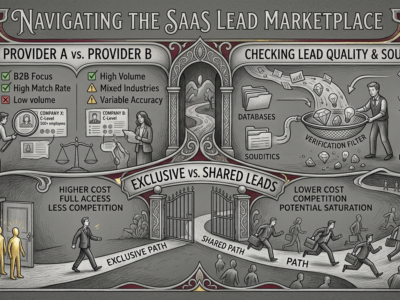
Shared leads are sold to multiple agencies. You might be buyer number four on a list of 200 contacts. By the time your email lands, three other agencies have pitched the same person the same service. The prospect is annoyed and your message reads like the others.
Exclusive leads are delivered to one agency. The prospect hears from you and nobody else. That single difference moves close rates from 1 to 3 percent on shared lists to 6 to 12 percent on exclusive leads. You are not competing on price against three lookalike pitches.
6-12%
Close rate on exclusive verified leads, against 1-3% on shared lead lists.
The price gap looks unfair until you do the per-close math. 200 shared leads at $1.50 each is $300 and closes one client. 50 exclusive leads at $12 each is $600 and closes three to six. The exclusive list costs more per contact and less per close, and cost per close is the only number that reaches your bank account.
Shared leads have one legitimate use. They are a cheap way to test a message or a new market when you have no budget and no expectations. Treat them as research, not pipeline. If you want the longer version of this comparison, read how to buy B2B leads the right way.
How to Vet a B2B Lead Provider Before You Pay
Most provider websites look identical. They all say verified, exclusive, and targeted. The way to separate them is to ask for proof, then check it against a small paid order.
Ask for a sample first. Not a demo account and not a screenshot of a dashboard. A real file of 20 to 30 leads in your niche. Providers that sell good data hand this over, because they know what you will find when you check it.
Run the sample through your own checks. Verify the emails with a tool like NeverBounce or Hunter. Look up each company. Confirm the person still works there. Confirm the signal they cited is real and recent.
- Does the record include a verified business email, not a generic info@ address?
- Is the phone number a direct line rather than a switchboard?
- Is there a named decision maker with a title you would actually pitch?
- Does the lead include the signal and the date it was captured?
- Was the signal captured in the last 30 days?
- Is the lead exclusive to you, with that guarantee in writing?
Ask four questions and write down the answers. How do you source leads? Are they exclusive to me? What is your replacement policy on bad data? How fresh is the signal?
The replacement policy is the one that separates real providers from list resellers. If a contact has left the company, do you replace it? A provider that stands behind its data will say yes with a number attached, such as 15 percent replacement within 30 days.
A provider that cannot describe its sourcing process specifically is reselling a database it bought from someone else. That is not automatically disqualifying. It does mean you are paying a markup for data you could pull yourself.
What Should B2B Leads Cost?
Pricing in this market spans three orders of magnitude, and the price alone tells you very little. A $0.30 contact and a $30 contact can both be good buys. It depends entirely on what is inside the record.
Raw data contacts run $0.10 to $2 each. Enriched records with a verified email and a direct line run $3 to $10. Signal leads with a named trigger event and exclusivity run $10 to $60 per lead.
Judge every price on cost per close, not cost per lead. Divide the list price by your expected close rate. A $5 shared lead at a 2 percent close rate is $250 per close. A $30 exclusive signal lead at a 10 percent close rate is $300 per close.
Those two numbers are close enough that volume decides it. 300 leads you never contact cost the same as 300 leads you work through in three weeks, except one of them produces nothing. If your team can send 100 emails a week, buy 300 leads a month, not 3,000.
The reason exclusive leads win on cost per close from month one is simple. You are not splitting the same prospect with three competitors, so your close rate roughly triples while your send volume stays flat. Fewer emails, more meetings, same budget.
How to Work a Purchased List Without Wasting It
Buying leads is not a substitute for outreach. A strong list with weak execution produces nothing, and a mediocre list with disciplined execution beats it. Here is how to run the part that happens after the file arrives.
Segment before you send. Sort by signal strength and recency. Work the leads with a signal from the last two weeks first, because your opener is still true for them.
Write the first line about them. Reference the signal, the company, or something specific you found on their site. A generic first line on a purchased list reads as spam and gets treated as spam.
Use a cadence, not a single send. Five to seven touches over 21 days is the standard. Most replies arrive on touch three or later. One email to a bought list is the fastest way to conclude that bought lists do not work.
Send from a separate domain. Never run cold email from your primary domain. Set up a dedicated sending domain, configure SPF and DKIM, and warm it for two to three weeks before the first send. Instantly, Smartlead, and Lemlist all handle rotation and warm-up schedules.
Track by signal type. Record reply rate, positive reply rate, and meetings booked for each signal. After 200 sends you will know which triggers convert for your service. Ask your provider for more of those.
The agencies that win are not buying more leads. They are buying fewer, better ones and following up faster.
Buy vs Build: Comparing Every Way to Fill Your Pipeline
Buying leads is one of four ways agencies fill a pipeline. Each has a real cost, a real speed, and a real failure mode. Here is the honest comparison.
| Source | Cost per close | Speed to first meeting | Consistency | Best for |
|---|---|---|---|---|
| Inbound organic (content and SEO) | Lowest over time | 4-9 months | High once ranking | Long-term compounding |
| Referrals and partners | Zero cash cost | 1-3 months | Low and lumpy | Warm, high-close deals |
| Cold data lists | High | 6-10 weeks | High volume, low quality | Volume and message testing |
| Exclusive verified signal leads | Low from month one | 2-5 weeks | High month to month | Agencies that need pipeline now |
Inbound organic is the cheapest per close and the slowest to start. A page that ranks for SEO leads produces inquiries for years. It still takes four to nine months to rank, and someone has to write it.
If you are weighing web design leads from a provider against a content program you have not started, the content program is nine months from its first inquiry.
Referrals convert at the highest rate of any source and arrive at the worst possible volume. You cannot schedule them, and they dry up exactly when you need them most, which is during a slow quarter.
Cold data lists are the fastest to launch and the most expensive per close. You can send 1,000 emails next week, and you will learn that 1,000 emails produce seven replies and two meetings.
Exclusive verified signal leads sit in the middle on every axis. They cost money up front, they arrive in days rather than months, and they convert at 6 to 12 percent instead of 1 to 3 percent. Cost per close is lower from month one, which matters when the leads are paid for out of this month’s revenue.
The recommendation that holds up: run one owned channel and one bought channel. Owned compounds over time. Bought covers the gap while it does.
Agencies that run only organic starve for six months. Agencies that run only bought leads never build an asset. A workable split is bought B2B leads for this quarter and one content cluster that ranks by next year.
Common Mistakes When Buying B2B Leads
Buying volume because the per-contact price is lower. 3,000 leads you cannot work are worth less than 300 you can. Fix: buy the number of leads you can genuinely contact in 60 days, no more.
Skipping the ideal client profile. Without one, every list looks fine and none of them fit. Fix: write down industry, company size, revenue band, geography, and decision-maker title before you talk to any provider.
Sending from your primary domain. One spam complaint can damage the domain your whole business runs on. Fix: a separate sending domain with SPF and DKIM, warmed for two to three weeks.
Sending once and quitting. Most positive replies arrive on touch three or later. Fix: five to seven touches across 21 days before you judge the list.
Judging on reply rate alone. A list can generate plenty of replies from people who will never buy. Fix: judge on positive replies, then meetings booked, then close rate.
Never ordering a sample. The provider website is marketing, not data. Fix: order 25 leads, verify them yourself, and only commit after the data survives your own checks.
FAQ
How much do B2B leads cost?
Raw data contacts run $0.10 to $2 each. Enriched records with a verified email cost $3 to $10. Signal leads with a trigger event and exclusivity cost $10 to $60. Judge the price on cost per close, not cost per lead.
Are shared B2B leads worth buying?
Rarely. Shared leads close at 1 to 3 percent because three or four agencies pitch the same person. They are useful for testing a message cheaply. They are not a pipeline, and the discount disappears once you count the wasted outreach.
What makes a B2B lead high quality?
Four things: a recent trigger event, a match to your ideal client profile, verified contact details, and exclusivity. A small list with all four converts far better than a large list with none of them.
How do I know if a B2B lead provider is legitimate?
Ask how they source leads, whether the leads are exclusive, what the replacement policy is, and how fresh the signal is. A legitimate provider answers all four with specifics. Vague answers mean they are reselling a database.
Should I buy B2B leads or build my own pipeline?
Do both, in sequence. Buy leads for pipeline this quarter while one owned channel compounds. Organic takes four to nine months to produce its first inquiry, which is a long time to run an empty pipeline.
How long before purchased leads produce meetings?
Two to five weeks if your infrastructure is ready. That includes a warmed sending domain and a written sequence. If you start from a cold domain, add two to three weeks of warm-up before you expect anything.
Where to Start
Start with a sample and a small order. Twenty-five leads in your niche, verified with your own tools, sent through a warmed domain on a five-touch sequence. That is a two-week test with a clear answer at the end of it.
If the sample data holds up and the sequence runs, scale the volume. If it does not, you learned something for the price of a small order instead of a retainer.
Want a sample before you commit?
Ask us for a free sample list of verified leads in your niche. You review the data quality before you spend anything.
LeadPot delivers exclusive, internet-verified B2B leads for agencies. See how our verified B2B leads work or talk to us about your niche.