
# Local SEO Leads: How to Find Businesses That Actually Need Local Search Help
You open Google. You search for “plumber near me” or “best restaurant in Chicago.” What you see is a local pack — that map-based result section with the three business listings, star ratings, review counts, and directions buttons. The businesses in that pack are getting 30 to 50 percent of all clicks from that search. The businesses below it are getting the scraps. For a local business, appearing in the local pack is not a nice-to-have. It is the difference between a full calendar and a quiet month.
That is why local SEO services are in demand. But that is also why local business owners are tired of being sold generic SEO packages that do not address what they actually need. They have been promised page one rankings. They have been sold monthly retainers with vague deliverables. They have worked with agencies that did not understand Google Business Profile optimization, citation building, or review management — the three pillars that actually move the needle for local search.
Your agency can stand out by being the one that actually understands local SEO. But you need the right leads to build that pipeline. Local SEO leads are not just any small business owners. They are business owners and marketing managers at companies with physical locations or service-area-dependent revenue who understand that local search visibility drives customer calls, foot traffic, and revenue. They are reachable. They have budget. And they are looking for expertise they cannot find on their own.
In this guide, you will learn what local SEO leads really are, how to read buyer intent signals from the signals local businesses leave online, how to verify that a local business actually needs your services, how to choose between DIY and DFY approaches for local SEO lead generation, which channels produce the best results, how to qualify leads effectively, and what mistakes to avoid.
—

What Are Local SEO Leads
Local SEO leads are businesses with a physical presence or defined service area that have demonstrated interest in improving their visibility in local search results. The main phrase here is “demonstrated interest.” A restaurant that has never searched for local SEO help, never complained about their Google rankings, and never tried to improve their online presence is not a lead. It is a prospect with no active need.
A real local SEO lead shows signs that they are aware of their local search performance, dissatisfied with it, or actively trying to improve it. They might have a poorly maintained Google Business Profile. They might be ranking below competitors in the local pack for their core service keywords. They might have inconsistent citations across directories. They might have a star rating problem — too few reviews, or bad reviews that are suppressing their visibility.
The local SEO market breaks down into several categories. Restaurants and hospitality businesses depend heavily on local pack visibility for walk-in traffic. Home services companies — plumbers, electricians, roofers, HVAC — depend on local search for service-area calls. Healthcare practices — dentists, chiropractors, physicians — compete aggressively for local pack positions because new patients often start with a local search. Retail and professional services — lawyers, accountants, real estate agents — also depend on local search for new client acquisition.
Each category has different pain points and different buyers. Restaurant owners care about review volume and photo optimization on Google Business Profile. Home service companies care about ranking across multiple service-area cities. Healthcare practices care about citation consistency and reputation management. Understanding these differences lets you target the right businesses with the right message.
—
Buyer Intent Signals for Local SEO Leads
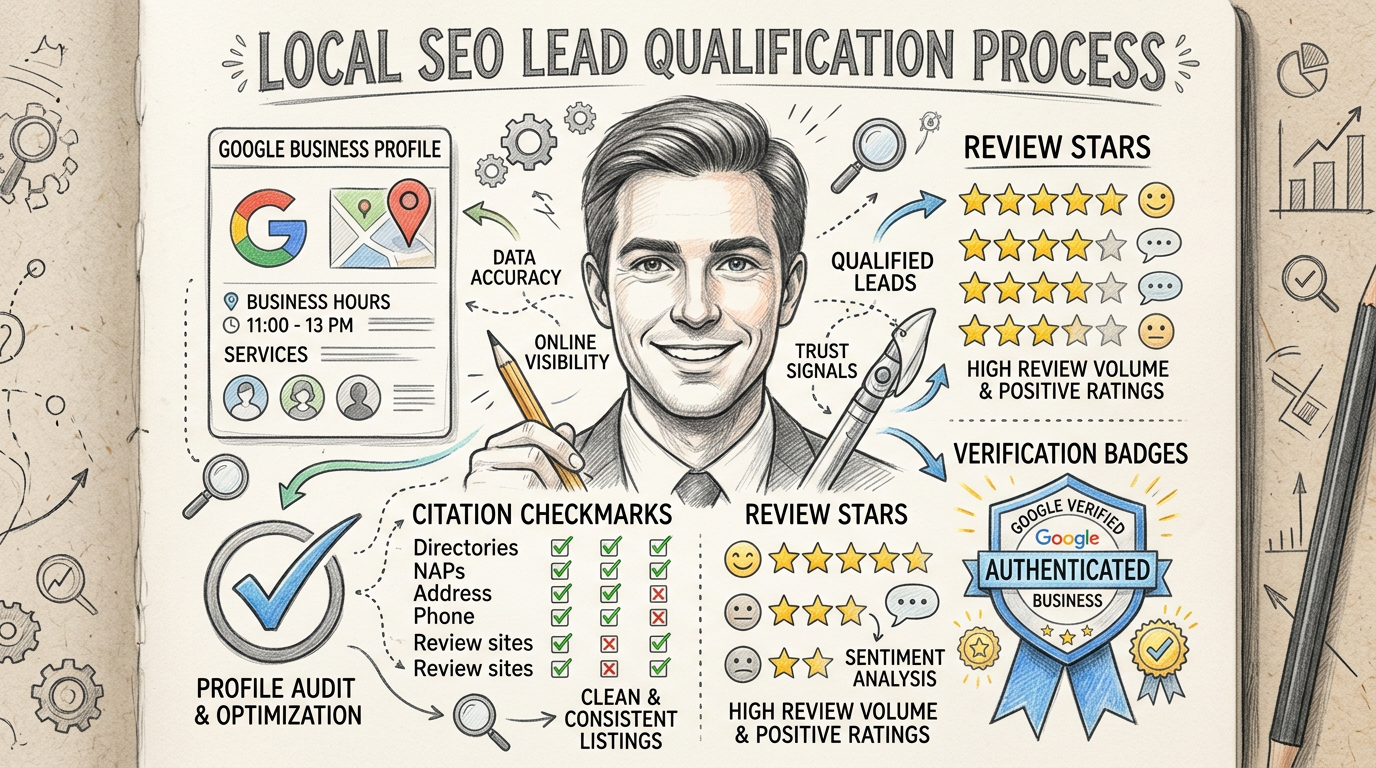
Local businesses leave signals everywhere. They are often louder and more visible than enterprise buyer intent signals because local business owners wear many hats and talk about their challenges publicly. Here is how to read those signals.
Google Business Profile Signals
A business’s Google Business Profile is a goldmine of intent signals. A profile with fewer than ten reviews and a rating below four stars is a business that is losing visibility and losing customers. A profile that has not been updated in months — no new posts, no Q&A responses, no photo updates — signals neglect. A profile with incorrect hours, missing service descriptions, or duplicate listings signals confusion about the platform. These are all businesses that need help and often know they need it.
Businesses that have recently experienced a drop in local pack rankings are particularly motivated. They have felt the impact of losing visibility. Calls have dropped. Foot traffic has declined. They know something is wrong even if they do not know how to fix it.
Local Pack Ranking Signals
When you search for a local service in any city, the three businesses in the local pack are the ones that have invested in local SEO or got lucky with early momentum. The businesses ranked fourth, fifth, and below are the ones that are actively losing. Those businesses below the fold are prime targets for your outreach. They can see exactly who is outranking them. They know what they are missing. Reaching them with a specific analysis of their local SEO gap is far more effective than sending a generic SEO pitch.
Citation Inconsistency Signals
Citations — the mentions of a business’s name, address, and phone number across directories, review sites, and data aggregators — are a foundational ranking factor for local SEO. Inconsistent citations are one of the most common and easiest-to-fix local SEO problems. A business with NAP inconsistencies across five or more directories is leaking ranking power. If you can identify those inconsistencies before outreach, you have a concrete problem to solve and a specific value proposition to present.
Review Signals
Review volume and review sentiment are local pack ranking factors. A business with 3.2 stars and 12 reviews sitting below a competitor with 4.7 stars and 89 reviews knows the gap. A business that has not received a review in 90 days is losing review momentum. Businesses with a pattern of negative reviews about the same issue — slow service, rude staff, pricing — have a reputation problem that local SEO expertise can help address.
Many local business owners are aware of these problems. They have Googled their own business. They have seen the reviews. They have noticed the drop in calls. They have tried to fix it themselves and gotten nowhere. They are ready for help from someone who knows the system.
If you want to see how local SEO leads fit into a broader client acquisition strategy, our lead generation overview covers the full pipeline from awareness to signed client.
—
How to Verify Local SEO Leads Are Genuine
Verification for local SEO leads focuses on three things: the business is real and operating, the business has a genuine local SEO problem, and the contact you are reaching can make the purchasing decision.
Business verification starts with the obvious: does the business exist? Is it open? Is the phone number active? Is there a website? Too many lead lists include businesses that have closed, changed ownership, or never really existed. Cross-checking against Google Business Profile, Google Maps, and the business’s own website catches most of these problems.
Local SEO problem verification requires checking the actual local search performance. Is the business ranking in the local pack for its core service keywords? If not, how far below the fold? What is the review situation? What does the citation profile look like? A business with no local SEO problems is not a lead. A business with specific, identifiable problems is a qualified lead with a clear pain point to address.
Contact verification means reaching the person who decides whether to hire an SEO agency. For small local businesses, that is often the owner. For multi-location franchises or professional service firms, it may be a marketing manager or practice administrator. Reaching the wrong person wastes your outreach and frustrates the contact.
LeadPot’s verification process checks all three layers. We deliver only accounts where the business is confirmed active, a local SEO problem has been identified, and the contact information for the decision-maker is current and verified.
—
DIY vs DFY: Which Approach Fits Your Local SEO Lead Strategy
The same DIY and DFY models that apply to other lead types apply here, but with some nuances specific to the local SEO market.
The DIY Model
With the DIY model, you receive a list of verified local SEO leads. Each account includes the business name, owner or marketing manager contact, verified contact details, and context about their local SEO situation. You run all outreach yourself.
The DIY model works well for local SEO if your agency already has outreach infrastructure and the capacity to execute consistently. Local SEO outreach requires a specific type of messaging — concrete observations about Google Business Profile issues, citation problems, and review gaps. It works best when the person sending the message understands local SEO at a practical level. DIY gives you full control over that messaging.
The cost structure is straightforward: you pay for the list and your team’s time. If you can convert even one local SEO client per month at a typical $500 to $2,000 monthly retainer, the list cost pays for itself many times over.
The DFY Model
With the DFY model, we run the full local SEO lead generation campaign on your behalf. We identify qualified local businesses, verify their local SEO gaps, manage outreach across multiple channels, and book qualified conversations directly to your calendar. You attend the calls and close deals.
The DFY model works for local SEO agencies that want to focus on delivering results for existing clients rather than prospecting for new ones. It works if you are expanding into a new city or service area and do not have the local network to find qualified businesses. It works if your team is already at capacity with client work.
For agencies comparing lead sourcing options more broadly, our buying SEO leads guide covers the ROI considerations for different lead types and price points.
DIY vs DFY: Side-by-Side Comparison
| Factor | DIY Model | DFY Model |
|---|---|---|
| What you receive | Verified local SEO lead list with business context and contact info | Booked conversations with qualified local businesses delivered to calendar |
| What you do | All outreach: emails, calls, LinkedIn, follow-ups, proposals, closing | Attend calls and close deals; provider handles outreach and qualification |
| Best for | Agencies with outreach capacity, local SEO knowledge, want message control | Agencies without prospecting time, expanding into new markets, want predictable volume |
| Minimum commitment | Per-list or per-lead purchase | 3-month campaign minimum |
| Cost structure | Lower direct cost; team time required for execution | Higher retainer; saves 10-20 hours per week on campaign management |
| Messaging control | Full control over outreach messaging and positioning | Provider crafts messaging with your input and approval |
| Time to first conversation | Depends on your team’s execution speed and list volume | Typically 2-3 weeks from campaign launch |
| Scalability | Limited by your team’s outreach capacity | Scalable to multiple cities and service areas without adding headcount |
For agencies that want good, exclusive local SEO leads with verified business data, exclusive SEO leads from LeadPot are built with the same verification rigor we apply to every vertical.
—
Channels That Work for Local SEO Lead Generation
Local businesses are everywhere, but they are not all equally reachable through the same channels. Here is where to find them and how to engage them.
Google Business Profile Optimization
Your own Google Business Profile is a lead generation tool. When a local business owner searches for local SEO help, they may find your profile. Optimize it with service descriptions, posts about local SEO case studies, Q&A content that addresses common local SEO objections, and photos of team members or results. A well-optimized GBP attracts inbound inquiries from local business owners who are already searching for help.
Local Business Directories and Associations
Local chambers of commerce, business associations, industry groups, and local directories are full of businesses that need local SEO help. These channels let you reach businesses by category and location. The engagement is typically warmer than cold outreach because the association context signals shared community interest.
Social Selling on LinkedIn and X
Many local business owners and marketing managers are active on LinkedIn and X. They post about their business challenges, share articles about digital marketing, and participate in industry discussions. Engaging with their content before sending an outreach message builds the familiarity that makes local business owners more receptive to conversations about their online visibility.
Email Outreach to Local Business Lists
Email outreach to verified local business contacts can be effective when the messaging is specific and relevant. Instead of “We offer SEO services,” try “I noticed your restaurant has 18 Google reviews and your competitor two blocks away has 127. Here is what that gap is costing you in local search visibility.” Specific observations get opened. Generic pitches do not.
Educational Content and Lead Magnets
Local business owners respond to content that solves specific problems. A free audit of their Google Business Profile. A guide to local pack ranking factors. A checklist for review management. These resources attract inbound interest from businesses that are actively looking for help. They also position your agency as the expert before any sales conversation begins.
—
How to Qualify Local SEO Leads: The important Checklist
Local SEO leads need to be qualified differently from other lead types because the local market has specific constraints around service area, budget size, and decisions speed.
Local SEO Lead Qualification Checklist
- Business has a physical location or defined service area relevant to local SEO
- Business has a Google Business Profile (active or inactive)
- Business has a specific, identifiable local SEO gap (low reviews, poor GBP optimization, citation inconsistencies, below-competitor local pack ranking)
- Contact is the business owner, marketing manager, or decision-maker for marketing spend
- Business operates in a service category with local search demand (verified through keyword search volume)
- Business location falls within your service coverage area
- Business has budget indicators consistent with your pricing model (revenue, employee count, current marketing spend)
- No recent engagement with a competing local SEO agency that would create switching friction
- Contact information verified within the last 30 days
- Business shows at least one recent signal of marketing awareness or dissatisfaction with current online visibility
A lead that passes this checklist is worth immediate, targeted outreach. The more specific the local SEO gap you can identify, the more effective your initial outreach message will be.
—
Common Mistakes Agencies Make With Local SEO Lead Generation
Local SEO lead generation has its own set of pitfalls. Here are the mistakes that cost agencies the most.
Mistake 1: Treating Local SEO Leads Like Any Other Business Leads
Local business owners are not the same as enterprise IT buyers or SaaS founders. They have different priorities, different budgets, different communication preferences, and different decisions processes. A pitch that works for a SaaS company will not work for a local restaurant owner. Craft messaging that speaks to local business concerns: revenue, foot traffic, phone calls, customer reviews, and local competition.
Mistake 2: Ignoring Google Business Profile as a Lead Source
Your own GBP is one of the most powerful lead generation tools for local SEO services. Business owners searching for local SEO help will find your profile. Posting GBP content about local SEO case studies, offering free GBP audits through your Q&A section, and responding to reviews professionally all generate inbound interest from businesses that are already looking for help.
Mistake 3: Outreach Without Specific Observations
“I can help with your local SEO” is not a message that gets opened by busy local business owners. “I noticed your restaurant’s Google Business Profile has 18 reviews and your main competitor has 127, which means you are losing about 40 percent of local search visibility” is a message that gets opened. The difference is specificity. Always lead your outreach with a concrete observation about the business’s actual local SEO situation.
Mistake 4: Using Shared Lists for Local SEO Outreach
Local businesses talk to each other. If two agencies are calling the same restaurant owner with the same local SEO pitch in the same week, the second call confirms the first agency’s claims. But it also means the owner has already heard the pitch. Shared lists in local markets lead to rapid list fatigue and damaged agency reputation.
Mistake 5: Underestimating the Sales Cycle
Local business owners often decide faster than enterprise buyers, but they also have tighter budgets and more skepticism about agencies. The sales conversation needs to address ROI in concrete terms: how many more calls, how much more foot traffic, what that means for revenue. Vague promises about “improved rankings” do not close local SEO deals. Specific projections do.
For agencies that want a structured approach to building a full local SEO client pipeline, exclusive SEO leads provide the verified, exclusive accounts that make consistent outreach possible.
—
Frequently Asked Questions
What are local SEO leads exactly?
Local SEO leads are businesses with physical locations or service areas that have demonstrated active interest in improving their local search visibility. They are identifiable through signals like poor Google Business Profile optimization, low review counts, citation inconsistencies, and below-competitor local pack rankings. A qualified local SEO lead has a contact decision-maker at a business that has a genuine, identifiable local SEO problem.
How do I identify local businesses that need SEO help?
Look for businesses that rank below their competitors in the local pack for core service keywords. Check their Google Business Profile for neglect signs — few reviews, no recent posts, incorrect information, missing photos. Check citation directories for NAP inconsistencies. Businesses that have recently lost local pack visibility or experienced drops in review volume are especially motivated buyers.
What is the difference between exclusive and shared local SEO leads?
Exclusive local SEO leads are sold only to your agency. You are the only outreach team contacting that business. Shared leads are sold to multiple agencies simultaneously. The response rate on exclusive local SEO leads is three to five times higher because the business has not been contacted by competing agencies. For local markets where businesses know each other, exclusivity is critical.
Which is better for local SEO lead generation: DIY or DFY?
DIY works if your team has outreach capacity and local SEO knowledge to craft specific, relevant messaging. DFY works if you want to focus on client delivery or are entering a new market. Many local SEO agencies start with DIY to control messaging and transition to DFY when their client load makes consistent prospecting difficult.
How long does it take to close a local SEO client from a lead?
Local business owners typically decide faster than enterprise buyers — often within one to three conversations — but the sales process still requires demonstrating specific value. Be prepared with a GBP audit showing concrete gaps, a clear explanation of what local SEO improvement would mean for their revenue, and case studies from similar local businesses. Most closed deals happen within two to four weeks of first contact.
What channels work best for reaching local business owners?
Google Business Profile optimization for your own agency, local business directories and associations, LinkedIn and X social selling, targeted email outreach with specific GBP observations, and educational content like free audit offers all work well for reaching local business owners. The most effective approach uses multiple channels in a coordinated sequence.
Are local SEO clients worth the effort?
Local SEO clients typically pay month
ly retainers between $500 and $2,000 depending on market size and service scope. More, local SEO retains clients longer than most other SEO services. Once a local business sees the revenue impact of local pack visibility, they rarely cancel. Average client lifespan exceeds 12 months. Many local SEO relationships extend three years or more.
—
Start Filling Your Local SEO Client Pipeline
Local SEO leads are businesses that have real local search problems, know they have them, and are looking for expertise they cannot easily find on their own. The agencies that win these clients are the ones that reach them with specific, relevant observations about their actual local SEO situation, not generic SEO pitches.
Whether you run outreach yourself through the DIY model or let us book conversations through DFY, the quality of the leads determines everything. Every outreach hour is only as productive as the account behind it.
If you want to see what verified local SEO leads look like for your agency and target markets, we can show you. No pressure. Just a clear look at what qualified, exclusive local business accounts look like in practice.
Frequently Asked Questions
How do agencies get SEO clients?
Agencies acquire SEO clients through content marketing, case studies, cold outreach, SEO audits as lead magnets, referrals, and demonstrating expertise through rankings on competitive keywords.
What SEO services sell best to clients?
High-demand SEO services include technical SEO audits, local SEO, E-E-A-T optimization, content strategy, and AI search visibility. Clients pay premium for measurable organic growth.
How do you pitch SEO services to businesses?
Lead with a free SEO audit showing current gaps, demonstrate quick wins with technical fixes, present a roadmap with projected traffic and revenue impact, and show social proof through case studies.