# B2B Leads UK: The Practical guide for 2026
Generating good B2B leads UK businesses can rely on is one of the most strategic investments a sales and marketing team can make. The United Kingdom offers a sophisticated B2B market with deep financial services heritage, a thriving technology ecosystem, and a regulatory environment that has made data compliance and customer trust central themes. This guide covers everything you need to know about sourcing, qualifying, and converting B2B leads in the UK, from London fintech scale-ups to Northern Powerhouse manufacturers and everything in between.
The UK B2B market rewards vendors who understand its nuances. London remains a global financial center, but the story of UK business is increasingly one of regional diversification. Manchester, Birmingham, Edinburgh, Bristol, and Cambridge have emerged as powerful B2B ecosystems in their own right, each with distinct industry concentrations and buyer cultures. Understanding these dynamics is important for any vendor looking to build a reliable UK pipeline.
Whether you are exploring buy-seo-leads as a rapid-entry strategy or building a full b2b-leads engine for long-term growth, this guide will equip you with the knowledge, frameworks, and practical insights needed to succeed in the UK market.

The UK B2B Market Overview
The United Kingdom is the fifth-largest economy in the world, with a business market that blends centuries-old institutions with modern innovation. London’s status as a global financial center is well established, but the broader UK market extends far beyond the capital.
Regional Business Hubs
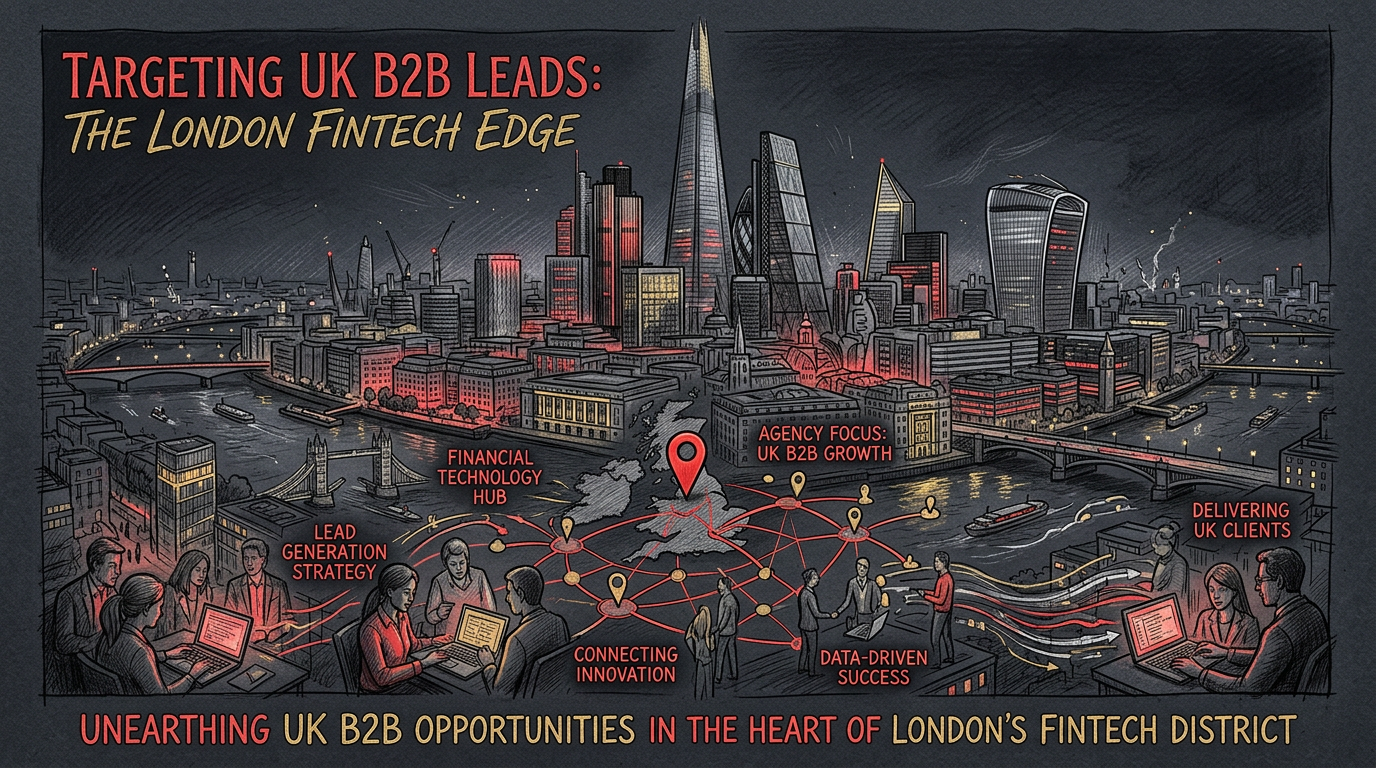
London – London is the UK’s dominant B2B hub, particularly for financial services, professional services, and technology. The city hosts the European headquarters of countless global corporations, the UK’s major banks, and a thriving fintech ecosystem. London B2B buyers are sophisticated, deal at high volumes, and expect vendors to demonstrate strong credentials quickly.
Manchester and the Northern Powerhouse – Manchester has emerged as the UK’s second-city technology hub. The Northern Powerhouse initiative has accelerated investment in digital infrastructure, creating a lively ecosystem of SaaS companies, digital agencies, and professional services firms. Manchester buyers tend to value practical solutions and respond well to vendors who understand regional business challenges.
Birmingham and the Midlands – Birmingham and the broader Midlands region host significant manufacturing, engineering, and professional services sectors. The region’s B2B market is oriented toward operational efficiency, supply chain management, and industrial technology.
Edinburgh – Edinburgh is a global center for financial services, particularly in asset management, insurance, and fintech. Scotland’s B2B market has a distinct character shaped by its legal system, regulatory environment, and strong professional services sector.
Bristol and the Southwest – Bristol has become a hub for creative technology, aerospace, and high-tech manufacturing. The region’s B2B ecosystem is characterized by innovation-focused buyers in aerospace, micro-electronics, and digital media.
Cambridge – Cambridge’s world-known university cluster has created one of Europe’s most concentrated technology ecosystems. The Cambridge Phenomenon spans AI, life sciences, deep tech, and enterprise software, making it a main market for vendors selling to high-growth technology companies.
main Industries Driving UK B2B Demand
The sectors most actively purchasing B2B products and services in the UK include:
- Financial services and fintech – London’s position as a global financial center creates sustained demand for compliance technology, payment processing solutions, customer data platforms, and financial software.
- Technology and SaaS – The UK hosts thousands of SaaS companies across London, Manchester, Cambridge, and Edinburgh. These companies are actively purchasing tools for growth, operations, customer success, and data management.
- Manufacturing and engineering – The UK’s manufacturing sector, concentrated in the Midlands and North, invests in operational technology, quality management systems, and supply chain solutions.
- Professional services – Law firms, accounting practices, and consulting agencies across the UK are upgrading their technology stacks and client management systems.
- Healthcare and life sciences – The NHS and private healthcare sector create demand for health technology, patient management platforms, and pharmaceutical technology solutions.
Buyer Intent Signals in the UK Market

Identifying prospects who are actively evaluating solutions requires reading the right signals in a market that moves quickly and rewards timely outreach.
London Fintech and the City
London’s fintech ecosystem is one of the most dynamic in the world. The city hosts thousands of fintech companies ranging from early-stage challenger banks to mature payment processors and regulatory technology vendors. London fintech buyers share identifiable intent signals:
- FCA authorization announcements and regulatory submissions
- Funding rounds from UK and international investors
- Product launches targeting specific financial services use cases
- Executive hires in technology, compliance, or growth roles
- Sponsorship or participation in London fintech events like Money20/20 and Fintech Connect
London fintech buyers move quickly and value vendors who understand both the technology market and the regulatory environment. Position your solution with specific references to FCA requirements, UK financial services use cases, and London market dynamics.
The Northern Powerhouse
The Northern Powerhouse initiative has transformed the business market across Northern England. Manchester, Leeds, Liverpool, and Newcastle now host thriving technology, digital, and professional services ecosystems. Northern Powerhouse buyers are increasingly sophisticated and connected, with growing appetite for technology solutions that help regional businesses compete on a global stage.
Northern buyer intent signals include:
- Investment announcements through the Northern Powerhouse Investment Fund or local growth initiatives
- Expansion into new office spaces in Manchester, Leeds, or Liverpool tech hubs
- Partnerships with Northern universities for research and development
- Participation in regional tech events like Manchester Tech Festival and Leeds Digital Festival
- Hiring signals indicating growth-stage expansion
For vendors targeting the Northern Powerhouse, positioning your solution as a tool for regional business growth and global competitiveness resonates strongly. Northern buyers appreciate vendors who understand the unique advantages and challenges of operating outside London.
GDPR Compliance Needs
The United Kingdom maintains its own version of GDPR through the UK GDPR, which closely mirrors the EU regulation but operates under UK jurisdiction. For B2B vendors, UK GDPR compliance is not optional – it is a market requirement that shapes purchasing decisions across industries.
UK GDPR buyer intent signals include:
- RFPs that specifically request UK GDPR compliance certifications
- CIO and data protection officer appointments
- Investment in data governance and privacy management platforms
- Participation in UK data protection and privacy events
- Public statements about data handling and customer privacy commitments
For vendors selling CRM platforms, marketing automation tools, customer data platforms, or any solution that handles personal data, UK GDPR compliance is a powerful differentiator in the UK market. Position your solution’s data handling practices, consent management capabilities, and privacy architecture as core value propositions.
Verification Methods for UK B2B Data
Data quality is the foundation of every successful B2B leads UK campaign. UK business data has specific characteristics that require targeted verification approaches.
Email Verification
UK business email domains use.co.uk,.com,.ltd, and increasingly,.io,.tech, and.ai extensions. Government departments use.gov.uk domains. Verify email addresses through multi-step validation: syntax checking, MX record verification, SMTP verification, and catch-all detection.
UK catch-all domains are common among small and medium enterprises, particularly those using Microsoft 365 or Google Workspace shared environments. Identifying catch-all domains prevents wasted outreach and protects sender reputation. Given the UK’s concentration of financial services and professional services buyers, maintaining strong deliverability metrics is important for long-term campaign success.
Phone Number Verification
UK phone numbers follow the +44 international format with specific area codes for geographic regions. London numbers use 020, Manchester uses 0161, Birmingham uses 0121, and Edinburgh uses 0131. Validating phone numbers against UK directory data and confirming that contacts still hold their listed titles adds confidence to your outreach.
Company House Verification
Companies House is the UK’s official register of companies. Every limited company in the UK is registered with Companies House, which publishes information about company status, directors, filing history, and registered addresses. Cross-referencing your B2B leads UK database against Companies House data confirms that target companies are active, identifies main decision-makers, and catches dissolved or dormant companies before they waste outreach budget.
DIY vs DFY: UK Lead Generation Approaches
The decision between in-house lead generation and outsourced campaigns depends on your team’s capabilities, timeline, and budget. Both approaches can deliver strong results in the UK market.
DIY Lead Generation
Building your own UK B2B lead generation capability gives you full control over targeting, messaging, and data management.
When DIY works for the UK market:
- You have a UK-based team member or team with local market knowledge
- Your ICP is clearly defined and you have historical conversion data
- You want to build long-term market penetration
- You have the capacity to invest in tools and process development
- Your sales cycle justifies the setup investment
important DIY tools for the UK market:
- Companies House API for company data validation
- LinkedIn Sales Navigator for UK-specific prospecting
- UK-focused email verification tools
- CRM with UK phone number formatting support
- Outreach platforms with UK time zone scheduling
DFY Lead Generation
Outsourcing to a done-for-you agency removes the operational burden of lead generation and accelerates time-to-first-lead.
When DFY is the right choice for UK B2B:
- You need leads quickly for a UK market entry or expansion
- You lack UK-based team members with local market expertise
- You want to validate messaging and ICP before investing in infrastructure
- You prefer predictable costs and defined timelines
- Your sales team is already stretched and needs qualified leads delivered regularly
What quality DFY UK campaigns include:
- Research on UK-specific buyer segments and intent signals
- List building using Companies House data, LinkedIn, and UK business directories
- Multi-channel outreach tailored to UK buyer preferences
- Lead qualification aligned with UK sales cycle expectations
- Reporting on metrics that matter to UK market dynamics
DIY vs DFY: Side-by-Side Comparison for UK B2B
| Factor | DIY Lead Generation | DFY Lead Generation |
|---|---|---|
| Setup complexity | High – requires tooling and process setup | Low – provider handles setup |
| UK market learning curve | Steep – you build the expertise | Moderate – agency brings UK knowledge |
| Cost per lead at scale | Lower at volume | Higher but predictable |
| Time to first lead | 6-14 weeks | 2-3 weeks |
| Control over UK-specific messaging | Full control | Shared with agency |
| Data ownership | Complete | Depends on contract terms |
| Best for | Teams with UK market presence | UK market entry or rapid scaling |
Many UK-focused B2B vendors use a phased approach: start with DFY to validate their ICP and messaging in the UK market, then transition to DIY as they build internal capability and market knowledge. This hybrid approach reduces risk while building sustainable capabilities. Evaluating buy-seo-leads and exclusive-seo-leads options alongside full DFY campaigns can help you find the right entry point.
Channels for Reaching UK B2B Leads
The UK B2B buyer is digitally sophisticated and active across multiple platforms. Understanding which channels deliver the best results for different segments of the UK market is important.
LinkedIn for UK Professional Outreach
LinkedIn is the dominant channel for B2B outreach across the UK, with particularly strong adoption in London’s financial and professional services sectors. UK professionals on LinkedIn are generally receptive to well-researched outreach, provided it is professional and relevant.
UK-specific LinkedIn strategies:
- Reference UK business events, regulatory changes, or economic news in outreach
- Use UK geographic filters to target specific cities and regions
- Engage with UK-focused business publications and thought leaders
- Reference London Stock Exchange or Companies House data for enterprise prospects
- Acknowledge UK-specific challenges such as Brexit-related market shifts
UK LinkedIn outreach performs best when it demonstrates familiarity with the UK business environment. Mentioning UK-specific context such as London office locations, Manchester growth stories, or Edinburgh financial services clusters adds credibility to your outreach.
Email Outreach for UK Prospects
Cold email remains a high-performing channel for UK B2B leads when executed with British business sensibilities in mind. UK professionals appreciate professionalism, clarity, and respect for their time.
UK cold email best practices:
- Keep subject lines professional and direct
- Reference UK-specific context: regulatory changes, market events, local industry trends
- Use British English spelling and conventions
- Respect UK time zones when scheduling outreach
- Maintain a formal but approachable tone
UK business culture values courtesy and professionalism. Avoid overly casual language, aggressive sales tactics, or American-style hyperbole. A measured, well-researched approach builds trust with UK buyers.
X / Twitter for UK Tech Communities
X has a lively UK B2B community, particularly strong in London’s fintech and tech scenes and Manchester’s digital ecosystem. UK tech founders, investors, and operators are active on the platform, making it valuable for top-of-funnel awareness and relationship building.
Use X to:
- Monitor UK tech event conversations around events like London Tech Week, Manchester Tech Festival, and various fintech conferences
- Identify prospects discussing relevant challenges in your category
- Share UK market insights and commentary to build authority
- Engage with UK tech media and influencers
Qualifying UK B2B Leads
Effective qualification separates high-value prospects from low-intent contacts. UK B2B leads should be evaluated through a framework that accounts for UK market characteristics.
BANT for UK Prospects
Budget – UK enterprise budgets often follow financial year cycles aligned with the tax year (April to April) or calendar year depending on the company. Public companies on the London Stock Exchange follow half-yearly reporting cycles that influence procurement timing.
Authority – UK enterprises, particularly in financial services and regulated industries, have formal procurement processes with defined approvers. Identify procurement teams, legal departments, and executive sponsors as part of your buying committee mapping.
Need – UK businesses face specific challenges related to UK GDPR compliance, Brexit-related market adjustments, regional economic disparities, and skills shortages in technology roles. Qualify leads against needs that reflect these UK-specific realities.
Timeline – UK procurement timelines vary significantly. Government contracts through frameworks like G-Cloud can take months. Private sector SaaS purchases may close in weeks. Understanding the likely timeline for your prospect type helps manage expectations.
Firmographic Filters for the UK
- Company size – UK businesses range from micro-enterprises to FTSE 100 corporations. Size directly impacts sales cycle complexity and deal value.
- Industry – Use SIC codes for precise industry targeting. The UK market has sector-specific nuances within industries.
- Geography – City and region-level targeting matters for field sales and local market expertise.
- Public vs private – LSE-listed companies have formal governance requirements. Private companies and subsidiaries have different buying patterns.
- Incorporation type – Limited companies, LLPs, and sole traders have different structures and decisions processes.
Common Mistakes When Buying B2B Leads UK
Avoid these common mistakes when sourcing and using UK B2B leads.
Mistake 1: Treating the UK as a Single Market
The UK is not London. While London dominates enterprise B2B activity, the Northern Powerhouse, Scotland, and regional hubs represent significant and growing markets. Focusing exclusively on London misses substantial opportunities and creates concentration risk.
Mistake 2: Ignoring UK GDPR Compliance
UK GDPR compliance is not optional for B2B vendors operating in the UK. Ensure your data sourcing, processing, and outreach practices comply with UK GDPR requirements. Non-compliance can result in significant financial penalties and reputational damage.
Mistake 3: Using Generic European or US Lists
The UK left the European Union, and its business environment has diverged from the EU in meaningful ways. Lists built for EU markets will contain irrelevant companies, incorrect regulatory assumptions, and data that does not map to UK-specific buyer contexts. Similarly, US-focused lists will miss UK-specific nuances entirely.
Mistake 4: Overlooking Companies House Verification
Companies House provides free, authoritative data on every UK limited company. Failing to verify your leads against Companies House means you risk targeting dissolved companies, incorrectly identified decision-makers, or outdated contact information.
Mistake 5: Neglecting Regional Buyer Differences
UK buyers in different regions have different priorities, communication styles, and purchasing behaviors. A London fintech buyer wants speed and innovation. A Midlands manufacturing buyer wants reliability and ROI proof points. A Scottish asset management buyer wants regulatory compliance and risk mitigation. Segment your outreach accordingly.
Checklist: What to Verify Before Buying B2B Leads UK
Use this checklist to evaluate any B2B leads UK provider before focused on a purchase.
- Data sourced specifically for the UK market with Companies House validation
- Multi-step email verification including UK domain catch-all detection
- UK phone numbers formatted correctly with valid area codes
- Decision-maker titles verified against LinkedIn and Companies House director data
- Company status confirmed via Companies House (active, not dissolved)
- SIC code classification for precise industry targeting
- Geographic segmentation available by city, region, and time zone
- Data refreshed within the last 30 days
- Provider compliant with UK GDPR requirements
- LSE-listing status available for enterprise targeting
- Sample records available for quality review
- Replacement policy for invalid contacts
Building a UK Lead Generation Pipeline
A strong UK pipeline combines market understanding, data quality, and execution that respects UK buyer preferences.
Define Your UK ICP
Start with clarity on which segments of the UK market align with your solution. Consider:
- Which UK cities and regions have the highest concentration of your ideal customers
- Which industries are most actively buying in your category
- What company sizes and revenue bands represent your best-fit accounts
- Whether you need bilingual or UK GDPR-specific positioning
- How your solution addresses UK-specific challenges
A well-defined UK ICP focuses your efforts and improves conversion rates by making sure outreach reaches genuinely relevant prospects.
Choose Your UK Channels
Select channels based on where your UK ICP is most active:
- LinkedIn – important for London financial services, professional services, and enterprise segments
- Email – Effective for mid-market and SME segments across all UK regions
- X/Twitter – Strong for London and Manchester tech communities
- UK industry events – Events like London Tech Week, Manchester Tech Festival, and industry-specific conferences generate warm leads
- UK business publications – Advertising and content in UK-focused publications builds brand awareness
Verify and Enrich
UK B2B leads UK campaigns fail most often due to poor data quality. Run every list through verification before outreach begins. Cross-reference against Companies House for company status. Verify email addresses and phone numbers. Confirm decision-maker titles through LinkedIn and Companies House director records.
Personalize for UK Context
UK B2B buyers respond to outreach that acknowledges their specific context. Reference UK-specific elements such as London Stock Exchange announcements, Companies House filings, UK industry reports, and local market events. A pitch that demonstrates understanding of the UK business environment will outperform a generic global message every time.
Measure and Iterate
Track performance metrics by UK region, industry segment, and channel. UK B2B buyers in different segments respond to different messaging approaches. Use data to refine your targeting, improve personalization, and increase conversion rates over time.
If you need a faster path to qualified UK contacts, exploring buy-seo-leads can provide a validated list while you build your own UK lead generation infrastructure.
UK GDPR and Data Compliance in Lead Generation
UK GDPR compliance shapes every aspect of UK B2B lead generation, from data sourcing to outreach execution to CRM management.
Data Sourcing Compliance
When buying B2B leads UK data from a provider, ensure they source and process data in compliance with UK GDPR requirements. This includes having appropriate legal bases for processing, maintaining records of processing activities, and providing transparency about how data is collected and used.
Outreach Compliance
UK GDPR and the Privacy and Electronic Communications Regulations (PECR) govern how you can contact business prospects. main compliance requirements include:
- Legitimate interest assessments for cold outreach activities
- Clear opt-out mechanisms in all communications
- Respect for suppression lists and unsubscribe requests
- Appropriate data handling throughout the outreach process
Record Keeping
Maintain records of your data sourcing, processing, and outreach activities. UK GDPR requires organisations to demonstrate compliance if challenged by the Information Commissioner’s Office (ICO). Proper record keeping protects your business and builds trust with UK prospects.
Lead Exclusivity and UK Market Performance
Lead exclusivity delivers measurable performance improvements in the UK B2B market. Given the UK’s relatively compact business community and the importance of reputation in relationship-based selling, overselling leads to multiple vendors can be particularly damaging.
Exclusive leads are sold to only one buyer exclusive web design leads, meaning your UK prospects encounter your outreach without competing messages from similar vendors. This exclusivity delivers:
- Higher response rates due to reduced prospect fatigue
- Stronger brand perception among UK B2B buyers
- Better relationship-building opportunities for UK sales teams
- Improved ROI on lead generation investment
When evaluating UK lead providers, ask about exclusivity models. Providers offering exclusive-seo-leads deliver consistently stronger campaign performance in the UK market than providers selling non-exclusive lists.
Conclusion: Building Your UK B2B Advantage
Generating B2B leads UK businesses can trust and convert requires a combination of market understanding, data quality, and execution that respects UK buyer preferences. The UK market offers exceptional opportunities for vendors who invest in specificity, compliance, and relationship building.
London remains the gravitational center of UK B2B activity, but regional hubs across the North, Scotland, and the Southwest are growing in importance. A segmented strategy that addresses the distinct needs of different UK regions and industries will outperform a generic London-first approach
.
Focus on the fundamentals: know your UK ICP, verify your data rigorously against Companies House, personalize your outreach for UK context, and ensure full UK GDPR compliance. Whether you build your pipeline in-house or partner with an agency, these principles will guide you toward consistent, scalable results in the UK B2B market.

Ready to Build Your UK B2B Pipeline?
Leadpot delivers qualified B2B leads UK businesses convert. From London fintech to Northern Powerhouse manufacturing, we provide the verified contacts, compliance-ready data, and UK-specific expertise your sales team needs to succeed.
Explore our services: Buy SEO Leads | Exclusive SEO Leads | B2B Leads
Keywords: B2B Leads UK, UK B2B leads, London B2B leads, Northern Powerhouse leads, UK GDPR lead generation, UK fintech leads, B2B lead verification UK, DIY vs DFY lead generation, UK B2B market, buy B2B leads UK
Frequently Asked Questions
What is B2B lead generation?
B2B lead generation is the process of identifying and attracting potential business clients who need your agency’s services. It involves prospecting, qualifying, and nurturing decision-makers at target companies.
How do you find B2B leads for agencies?
Effective B2B lead sourcing includes LinkedIn prospecting, industry databases, cold outreach, referral programs, and content marketing. Focus on decision-makers like marketing directors and CEOs.
What makes a qualified B2B lead?
A qualified B2B lead has decision-making authority, budget availability, a genuine need for your services, and a realistic timeline. Qualification frameworks like BANT help prioritize prospects.