Marketing agencies are good at many things – strategy, creative, media buying, analytics, reporting. Most are not good at generating leads for themselves. There is a paradox at the heart of agency life: the teams that are brilliant at generating leads for clients spend most evenings struggling to fill their own pipeline. The same skills do not always transfer when the product is your own agency.
This is not a moral failing. It is a structural problem. Most agencies do not have a dedicated business development function because founders and operators are too busy delivering client work. The result is a pipeline that swings between abundance and drought, with a stressful feast-or-famine cycle that disrupts hiring, planning, and the quality of clients the agency can afford to take.
This article covers two lead generation models that solve the problem at the source: receiving internet-verified exclusive accounts and running the outreach yourself (DIY), or having a provider run the entire campaign – social selling, email, and educational content – on your behalf (DFY) for a 3-month minimum commitment. For a deeper dive on sourcing SEO-specific leads, see SEO lead generation.
Why Marketing Agencies Struggle With Their Own Lead Generation
The paradox: experts at client leads, novices at own leads
Marketing agencies spend every day generating leads for clients. They run paid campaigns, optimise landing pages, write compelling copy, build nurture sequences, and report on attribution. They know more about lead generation than almost any other type of business.
Then they go home and cannot apply that expertise to their own agency. Psychologically, it is hard to apply the same rigour to selling your own agency that you apply to selling a client’s product. Structurally, most agencies do not have a separate business development function. The founders are too busy delivering client work. The account managers are too busy managing accounts. The strategy team is too busy building strategies. Lead generation falls between roles and nothing systematic happens.
The feast-or-famine cycle
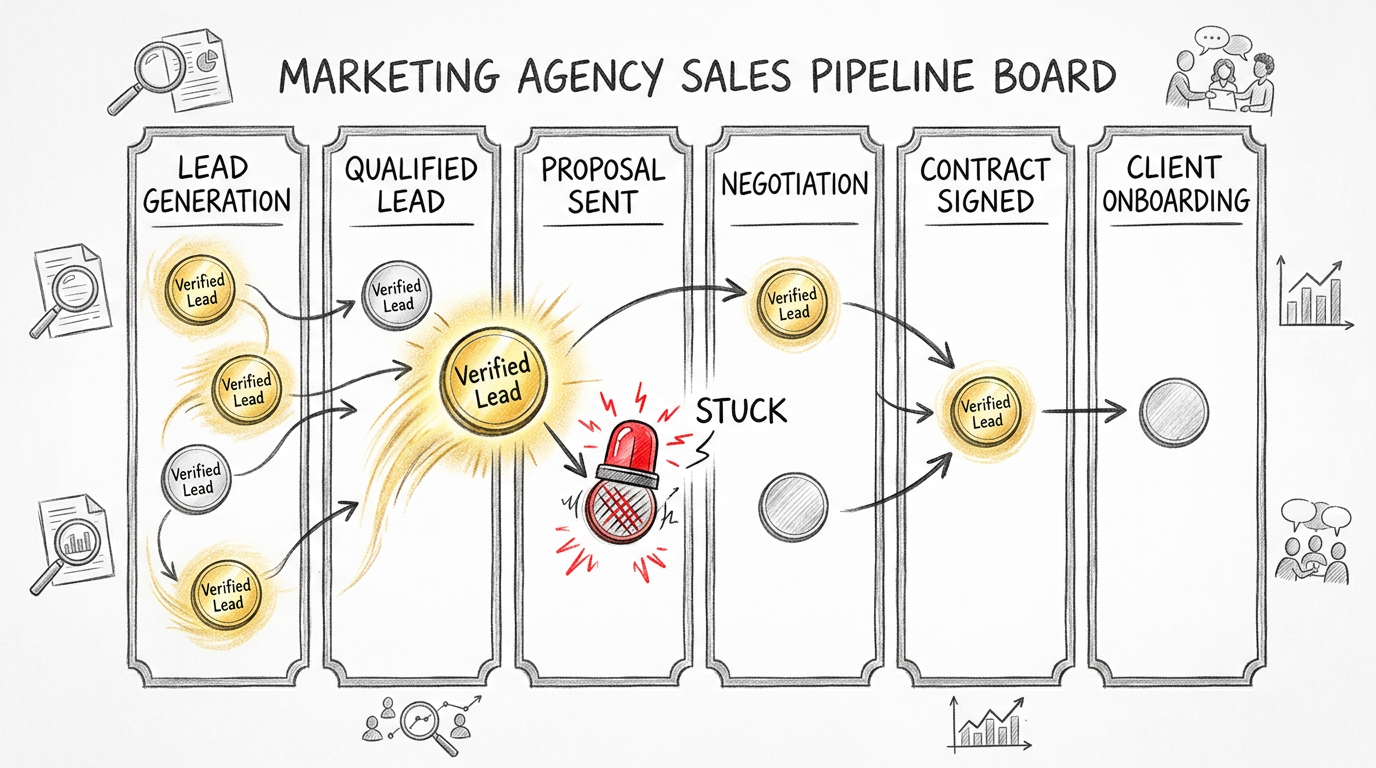
The pipeline swings. A big referral lands and the agency is full of work. The team hires. The team overcommits. Then the referral work wraps up, the pipeline empties, and the agency is back to cold outreach and hope.
When the pipeline is full, you can be selective about clients. You charge what you are worth. You deliver great work because you have time to focus. When the pipeline is empty, you take work you should not, hire before you are ready, and compromise on client quality to keep revenue flowing.
The cycle is not just stressful. It is expensive. Team morale, work quality, and the agency’s reputation all suffer when the pipeline is unpredictable.
Why referrals alone are not enough
Referrals are the best leads marketing agencies receive. They are pre-qualified, trust is established, the sales cycle is shorter, and the close rate is higher.
The problem is volume and timing. Referrals arrive in unpredictable bursts. You cannot plan headcount, project timelines, or cash flow around referrals alone. And relying entirely on referrals means your agency’s growth is dependent on your clients’ satisfaction and willingness to refer – factors you can influence but never fully control.
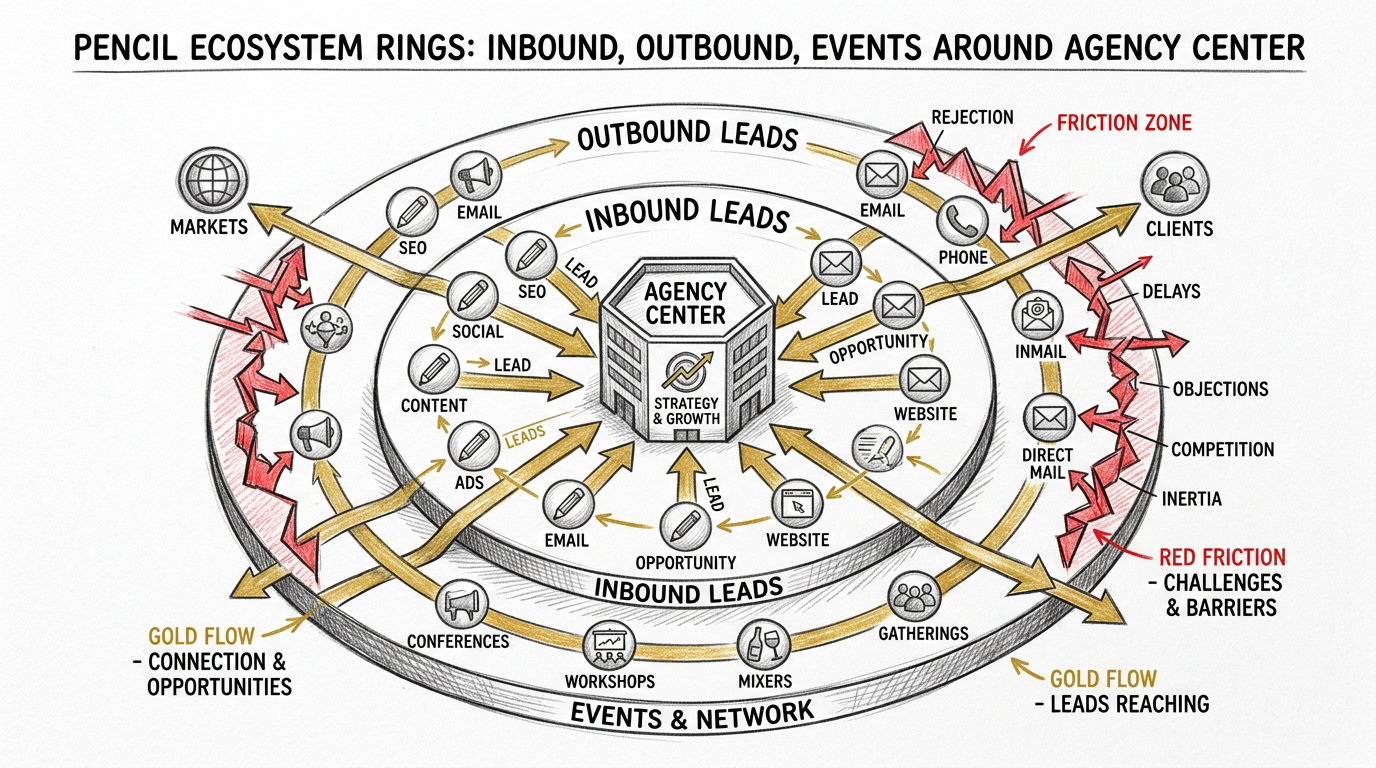
Two Models for Marketing Agency Lead Generation
DIY: Verified Accounts, Your Outreach
In the DIY model, your provider delivers a list of internet-verified accounts to your agency. Each account includes complete lead information: decision-maker name, verified email, verified phone, company size, industry, location, and the specific marketing service the account was actively researching.
Your team runs the outreach – email, LinkedIn, phone, social selling – using whatever channels match your agency’s process. The provider’s job is to deliver verified accounts with real intent. Your job is to convert them.
This is the more affordable model and the more controllable one. You decide messaging, sequences, timing, and follow-up cadence.
Best for: agencies with an in-house BD team, established outbound processes, and the time to run campaigns consistently.
DFY: Provider Runs the Campaign, You Get Booked Conversations
In the DFY model, the provider runs the campaign on your behalf. Minimum commitment: 3 months. During those months, the provider handles social selling across LinkedIn, X, Instagram, and Reddit, targeted email campaigns, and educational content creation that acts as a lead magnet – building trust and credibility with prospects before your agency ever speaks to them.
The campaign is built around your niche and target geography. If you want to reach e-commerce businesses in North America, the outreach messaging and content are built around e-commerce marketing challenges. You receive booked conversations directly into your calendar.
Best for: agencies that want to focus on delivery rather than prospecting, agencies entering a new niche or geography, agencies without the infrastructure to run consistent outbound, agencies that have tried DIY and want to scale without hiring more BD staff.
How Internet Verification Works for Marketing Agency Leads
What internet-verified means
An internet-verified account has shown documented online behaviour that proves a real, current need for marketing services. This might be a SaaS founder searching for “marketing agency for SaaS,” a CMO asking for recommendations on Reddit, a small business owner downloading a marketing budget template, or an in-house marketing manager searching for an external agency partner.
The verification process matches each account to one or more of these signals before the lead is delivered. You are not cold-calling a list. You are reaching out to an account that has already told the internet it needs your services.
Complete lead information
A verified marketing lead arrives with:
- Decision-maker name, verified email, verified phone
- Company domain, size, industry, geographic location
- The specific marketing challenge the account was researching
- The internet signal that verified the lead’s intent
- The date of the most recent signal
With this context, your first message can reference the prospect’s situation – not a generic pitch.
Channels Used in DFY Marketing Agency Campaigns
Social selling on LinkedIn, X, Instagram, and Reddit
The DFY provider runs targeted outreach on the platforms where your prospects are active. LinkedIn is the primary channel for B2B marketing services – the decision-maker is almost always there, and the professional context makes outreach feel less intrusive.
Reddit is particularly valuable because prospects ask for agency recommendations, complain about marketing problems, and discuss service providers openly in marketing and business communities. These posts are gold mines for intent signals.
X is valuable for brand-focused businesses where the founder or marketing director is active. Instagram for visual brands and DTC companies.
The outreach is not a connection request followed by a sales pitch. It is a series of personalised touches that build familiarity and credibility before the prospect is ready to engage with a sales conversation.
Targeted email marketing
Email sequences nurture accounts from first contact to a booked consultation. The sequences are built around the specific challenge the account was researching – not generic templates. Each email advances the relationship by offering insight, proof, or a clear next step.
Educational content and lead magnets
Educational content is the trust-building layer that separates DFY from simple list delivery. Before the first sales conversation, the prospect has engaged with content the provider created – a guide, a checklist, a benchmark report, a case study – that demonstrates expertise and gives the prospect a reason to trust your agency.
A prospect who downloaded your agency’s “SaaS Marketing Budget Allocation Guide” and then receives a personalised outreach referencing that download is significantly more likely to respond than a prospect who received a cold pitch with no context.
Why Exclusivity Matters for Marketing Agency Leads
Shared leads divide your close rate
Shared marketing leads are sold to multiple agencies simultaneously. When five agencies email the same prospect, the prospect disengages. One agency might close. The other four waste their outreach budget and sequences.
Exclusive leads mean the conversation is yours. The prospect receives one outreach sequence from one agency. Trust builds from the first touch. The close rate reflects that.
Exclusive leads create better client relationships
The first agency a prospect speaks to sets the benchmark. With exclusive leads, you set that benchmark. With shared leads, you are often the second or third agency in a crowded inbox – and the prospect’s first impression of your agency is not “this is the right agency for me.” It is “another pitch in a stack of pitches.”
Other Lead Generation Strategies for Marketing Agencies
Content-led SEO
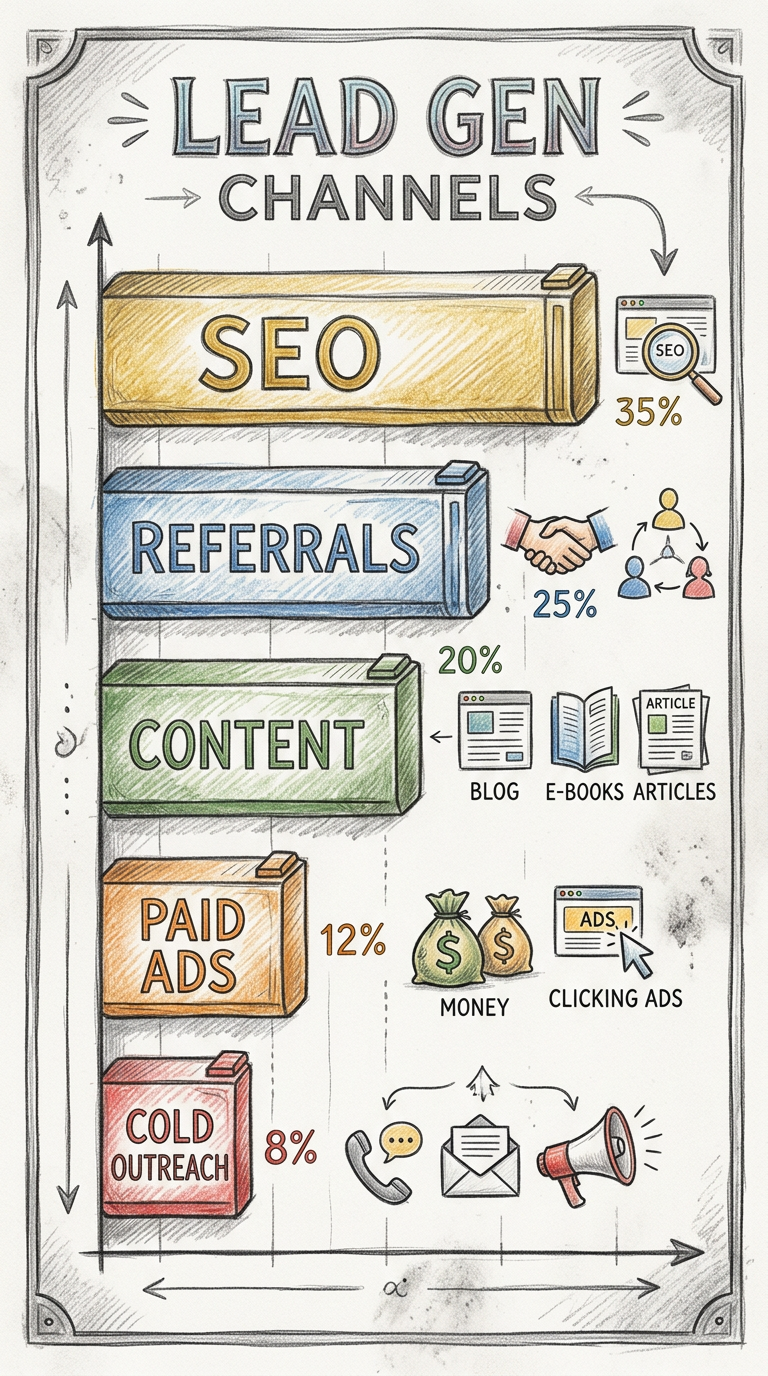
Content that ranks for commercial intent keywords is a 24/7 lead generator. Target keywords like “marketing agency for SaaS,” “PPC management for e-commerce,” or “social media marketing agency” – queries where prospects are actively evaluating solutions. Each piece of content acts as a continuous lead capture mechanism.
Case study landing pages
Case studies are your most powerful conversion tool. “How We Increased MQLs by 40% for a SaaS Company in 90 Days” converts at a much higher rate than a generic service page. Optimise for industry-specific keywords.
Paid advertising
Paid advertising on LinkedIn, Google, and Meta produces leads quickly but requires ongoing optimisation. The most efficient campaigns target narrow audiences by industry, company size, and decision-maker role.
Referral programmes
Happy clients are your best lead source. Formalise referrals: ask at the right moment, offer mutual value, maintain relationships with complementary agencies.
Speaking and webinars
Hosting webinars positions your agency as an authority and generates warm leads from prospects who have already engaged with your expertise.
How to Choose Between DIY and DFY
Choose DIY when:
- You have a BD team with established outbound processes
- You want full control over messaging and cadence
- You are testing a new niche and want to learn what resonates before scaling
Choose DFY when:
- Your team is focused on client delivery without bandwidth for outbound
- You need pipeline volume within 60-90 days
- You are entering a new niche or geography
- You have tried DIY but execution was inconsistent
Use both when:
- DFY for top-of-funnel volume in your target niche
- DIY for high-priority accounts your team wants to handle with custom outreach
How to Convert Marketing Agency Leads Into Clients
The consultation call
Focus on the prospect’s situation, not your services. Ask about their current marketing performance, their goals, their team setup, and their budget. Listen more than you talk.
The proposal
Lead with outcomes: “We will increase your MQLs by 40% and reduce cost per MQL by 30% within 90 days.” Support with case studies and a clear methodology.
Speed to lead
Contact verified leads within 24 hours. The signal that verified them is fresh. The prospect is actively thinking about their marketing problem.
The Buyer Psychology Behind Agency Lead Generation
Why marketing decision-makers resist agency outreach
Marketing directors and founders receive dozens of agency outreach emails per week. Most of them are generic, self-serving, and poorly targeted. The result is a mental filter: “if it sounds like an agency pitch, delete it.” This filter activates within seconds of opening an email – before the prospect has read a single sentence about your capabilities.
Internet-verified leads bypass this filter because the outreach references something the prospect has actually done – a search they performed, a post they wrote, a content they downloaded. The brain processes this differently: “this person has done their homework.” That small difference – personalised context versus generic pitch – is the difference between a deleted email and a reply.
Why exclusivity changes how prospects perceive your agency
When a prospect knows they are being contacted by one agency only, the psychological dynamic shifts entirely. They are not being sold to – they are being invited to a conversation. The urgency is gone, the competition anxiety is gone, and the prospect can actually evaluate whether your agency is a fit without the noise of ten other pitches crowding their inbox.
Why the DIY Model Works Best When Your Agency Has an Outbound Process
The list-building trap
Most agencies that do their own outbound spend the bulk of their time building lists, not selling. A team might spend two days scraping LinkedIn, one day cleaning the data, and three days writing outreach sequences – only to find that 60% of the contacts are wrong, the emails bounce, and the response rate is below 1%.
Internet-verified DIY leads eliminate the list-building phase entirely. The team opens a verified list and starts outreach the same afternoon. The time saved on list-building redirects into outreach volume, follow-up quality, and qualification conversations – the activities that actually generate clients.
The message-testing advantage
When your team has a verified list of accounts with documented pain points, message testing becomes faster and more productive. Instead of testing messaging on a generic list and waiting for responses, your team can test different angles on accounts whose pain points are known. “We helped a SaaS company recover from a Google update” versus “We helped a SaaS company increase organic traffic by 60%” – both are testable, and both are grounded in the real pain points the accounts in your list have demonstrated.
Why the DFY Model Works Best When Your Agency Needs Consistency
The consistency problem with in-house outbound
Most agencies start outbound with enthusiasm. Two weeks of intensive outreach produces a handful of responses. Then a big client project lands, the outreach stops, and the momentum is lost. Restarting outbound cold is harder than maintaining it.
DFY solves this because the provider is responsible for sustained execution. The campaign runs consistently – outreach sequences go out, content gets published, follow-ups happen – regardless of what else is happening inside your agency. The result is a pipeline that builds steadily, not one that depends on your team’s availability.
The niche-entry advantage
When your agency enters a new niche or geography, you lack the case studies, the content, and the brand recognition that make outreach effective in your existing market. A DFY campaign built around the new niche solves this: the provider creates niche-specific content, builds outreach sequences around the niche’s specific pain points, and targets the decision-makers in that niche.
Your agency arrives in the new market with a campaign that looks like it has been running for months – because it has. The provider built it while your team was focused on existing clients.
Measuring Lead Generation ROI for Marketing Agencies
Cost per lead is the wrong metric
Most agencies measure lead generation by cost per lead. But cost per lead is meaningless without context. A $10 lead from a shared list with a 1% close rate costs $1,000 per close. A $150 exclusive lead with an 8% close rate costs $1,875 per close – but the client quality is higher, the retention is better, and the referral value is greater.
Measure cost per close, not cost per lead. Measure client lifetime value, not just first-year revenue. Measure referral rate, not just conversion rate. These are the metrics that tell you whether your lead generation is actually working.
Scaling Agency Lead Generation
From 5 to 20 leads per month
The agencies that successfully scale their lead generation do three things: they move from DIY to DFY for top-of-funnel volume, they invest in case study content that improves conversion rates across all channels, and they formalise their referral programme so happy clients become a systematic lead source rather than a random event.
The transition point is usually around 5-10 leads per month via DIY. At that volume, your team is spending meaningful time on outreach. Moving the top of the funnel to DFY frees up that time for closing and delivery while maintaining pipeline volume.
Adding new niches
The fastest way to add a new niche is to run a targeted DFY campaign in that niche. The provider builds the campaign around the niche’s specific pain points, creates the content, runs the outreach, and delivers conversations. Your team then evaluates the quality of those conversations and decides whether to invest in building organic authority in the new niche through content and case studies.
FAQs
What is the best lead generation model for marketing agencies?
A combination of internet-verified exclusive leads (DIY or DFY) with content SEO, case studies, and a structured referral programme.
What does internet-verified mean for marketing leads?
The account has shown documented online behaviour that proves a current need for marketing services.
DIY vs DFY – which is right for my agency?
DIY if you have in-house outbound capacity. DFY if you want a 3-month minimum campaign that books conversations into your calendar.
Can DFY campaigns target specific niches and regions?
Yes. Every campaign is built around the niche you want to target and the regions you want to focus on.
How much do marketing agency leads cost?
DIY is typically per-lead or per-list. DFY is a monthly retainer with a 3-month minimum.
Conclusion
Marketing agencies are experts at generating leads for clients. Applying that expertise to their own pipeline requires the right model: receiving verified accounts and running outreach yourself (DIY), or having a provider run the full campaign – social selling, email, content – on your behalf (DFY).
Both models work when the leads are internet-verified and exclusive. The agencies that never return to feast-or-famine combine both approaches: organic authority for long-term efficiency, and bought leads for immediate consistency.
Want to see what internet-verified, exclusive marketing leads could look like for your agency? Ask us for a sample.