Every SEO agency reaches the same moment: you are good at what you do, your existing clients are happy, and you have capacity to take on more work. But the pipeline is not filling up fast enough. You are doing everything right on the delivery side and struggling on the business development side.
Finding SEO clients is not the same as finding clients for other services. SEO buyers have specific concerns – trust, transparency, timeline, and past bad experiences with agencies that over-promised and under-delivered. The agencies that win at SEO client acquisition understand these concerns and build their strategy around them.
This guide covers the complete process of finding and winning SEO clients, including a lead generation model – internet-verified, exclusive leads from buying SEO leads through DIY or DFY – that removes the prospecting bottleneck and gives your agency a consistent pipeline of qualified conversations.
Understanding the SEO Client Mindset
The three types of SEO buyers
Most SEO prospects fall into one of three mindsets when they start looking. Your outreach, your content, and your lead generation strategy need to address the mindset of the prospect in front of you.
“We tried SEO before and it did not work” – This prospect is sceptical. They invested money in an agency, waited six months, and saw little to no results. They need proof before they will trust another agency. Lead with case studies that show a similar starting point, transparent methodology, and honest timelines. Do not oversell. They have been oversold before.
“We know we need SEO but do not know where to start” – This prospect is overwhelmed. They know organic traffic is important but do not understand what SEO involves, what it costs, or how to evaluate an agency. They need education before they are ready to engage. Lead with free educational content – an audit, a guide, a diagnostic – that gives them a clear picture of what good SEO looks like.
“Our current agency is not delivering” – This prospect is frustrated. They have an agency, but the results are not coming, the communication is poor, or the methodology is opaque. They need a clear alternative with a faster timeline and better communication. Lead with a specific diagnosis of what is likely going wrong and how your approach is different.
One-size-fits-all messaging will not resonate across all three. The agencies that win at SEO client acquisition segment their outreach and their content to match the prospect’s mindset. They do not send the same pitch to every prospect. They adapt.
What SEO clients actually care about
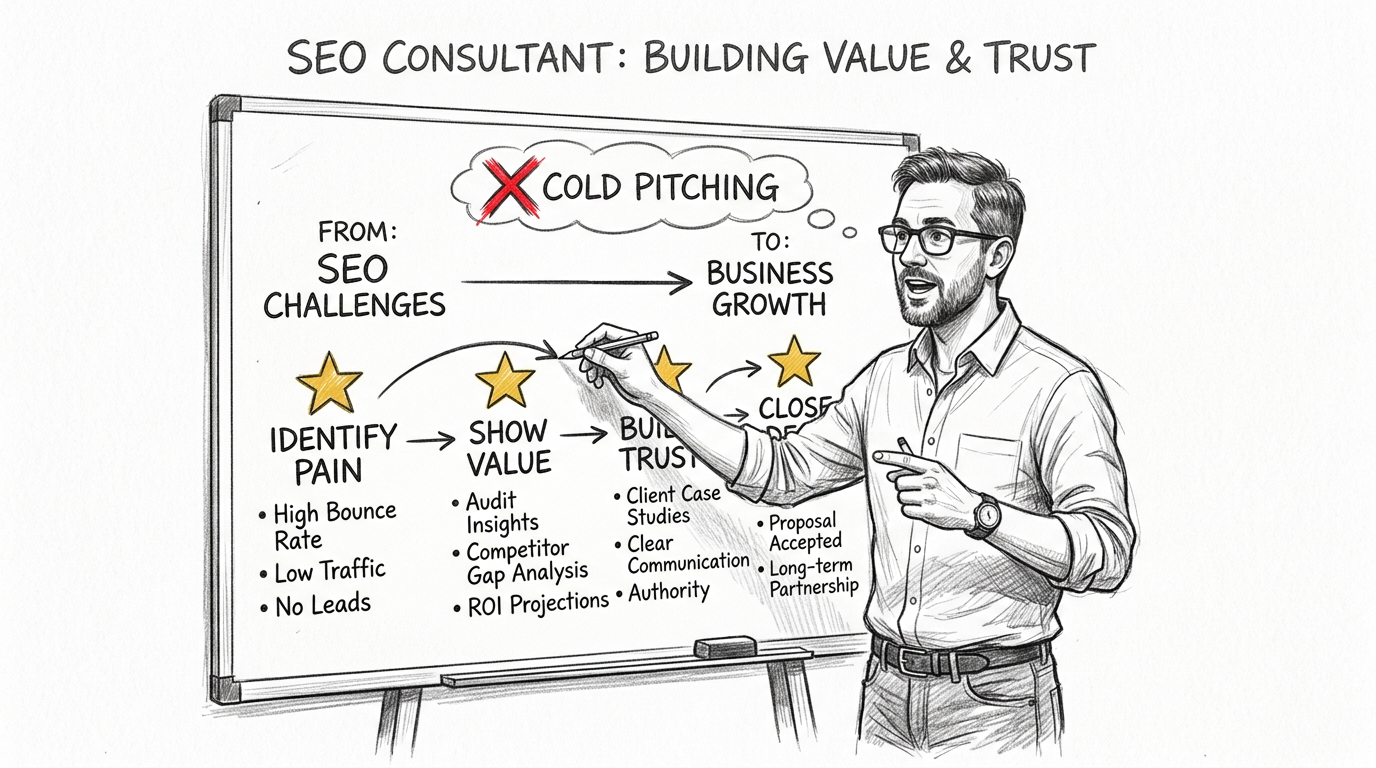
SEO clients care about three things, in this order: trust, transparency, and results.
Trust: “Will this agency deliver what they promise?” This is the first question every sceptical SEO buyer asks. It is the reason case studies, testimonials, and third-party validation matter more in SEO pitches than in almost any other service pitch.
Transparency: “Can I understand what they are doing and why?” SEO is technical. Most business owners do not understand it. The agencies that win clients explain SEO in plain language, show what they are working on, and connect every activity to a business outcome.
Results: “Will I see actual growth in my organic traffic and leads?” This is what the prospect ultimately cares about. But it is the third question, not the first. You cannot skip trust and transparency to get to results. The prospect needs to believe you before they care about what you can deliver.
How the Verified Lead Model Helps You Get SEO Clients
The fastest path to qualified SEO conversations
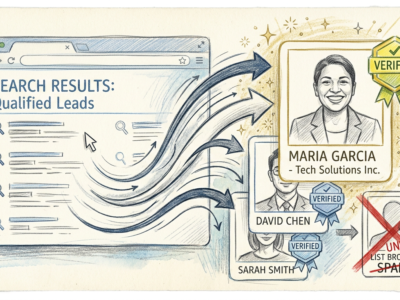
Buying internet-verified, exclusive SEO leads removes the prospecting phase. Instead of building lists, writing outreach sequences, and waiting for responses, you receive accounts that have already shown documented intent to engage with an SEO agency.
Each account arrives with complete information: the decision-maker’s contact, the company context, the specific SEO pain point they were researching, and the signal that confirmed the intent. Your outreach starts with context – not a cold pitch to a random contact.
DIY: you run the outreach on verified accounts
In the DIY model, the provider delivers the verified accounts. You run the outreach – email, LinkedIn, social selling, calls. You control the messaging, the sequences, the timing.
Best for: agencies with an in-house BD team and established outbound processes.
DFY: the provider runs the campaign, you get booked conversations
In the DFY model, the provider runs the campaign on your behalf. Minimum commitment: 3 months. The provider handles social selling across LinkedIn, X, Instagram, and Reddit, targeted email campaigns, and educational content that acts as a lead magnet. You receive booked conversations directly into your calendar.
Best for: agencies that want to focus on client delivery, agencies targeting specific niches or geographies, agencies without the infrastructure to run consistent outbound.
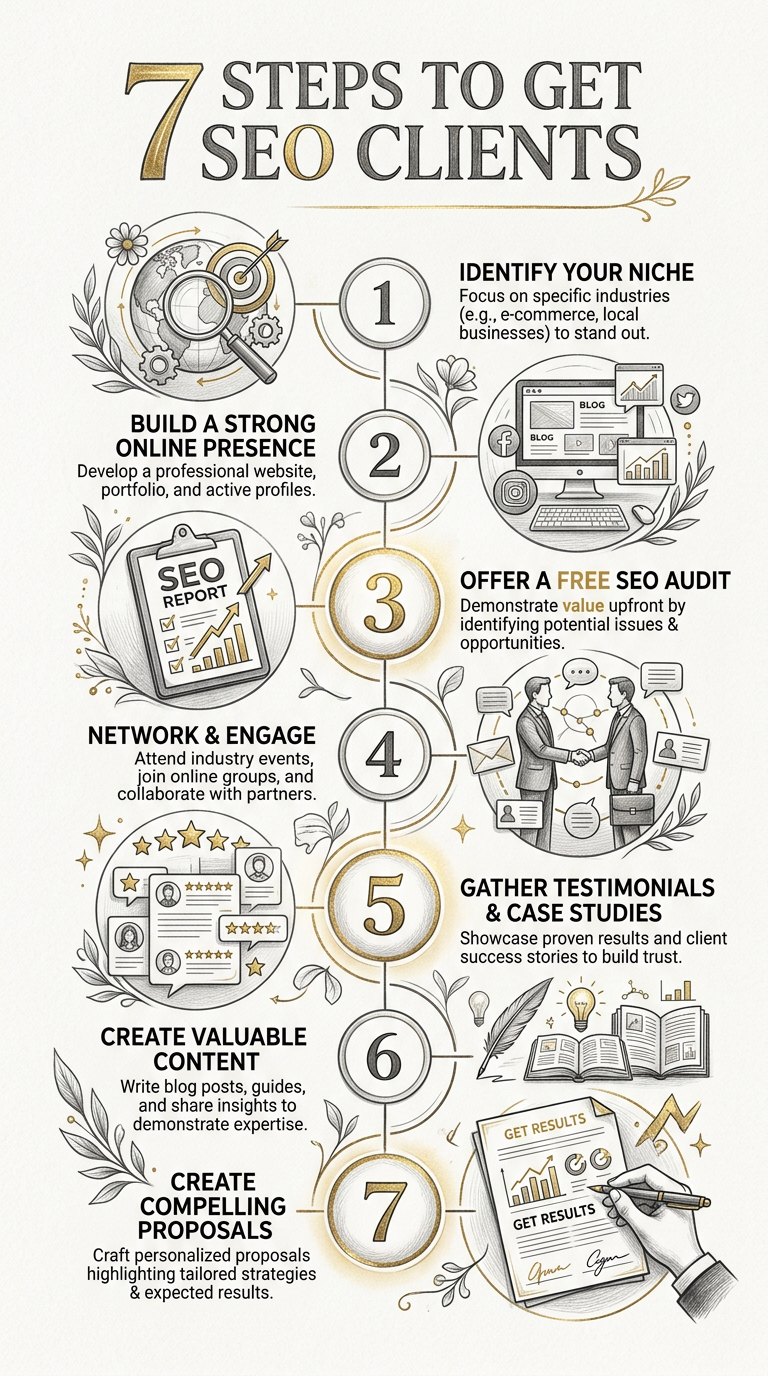
Step 1: Define Your Ideal SEO Client
Why niching down gets you better clients faster
The agencies that struggle to find SEO clients say “we work with any business that needs SEO.” That is not a niche – it is the absence of one. Niching down – “we work with SaaS companies doing $50k-$500k MRR” or “we work with e-commerce stores selling homewares” – makes every part of client acquisition easier.
Niching down means your content can be more specific, your case studies more relevant, your outreach more targeted, and your pricing more confident. Prospects in your niche see you as an expert in their world, not a generalist who works with everyone.
How to identify your best-fit SEO clients
Look at your existing clients. Which ones have the best results? Which ones pay on time? Which ones are the most enjoyable to work with? Those are your ideal clients. Now work backwards: what do they have in common?
Your ideal client profile should include: industry or niche, company size (revenue or team), decision-maker role, monthly budget range, and the specific SEO problem they hired you to solve.
Targeting in the DFY model
DFY campaigns are built around your ideal client profile. If you target SaaS companies in North America, the social selling, email, and educational content are all built around SaaS SEO challenges. Every prospect in the campaign matches the profile you defined.
Step 2: Build Authority That Attracts SEO Clients
Publishing SEO-focused content
Your website should be your best lead generation tool. Publish content that demonstrates your expertise and targets the keywords your ideal clients search for: “how to choose an SEO agency for SaaS,” “SEO for e-commerce: a complete guide,” “what to expect from an SEO agency.”
Content that ranks for commercial intent keywords generates inbound leads consistently. Unlike outreach, which requires ongoing effort, content continues to attract prospects long after it is published.
Case studies with specific, verifiable results
Case studies are your most powerful conversion asset. Each case study should follow a simple structure: the client’s problem, your approach, the results (with specific numbers), and a client quote. Optimise case studies for industry-specific keywords.
“How We Increased Organic Traffic by 120% for a SaaS Company in 6 Months” is infinitely more persuasive than a generic service page.
Speaking and thought leadership
Speaking at industry events, appearing on podcasts, and publishing opinion pieces on LinkedIn or industry publications positions you as an authority and generates warm leads from prospects who have already engaged with your expertise.
Step 3: Use Outreach Strategies That Work for SEO Clients
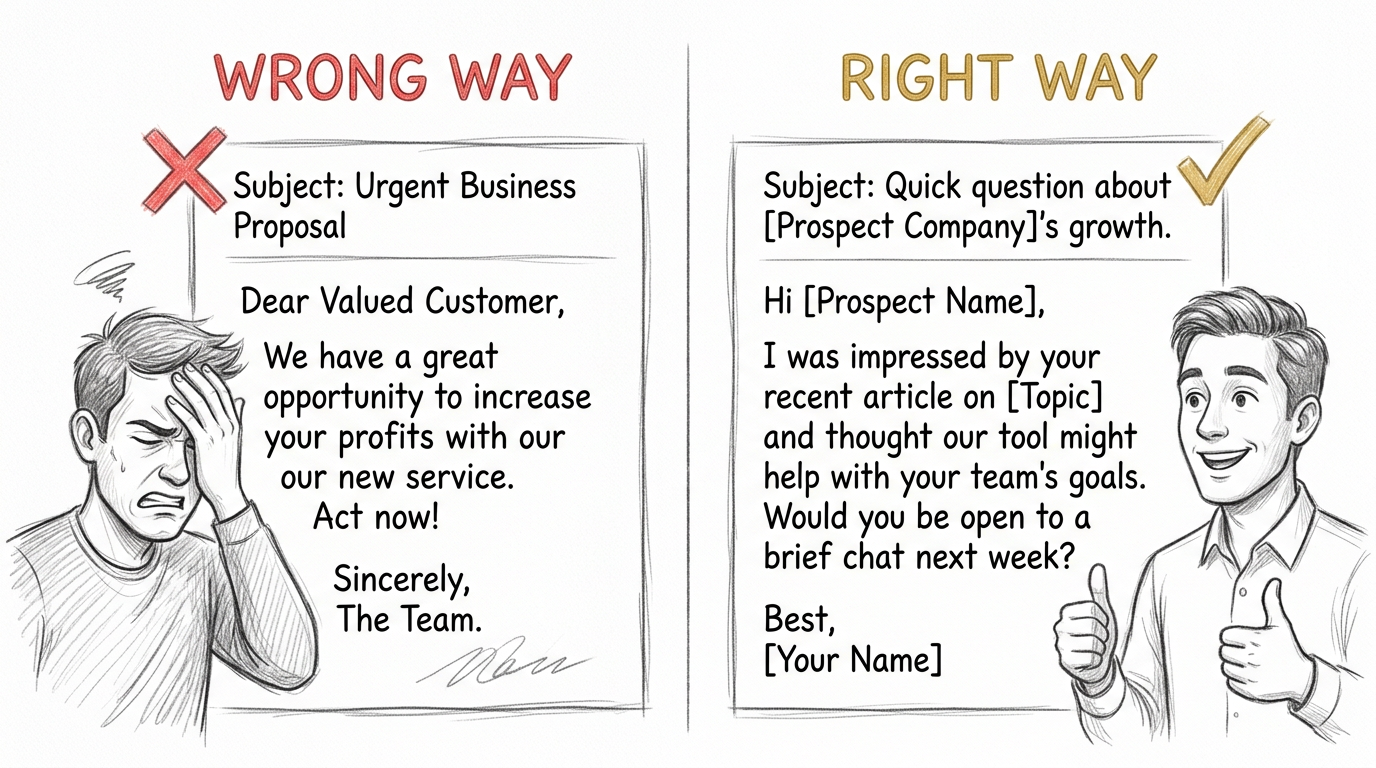
Personalised cold outreach on verified accounts
When you receive a verified SEO lead, you have context. Reference it: “I saw you were researching SaaS SEO pricing – we helped three SaaS companies increase organic traffic by 60% in six months.”
This is warm outreach to an account that has already shown interest in SEO services. The response rate reflects that.
Warm introductions and referrals
Happy clients are your best lead source. Formalise referrals: ask at the right moment (after delivering strong results), offer mutual value, maintain relationships with complementary agencies (web design, PPC, CRM) who refer SEO clients.
LinkedIn lead generation
LinkedIn is the best platform for finding SEO decision-makers. Optimise your profile, publish content that demonstrates expertise, engage with prospects’ posts before reaching out, and use LinkedIn Sales Navigator to find decision-makers in your target industries.
Step 4: Convert Prospects Into SEO Clients
The consultation call
Focus on the prospect’s situation, not your services. Ask about their current SEO performance, their goals, past agency experiences, and their budget. Listen more than you talk. Good-fit prospects tell you they are a good fit in the first 10 minutes.
The proposal that wins
Lead with outcomes: “We will increase your organic traffic by 50% and your organic MQLs by 30% within six months.” Support with a clear methodology, specific milestones, and transparent pricing.
Pricing and packaging
Price based on the value you deliver, not the hours you spend. Monthly retainers are the standard model for SEO. Offer clear tiers: starter, growth, enterprise.
Handling objections
“We tried SEO before” – show a case study from a similar client. “SEO takes too long” – show a 90-day roadmap with milestones. “It is too expensive” – show an ROI calculation that proves the investment pays for itself.
The Hybrid Model: Organic + Verified Leads
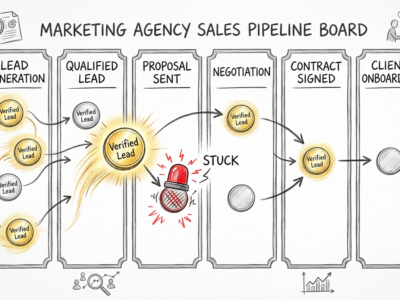
Most successful agencies use both. Build organic pipeline through content SEO, case studies, and referrals for long-term authority and cost efficiency. Buy exclusive, verified leads for immediate pipeline consistency when you have capacity to take on more clients.
Organic channels provide the foundation. Verified leads fill the gaps and keep the pipeline flowing during slow periods. Together, they eliminate the feast-or-famine cycle.
How the DFY Model Fits Into a Full SEO Client Acquisition Strategy
Why most agencies need both DIY and DFY
DIY is powerful when you have the team and the process to execute consistently. DFY is powerful when you want pipeline volume without the operational overhead. The agencies that master client acquisition use both: DIY for the accounts they want to prioritise with custom outreach, DFY for consistent top-of-funnel volume across their target niche.
The 3-month DFY commitment and what to expect
DFY campaigns are a 3-month minimum because cold outreach requires sustained effort to convert prospects who are not yet familiar with your agency. Within 30-60 days, you should see the first booked conversations. By month three, the campaign is running at full momentum and the pipeline is building.
How to Retain and Grow SEO Clients
Onboarding that sets expectations
Share a 90-day roadmap from day one. Establish reporting cadence. Assign a single point of contact. The clients who stay long-term are the ones who understand what SEO involves and see progress against clear milestones.
Reporting that builds trust
Monthly reports should show progress against specific goals, not just rankings. Show organic traffic trends, lead generation from organic search, and revenue attribution. The more transparent your reporting, the more trust you build – and the longer clients stay.
Upselling and expanding accounts
The easiest client to win is the one you already have. Identify upsell opportunities: new keyword targets, additional pages, international SEO, technical SEO audits, content production. Present these as natural extensions of the work you are already doing, with clear ROI calculations.
The SEO Client Acquisition Funnel
Awareness stage
At the top of the funnel, prospects are aware they have a problem but have not yet committed to solving it. Content marketing – blog posts, social media, podcasts – generates awareness and positions your agency as an authority.
The awareness stage is where most agencies invest the majority of their content effort – and where most of it goes to waste. Publishing “What Is SEO” content attracts students, not buyers. Publishing “How to Choose an SEO Agency” attracts buyers.
Consideration stage
Prospects in the consideration phase are actively evaluating solutions. Case studies, comparison guides, and free tools move prospects from awareness to consideration.
This is where most agencies lose prospects. The website does not give prospects enough information to evaluate whether the agency is the right fit. The case studies are vague (“we helped Client X with SEO”) instead of specific (“we increased organic traffic by 60% for a SaaS company doing $300k MRR over six months”). The pricing is hidden behind a contact form instead of clearly presented on a dedicated page.
The agencies that close at the highest rates make the consideration stage frictionless. Prospects can evaluate the agency, see the results, understand the pricing, and book a call without friction.
Decision stage
Prospects at the decision stage are ready to buy. They need a clear call to action, a simple consultation process, and social proof that your agency delivers results.
Decision-stage prospects respond best to clear, outcome-focused proposals. “We will increase your organic traffic by 50% and your organic MQLs by 30% within six months” wins over “we will write 4 blog posts per month and build 10 backlinks per month.” The first speaks to outcomes the prospect cares about. The second speaks to activities the prospect does not understand.
How to Win SEO Clients From Competitors
Switching is easier than starting
Most SEO clients who switch agencies did not start by switching – they started by becoming disappointed with their current agency. Your lead generation strategy should target these prospects specifically.
Buying an exclusive list of businesses currently spending budget on SEO (hiring signals, active agency contracts inferred from job listings) gives you a pipeline of prospects who are already paying for SEO and may be open to better alternatives.
The conversion strategy is different: instead of convincing them to invest, you convince them to switch. Lead with case studies that show a clear before-and-after. Offer a free audit of their current SEO performance. Show them specifically what their current agency is missing.
Common Mistakes When Trying to Get SEO Clients
Mistake 1: underestimating the sales cycle
SEO is a long sale. Most agencies design their sales process around the first call and the proposal – and forget that the prospect needs time to think, evaluate, and decide. Build a nurture sequence that maintains the prospect’s attention over 2-3 weeks between the first call and the signed contract.
Mistake 2: competing on price
SEO is one of the few agency services where price competition is consistently a losing strategy. Cheap SEO buyers are cheap clients – they demand more, churn faster, and refer less. Compete on outcomes, expertise, and transparency. Price for clients who value quality.
Mistake 3: not setting clear expectations
The #1 reason SEO clients churn is unmet expectations. If you told them they would see results in 3 months and they did not, they leave. Set clear, honest timelines. Show them the milestones they will hit at 30, 60, and 90 days. Make sure they understand what SEO can and cannot do for their business.
Mistake 4: relying on a single channel
Agencies that rely entirely on referrals experience feast-or-famine. Agencies that rely entirely on cold outreach experience low quality. Agencies that rely entirely on content marketing experience slow growth. The agencies that consistently get SEO clients use all three channels, plus exclusive verified leads.
FAQs
How do I get SEO clients fast?
Buy exclusive, internet-verified SEO leads through a DFY program (3-month minimum) for immediate pipeline volume, while building organic channels for long-term consistency.
Where do SEO agencies find clients?
Inbound through content SEO and referrals, outbound through LinkedIn and targeted outreach, and through verified lead providers offering DIY or DFY programs.
How much should I charge for SEO services?
Price based on client value, not hours. Monthly retainers typically range from $500 to $5,000+ depending on scope and expected outcomes.
How long does it take to get SEO results for clients?
3-6 months for meaningful ranking improvements, 6-12 months for significant organic traffic growth. Set expectations clearly from the start.
How do I stand out as an SEO agency?
Niching down, publishing specific case studies, transparent reporting with outcome guarantees, and a hybrid pipeline model (organic + verified leads).
Conclusion
Getting SEO clients requires a combination of authority building, targeted outreach, and consistent pipeline management. The fastest way to fill a pipeline when you need volume is internet-verified, exclusive SEO leads – through DIY if you have in-house capacity, or DFY if you want a provider to run the campaign end-to-end.
The agencies that succeed at SEO client acquisition use both approaches. Organic channels build long-term authority. Verified leads provide immediate pipeline consistency.
Want to see what internet-verified, exclusive SEO leads could look like for your agency? Ask us for a sample.