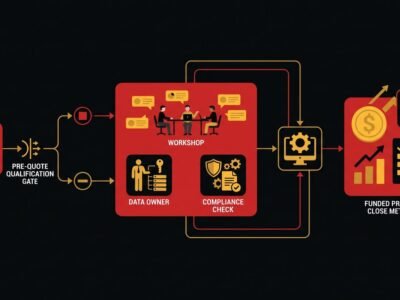

Case Study: A Social Agency Filtered 90 No-Show Prospects Down To Its First Four Retainers
A social media agency in Chicago pulled 90 discovery-call slots out of a single quarter of Facebook and Instagram lead ads. The sales calendar looked full. Four of those 90 became monthly retainers. The other 86 no-showed the call, told the closer they had no budget to post, or disappeared between booking and booking confirmation.
That is the failure mode of most social media lead generation. The channel fills your pipeline with people who look like social media marketing prospects but cannot pay for them. This case study shows how the agency rebuilt its funnel around three pre-qualification checks, a content nurture track, and call speed under 48 hours.
The Scenario: 90 Booked Slots, 4 Closed Retainers
The agency sold managed social campaigns at a $3,500 monthly retainer. It booked meetings through Facebook Lead Ads and Instagram comment automation, and its closers worked the queue in booking order. A 30-minute discovery call was the only gate between a lead and the sales stage.
Two patterns showed up in the notes. Roughly a third of the prospects never made the call. Of the people who did show, many had not posted on their own accounts in months, ran their social presence through a friend, or could not name a dollar figure for marketing spend. They were interested in the idea of social media marketing. They were not buyers of it.
The 4 to 90 close rate produced broken unit economics. At a $3,500 retainer, the agency needed every close to justify the ad spend. It responded by buying more volume, which bought more of the same. The fix was not a bigger lead list. It was a smaller, verified one.
Every wasted discovery call also cost the team 30 minutes of closer time plus the follow-up sequence that goes out after it. Multiply that by 86 dead slots and the quarter lost roughly 40 hours of selling capacity before a single retainer was signed. The booking confirmation cadence itself was part of the problem: one reminder two days before the call does not move the no-show needle on a queue this large.
The Filter Rebuild: Three Gates Before a Human Makes a Call
Gate One: Actively Posting
First check: has the prospect posted on their own channel in the last 30 days? A social media marketing prospect that is not posting is a content team with a job to lose, not a marketing department with a budget. The agency verified this in under five minutes by scrolling the account, checking the date on the last original post, and confirming the post was not a repost or a reshare of a partner account. Resellers and lead sources that pass only the “has a social account” test mostly hand you dormant accounts.
The check also surfaces the accounts that are posting but posting badly. A brand that is up but has three followers and no engagement still qualifies, because the goal of gate one is activity, not quality. The quality work is what your retainer exists to do. Screening out low-quality posters at the booking stage is where most funnels get it wrong, because it mixes the qualification question with the delivery question.
Gate Two: Has a Budget
Second check: can the prospect name a marketing budget? The screen asked one question: what do you spend on marketing today? No number, no call. The agency found that a prospect able to state even a rough figure, $500 a month on ads, $1,200 on a designer, was several times more likely to convert than one who answered with “we are still figuring that out”. Budget language is the cheapest qualifier in B2B selling.
A posting agency without a posting budget cannot work with you. This is the same test that separates real social media leads from demo-signup noise: intent to spend, not interest to learn.
Gate Three: Decision Maker on the Line
Third check: is the person on the call the one who signs? The agency moved the qualifier into the booking flow, where the form asked for the candidate role. A store owner, a founder, a marketing manager with budget authority. Junior team members who book on their own got routed to a resources page instead of the calendar.
Move the Unqualified to a Content Nurture Track
The rebuild did not discard the leads that failed the gates. It moved them, which is the flow documented in our how it works walkthrough. Prospects without a budget went into a six-email content sequence about social posting frequency, content calendars, and platform basics, with a retargeting ad pointing at a “when you are ready” page. A share of them came back a quarter later with budgets that had matured. Wasted on a closer, they would have been dead forever.
The cost difference between the two tracks is stark. A closer working an unqualified lead spends 30 minutes plus a three-email follow-up sequence, roughly 45 minutes of paid time. The same lead in the nurture track costs the price of one email send and one retargeting impression, well under $0.50. The gate model is not about discarding unqualified prospects. It is about spending the right kind of attention on the right kind of problem.
That split is the whole point. Your unqualified social media marketing prospects are not a lost channel. They are a lagging indicator of a future buyer. Nurture the lag, call the lead.
Call Within 48 Hours
Speed was the multiplier. The agency set a 48-hour maximum on first contact, and the target was same-day. Industry benchmarks put the meeting-booked rate on cold email at 1.1 percent across 400 campaigns, and cold email meeting-booked rates from Lemlist sit around 3.43 percent of total emails sent. Social leads convert better than cold email, but only when you call before the lead cools. A lead that waits five business days to hear from you has already talked to the agency that called on day one.
The 48-hour rule also protects the pipeline. A two-day delay on a queue of 30 leads costs the agency roughly one whole extra week of working time per salesperson. Speed is a capacity problem, not a quality one, and it costs a calendar, not a budget.
Three-Touch Reactivation for No-Shows
The no-show bucket got its own sequence. Day one: a text with a reschedule link. Day three: a voicemail referencing the specific service they booked, not a generic “hope you are well”. Day seven: an email that frames the miss as their choice and leaves a single calendar link. Three touches, nine days, zero new content. The agency recovered roughly a fifth of the no-shows through that sequence alone, and the recovered calls converted at the same rate as the ones that originally showed up.
Reactivate no-shows instead of chasing new volume. The third touch is the last touch. Beyond it, the lead is in nurture, and you send it there with a single link, not a new sales pitch.
The sequence did not add any new content, which was deliberate. The no-show had already seen the booking email, the confirmation, and the reminder. Writing a fourth message with fresh arguments resets the prospect to a stranger and costs more attention than it earns. The three-touch sequence works because it is short, specific, and ends cleanly, and the clean ending is what makes the nurture handoff feel natural rather than a last-chance sales pitch that the lead had already rejected.
The Economics: Retainer Math Against Social CPL Benchmarks
LocaliQ published a 2026 Facebook ads benchmark with a cost per lead of $27.39. Metadata surveyed 153 B2B advertisers and found $145 per lead on Facebook and $138 per lead on Instagram. The two numbers bracket the real range, because a self-serve consumer run books far more than a B2B agency account ever will. Plan your funnel against both and you will not be surprised by the middle.
86
of 90 discovery slots no-showed or lacked a posting budget. Four became $3,500 monthly retainers, a 4.4 percent booking-to-retainer conversion.
The math works like this. At $145 per B2B lead, a quarter of 90 leads cost about $13,050 in ad spend. Four retainers at $3,500 a month produce $14,000 in month one. The agency broke even in month one only because the retainer recurs. By month two it was in profit on the same four clients. The same spend booked against unqualified volume would have produced one or two closes, and the quarter would have lost money.
Recall the second and third months. A social media retainer that lasts 9 to 12 months at $3,500 a month is worth $31,500 to $42,000 per client. Four of those clients, even at the short end, is $126,000 of projected annual revenue against $13,050 of ad spend. That is roughly 9.6x return on the quarter, and the retainer-conversion math only works if the gate model holds, because every unqualified slot on the calendar is a slot that would otherwise have consumed the same ad budget and produced a fraction of the revenue.
The benchmark context matters here. At LocaliQ’s $27.39 Facebook CPL, the same 90-lead quarter would have cost $2,465 in ad spend, and the 4-keeper outcome would still have cleared the break-even line by month two. At Metadata’s $145 B2B figure, the cost is 5.7 times higher, and the quarter only works because the retainer recurs. The gate model is what makes the B2B benchmark survivable, because it is the difference between paying $145 for a lead that no-shows and paying $145 for a lead that converts into a nine-month retainer.
Cut the no-shows and the CPL you paid for the rest stops being a waste line. The gate model is the cheapest close-rate improvement in this funnel because it costs a calendar, not a budget.
The rebuild flipped the base. With three gates, the same ad budget booked fewer, better slots. The close rate on the rebuilt funnel ran near 15 to 20 percent on the calls that actually happened, because every prospect on the calendar had passed the posting, budget, and decision-maker checks before a human ever picked up the phone. That is the retainer-conversion math: cut the no-shows, and the CPL you paid for the rest stops being a waste line.
What To Steal From This Funnel
- Verify the last original post inside 30 days before any call gets booked.
- Ask the budget question in the form, not on the call. “What do you spend on marketing today?” A number, or no call.
- Route non-decision makers to a resources page and keep the calendar for owners and budget holders.
- Move every unqualified lead into a six-email content sequence with a retargeting ad, not the recycle bin.
- Hold the 48-hour call speed. Same day if you can, two days hard maximum.
- Run a three-touch no-show sequence: text on day one, voicemail on day three, email on day seven. Ninth-day link only.
Unfiltered vs Filtered: What Changes When You Gate Before the Call
| Stage | Unfiltered Funnel | Filtered Funnel |
|---|---|---|
| Booking | Any lead, any role | Three gates: posting, budget, decision maker |
| No-shows | Roughly a third, gone | Three-touch sequence recovers about a fifth |
| Unqualified shows | Eats 30 minutes of closer time | Routed to nurture before the call |
| Call speed | 5+ business days | 48-hour maximum, same-day target |
| Quarter outcome | 90 slots, 4 retainers | Fewer slots, 15-20% close on shows |
The unfiltered funnel pays for itself on volume and dies on quality. The filtered funnel pays on a smaller base and keeps paying. If you buy your social media leads from a provider rather than a self-serve ad account, the gate model still applies, and it applies harder, because you are paying for the lead up front. Our lead qualification framework walks through the same three checks against purchased signal leads so you can verify what you are buying before you buy it.
If you run social campaigns in-house and book your own leads, the gate model still applies to the booking flow itself rather than to a provider. The difference is that a provider who already runs these three checks before a lead reaches your CRM gives you back the 86-slot problem entirely. You only see the 4-slot outcome on your calendar, not the 86 that no-showed. That is the structural advantage of a qualified feed over a raw lead export: the filtering happens before the cost, not after.
The distinction matters if you are weighing a provider against a self-serve ad account for social media marketing prospects. Self-serve Facebook and Instagram lead ads hand you the raw lead at $27 to $145 and leave every gate to your team. A qualified feed runs the same three checks before the lead is exported, so your queue only ever sees names that have passed. The trade-off is price: a qualified lead costs more per name because the filtering happened upstream. For an agency with a two-person sales team, that premium is almost always cheaper than the closer time it saves on the 86-slot pattern.
Get The Full Case Study PDF
Read the full benchmark-grounded walkthrough, the complete follow-up sequence, and the cost-per-close math. Enter your work details below to download the PDF.
We will send one email with your download link. No spam, no cold sequences.
Frequently Asked Questions
How many social media leads should an agency book per week?
Book only as many discovery slots as your sales team can call inside 48 hours. A two-person sales team can work a queue of 20 to 30 leads a week at a 48-hour speed. Booking more than that on a filtered funnel does not close more retainers. It ages the queue and drops your show-up rate.
What is a good no-show rate for agency discovery calls?
Around a third of booked discovery calls no-show without a reactivation sequence, which is the pattern this agency ran into across its 90 slots. A three-touch text, voicemail, and email sequence recovers roughly a fifth of those. Treat a no-show rate above 40 percent as a booking flow problem, not a prospect problem, and check your confirmation cadence first.
How do you qualify a social media lead without asking for their budget?
You cannot. The budget question is the qualifier. Frame it as spend, not target: “What do you spend on marketing today?” A prospect who names a number, even a small one, has a working marketing line. A prospect who dodges the question is in learning mode, and your nurture track exists exactly for that mode.
Should unqualified leads be deleted or nurtured?
Nurture them. An unqualified social media marketing prospect today is a qualified one next quarter once the budget matures. A six-email content sequence plus a retargeting ad costs almost nothing and keeps the relationship warm without spending closer time on a call that cannot close.
What call speed should a social agency hold to?
48 hours maximum, same day as the target. Industry benchmarks put the cold email meeting-booked rate at 1.1 percent across 400 campaigns, and Lemlist reports around 3.43 percent cold email meeting-booked rates. Social leads beat both numbers, but only when you call before the lead cools. A five-day delay hands the lead to whoever called first.
How much should a social agency pay per lead?
Benchmark against published numbers. LocaliQ puts Facebook ads cost per lead at $27.39 in its 2026 report. Metadata found $145 per lead on Facebook and $138 per lead on Instagram across 153 B2B advertisers. A provider charging $300 to $400 per verified social lead (see the pricing FAQ) only works if your close rate and retainer value clear that number, which is why the gate model comes first.
If you want to run the same checks against a purchased feed instead of self-serve ads, the marketing automation leads guide covers how to wire the three gates into an automated booking flow so the queue fills itself without a salesperson touching a calendar. For a broader view of where B2B agencies should point their ad spend, see the b2b leads overview and the DIY vs DFY lead generation comparison.
Put the Gate Model on Your Next Social Campaign
The four retainer outcome came from the filter, not the ad spend. You can run the same three checks on any social media lead source, including the purchased, internet-verified lists that feed agency funnels without the no-show pattern. The gate model fits any channel because it is a booking flow, not a platform tactic.
Run the 3 gate checks on 30 real names
Pull a sample of social media leads from your current source and run the posting, budget, and decision-maker checks before you spend a dollar on volume. We can hand you a verified sample in your niche to test the funnel first.