Case Study: A Web App Dev Shop Turned Just-Quoting Prospects Into Funded Projects
Twenty web app quotes a month. That was the old rhythm at this shop. Roughly one in ten of those prospects ever had a funded project behind the brief. Nineteen of twenty ended in a polite no. The sales team kept quoting anyway, because a quote felt like progress. It was not. This case study shows the rebuild that stopped it.
You get the exact pre-sell structure the shop now runs. It works for any custom web application practice that sells to B2B buyers and wants funded projects, not interested people.
The Problem: Every Prospect Wanted A Quote First
The shop built custom web applications for B2B buyers. Developers, designers, one founder. Inbound came from a blog, two referrals, and a cold outreach list the team itself maintained. Every week, new inquiries landed with one line. They just wanted a quote.
The quote took two to three days. The prospect then vanished. Or returned with a brief that had no data owner. Or no compliance ask. Or no budget line at all. The team discovered the gaps later, sometimes after a second scoping call. Sales hours went into work that never became a project.
The worst part was the shape of the pipeline. Most leads were idea-stage. A person with a concept, a Figma file, and a timeline. No company budget. No decision maker in the thread. No one accountable for the data the app would touch. The shop was selling to dreamers with production expectations.
Two symptoms showed up in the numbers. Quote volume stayed high while funded projects stayed low. The team kept cost-per-inquiry on the whiteboard. That metric made the broken process look efficient. Twenty inquiries a month felt like a healthy funnel. It was not. It was the shop paying twice. Once for the quote, again for the follow-up that nobody answered.
This is the failure mode behind most web app development lead funnels. The keyword traffic arrives. The quote request arrives. The money does not. If you run a custom web application practice, that pipeline shape looks familiar. Your team quotes first and qualifies never, or too late. The B2B lead qualification problem gets worse when the buyer thinks the quote is free.
The Rebuild: Pre-Sell Before The Quote
The rebuild started with a definition. The team wrote down what funded actually means on a web app project. Not interested. Not validated. Funded.
Funded means four things are true before a quote ships. One, a real data owner exists. A named person who will own the data the app creates, stores, and exposes. Two, compliance needs are stated, not assumed. GDPR, HIPAA, SOC 2, or a clean none of the above. Three, budget exists in writing, even if it is a range. Four, the decision maker sits in the conversation, not the procurement intern below them.
Missing any one of the four, the project is pre-funded. That is not the same as unfunded, but it is not funded. Pre-funded work dies in the gap between quote and kickoff. The gap is where boards defund projects and data owners move on.
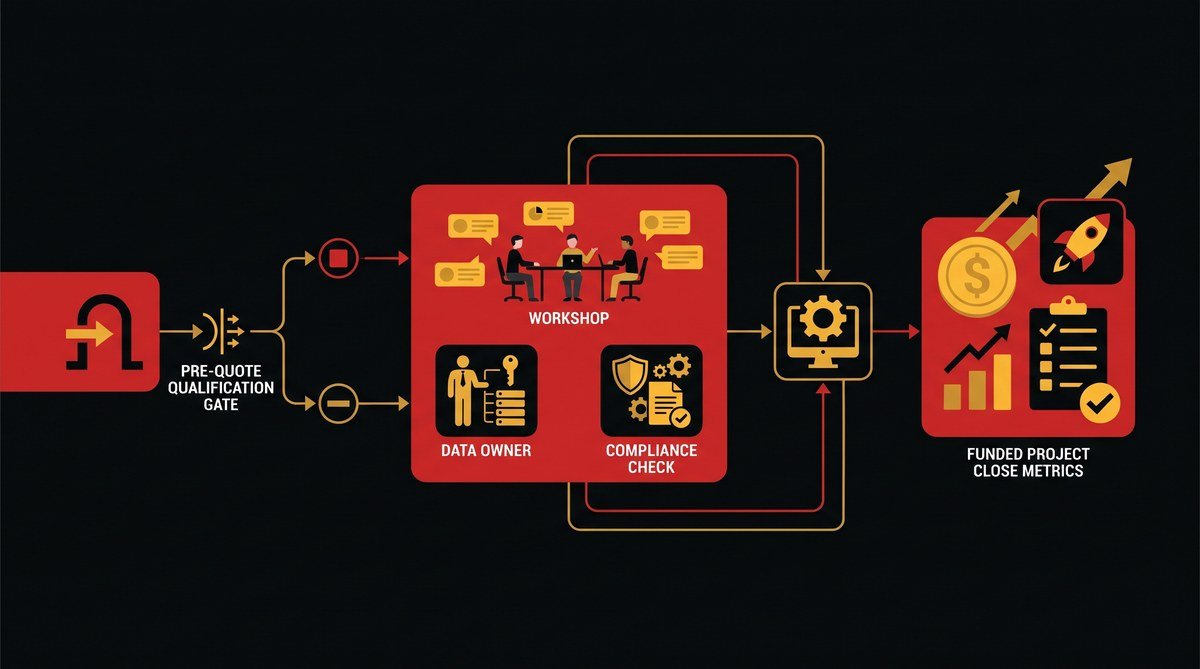
The shop rebuilt the funnel around that definition. No quote ships before a 45 minute scope workshop. No workshop books before the four checks pass. The quote stopped being the opener. It became the closer.
The reframe took one afternoon. The practice stopped treating every web app development lead the same. A qualified inquiry got a workshop slot inside 48 hours. An unqualified one got a disqualification script and a referral to a cheaper builder. Both paths cost less than the old single path, which was a free quote into the void. The intake screen mirrors the lead qualification framework the shop now publishes.
How The Shop Ran It (5 Steps)
The full system runs in five steps. Each one takes hours, not weeks. None of them need new tools. They need new defaults.
Step 1: Disqualify at the inbox, not the kickoff. The team built a two minute screen into the intake form. Who owns the data? What compliance applies? Is there a budget range, even a wide one? Who signs off? A no on any question moves the lead to a nurture track. That track is honest. It tells the prospect this shop is not the cheapest option for idea-stage work, and points them to a lower cost path. The disqualification script took an evening to write and now saves two sales days a week.
Step 2: Pre-sell the scope workshop before quoting. Qualified prospects book a 45 minute scope workshop. The workshop is free, but it is not a discovery call. It has an agenda, an output, and a cost on the invoice for no-shows. The output is a one page scope document the shop writes during the call. By the end, the prospect knows exactly what the app will do, what it will not do, and where their budget lands against it. The quote, when it ships, is a confirmation of that document. Not a cold estimate into a live brief.
Step 3: Verify the data owner and compliance needs on the record. Before the quote ships, the shop writes both into the scope document and into the quote itself. Named data owner. Stated compliance regime. Budget range with a signature line under it. This is the moment idea-stage prospects reveal themselves. The ones with real projects absorb the two added lines. The ones without them stall, or disappear, or ask to keep it simple. Keeping it simple is the tell.
Step 4: Ship the qualified quote inside 48 hours. Speed to quote is the conversion lever the old process never had. The workshop produces the scope document. The quote is a reformat of it. Developers draft, the founder reviews, it ships the next business day at the latest. The shop tracks the clock from workshop end to quote delivery. The 48 hour mark is a published promise on the workshop invite. Prospects who feel the momentum commit. The ones the shop used to chase for three weeks now just sign.
Step 5: Track cost per funded project, not cost per inquiry. The metric swap is the whole second half of the rebuild. Cost per inquiry rewards volume. It paid the team for dreamers. Cost per funded project pays only for projects that started with a signed budget, a named data owner, and a stated compliance regime. The shop now reports one number per month. Total acquisition spend, divided by funded projects signed. That number went down while quote volume went down. That is the shape of a fixed funnel, not a broken one that got quieter.
Each step is a default, not a policy. The team wrote them into the intake form, the workshop invite, and the quote template. A new hire can run all five without asking. That is the point. The system lives in the documents, not in the founder’s head.
What It Cost And What It Returned
The rebuild was cheap. One afternoon of definition work, an evening on the disqualification script, and a scope template the developers built between two sprints. No new tooling. No new headcount. The real cost is the one you cannot see on an invoice. You stop working idea-stage prospects, and their silence feels like lost revenue for about a month before the math catches up.
1 in 10 to 3 in 4
Funded outcomes per quote, before and after the pre-sell rebuild. The quote volume fell. The funded share of the remaining quotes tripled.
The benchmarks that frame the rebuild are public numbers, not shop claims. Per a Lemlist 2025 dataset of 400 B2B campaigns, cold email replies averaged 3.43 percent and booked meetings averaged 1.1 percent. A web app shop running inbound at that baseline gets one in ninety inquiries to a meeting. The pre-sell rebuild does not beat those numbers. It stops paying for the eighty-nine that were never going to fund anything. For paid search context, Zeliq pegs B2B SaaS cost per lead between $30 and $200, and WordStream’s 2026 US search report puts the median cost per lead at $66.69. A single funded web app project at a typical $15,000 to $40,000 price point absorbs that number with room to spare. The unit that matters is the funded project, and the funnel now optimizes for exactly one of those, not for raw inquiry volume.
The return was uneven at first. For shops that split their own outreach from purchased signal leads, see the DIY vs DFY lead generation tradeoffs before you copy step one. Quote volume dropped in the first month. That number is not on any pitch deck. It is the honest shape of a fixed funnel. What came back with it was the workshop to quote conversion, the 48 hour ship time, and a cost per funded project the team could defend to a board. The old whiteboard metric, cost per inquiry, came off the wall.
What To Steal
Copy this before your next sales call
- Define funded before you sell it. Data owner, compliance, budget, decision maker. All four, in one sentence, at the top of every quote.
- Put a two minute qualification screen in the intake form. One question per check. A no is a referral, not a fight.
- Make the scope workshop the gate. Free, agenda-driven, with a written output. No workshop, no quote. Ever.
- Ship qualified quotes inside 48 hours. Publish the promise on the invite. Momentum closes what chasing never did.
- Take cost per inquiry off the board. Report cost per funded project instead. The metric you pay for is the project, not the ping.
- Write all five steps into your templates. If the system lives only in the founder’s head, it dies on their holiday.
Each item above is a template change, not a strategy seminar. The disqualification script, the workshop agenda, the quote header with four signature lines. None of them need a deck. That is what makes the rebuild portable to your next web app development lead, whatever it arrives as.
When A Quote Is Still The Right Move
The pre-sell system is not for every inquiry. Some buyers need the quote to evaluate you against two other shops. Some deals are one off and urgent. Knowing when to skip the workshop is part of the system. The table below is the decision rule the shop actually runs.
| Quote-first fit | Pre-sell-first fit |
|---|---|
| The brief is fixed and fully scoped. Pages, screens, integrations, all named before the ask. | The brief is a paragraph and a timeline. Scope is still forming and needs a working session. |
| The buyer is comparing three shops and needs comparable numbers on the table. | The buyer is one shop deep and wants a partner, not a bidder. |
| Data owner, budget, and compliance are all already stated in writing. | Any of the four funded checks is missing or vague. The workshop fills the gap. |
| Decision is due this week. Speed beats process. | Decision sits weeks out. The workshop earns the wait. |
The rule of thumb the shop runs: quote-first when the buyer has already done the pre-sell work themselves. Pre-sell-first when they have not. If the brief reads like a spec sheet, ship the quote. If it reads like a brainstorm, ship the workshop invite. Most web app development leads land somewhere between. Those go to the workshop, because the gap between the two is where the dreamers hide.
FAQ
Is the scope workshop really free, or is it a disguised fee?
It is free for qualified prospects who show up. The no-show fee covers the developer time, which is the real cost. The fee exists so the calendar respects itself. A free slot with no consequence books badly. The no-show line is what makes the free offer sustainable.
How does a two person shop run all five steps?
Two people run five steps by sequencing, not by parallelizing. The intake screen runs in the form, so it costs zero staff time per lead. The workshop and the quote are the same person, the founder. Disqualification is a script, not a meeting. The whole system fits in one calendar.
What if the prospect says the data owner question is annoying?
Then the answer tells you something useful. A funded project has someone who already cares about the data question. A prospect who finds the question strange is usually pre-funded, or working off an idea with no operational owner behind it. Log the answer and route it to the nurture track without a debate.
Do the benchmarks apply to a web app shop or just SaaS?
The Lemlist 2025 reply and meeting numbers are B2B outbound numbers, and they bound any cold B2B pipeline, agency included. The Zeliq and WordStream cost per lead ranges are paid channel benchmarks. Use them to size acquisition spend per funded project, not to forecast how a single inquiry converts on its own.
How fast does the 48 hour quote promise actually hold?
It holds when the scope document writes itself during the workshop. The quote is a reformat, not new research. The shop tracks the clock from workshop end to delivery and publishes the average to the prospect list. Missing the window shows up immediately, which is the whole point of the public number.
Where should a shop source its next qualified web app leads?
Start with the channels that already carry the funded checks. Referrals from past funded clients arrive pre-qualified. Exclusive internet verified web app development leads from a provider that shows its verification work, not just its list size, arrive with the same signal. The pre-sell system works best when the input is already screened. If the screen is missing, rebuild it on top of the mobile app development leads signal set, which runs the same funded checks against app store signals.
Stop Quoting Into The Void
The rebuild was not a new channel or a new pitch. It was a new order of operations. Define funded, screen early, workshop before quote, ship fast when qualified, pay only for outcomes. Each step is one template and one afternoon of work. If your sales team is still quoting into unverified inboxes, that is the fix, not a bigger funnel. The 48 hour quote only wins when the quote arrives on a project that was funded before the first call. If you are running custom web application development for B2B buyers, the lead qualification framework is where the four funded checks turn into a screen you can actually run.
See which of your open inquiries are actually funded
No pitch deck, no demo call. Tell us how many open web app inquiries you carry and how many of them name a data owner and a budget range. We will map each one against the four funded checks and mark which belong in the workshop queue and which belong in nurture. If the queue is short, that is an answer too. It is not a reason to work harder on the dreamers.
Get The Full Case Study PDF
Read the full benchmark-grounded walkthrough, the complete follow-up sequence, and the cost-per-close math. Enter your work details below to download the PDF.
We will send one email with your download link. No spam, no cold sequences.